.svg)





Key Takeaways
- Autoimmune diseases like lupus, Sjögren's syndrome, and scleroderma are commonly associated with positive ANA tests
- A positive ANA can occur in healthy people, with 5-15% of the general population testing positive without disease
- The ANA pattern and titer level (homogeneous, speckled, nucleolar, 1:80, 1:160, 1:320+) help determine disease likelihood
- Infections, medications, and age can also trigger positive ANA results without underlying autoimmune disease
- Follow-up testing with specific autoantibodies (anti-dsDNA, anti-Sm, anti-SSA/SSB) provides clearer diagnostic direction
- Your symptoms and physical examination findings matter more than the ANA result alone for diagnosis
What a Positive ANA Means
A positive ANA test means your blood contains antibodies that target components within your cell nuclei. Think of it like your immune system's security force mistakenly flagging your own cellular structures as foreign invaders.
The test measures both the titer (concentration) and pattern of these antibodies. Titers start at 1:80 and increase to 1:160, 1:320, 1:640, and beyond. Higher titers suggest more antibodies present, but don't always correlate with disease severity.
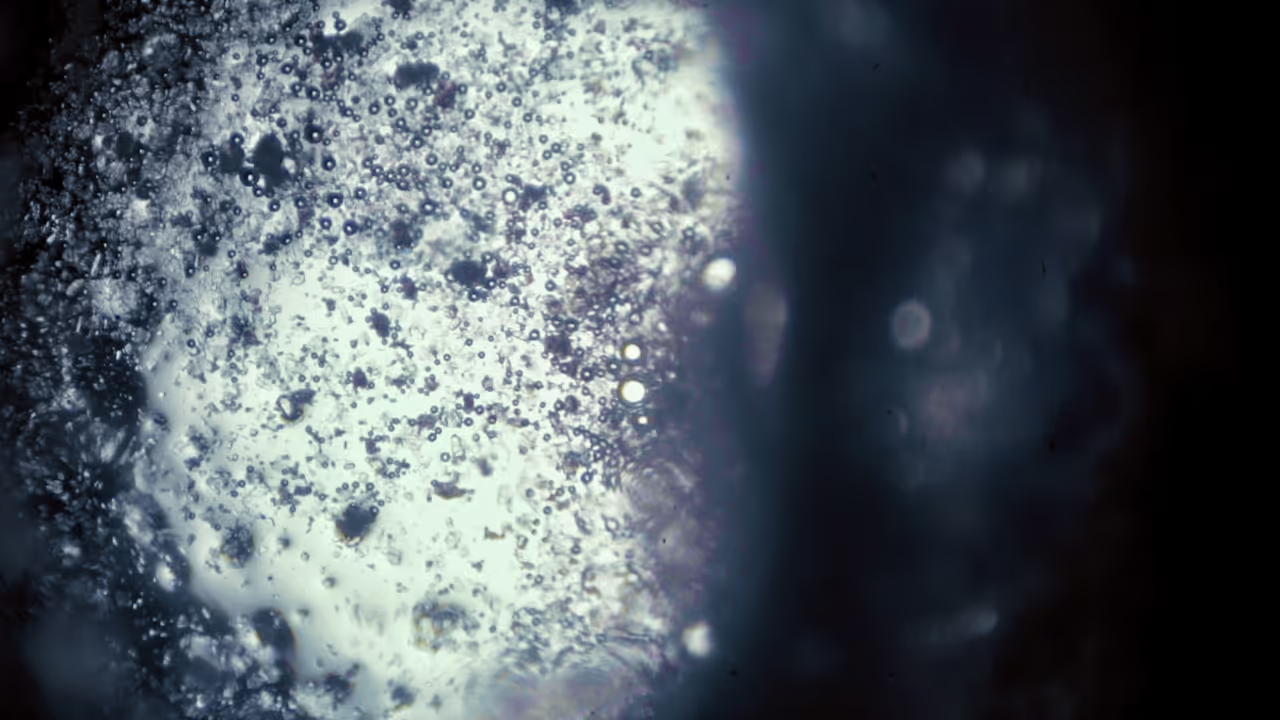
ANA patterns appear under fluorescent microscopy as different staining configurations. Homogeneous patterns create uniform nuclear staining, often associated with lupus. Speckled patterns show dotted nuclear staining, linked to various autoimmune conditions. Nucleolar patterns highlight the nucleoli specifically, commonly seen in scleroderma.
The critical point: a positive ANA is a screening tool, not a diagnosis. It signals your immune system is active against self-tissues, but requires additional testing and clinical evaluation to determine if disease is present.
Autoimmune Diseases That Can Be Associated with Positive ANA
Systemic lupus erythematosus (SLE) is commonly associated with positive ANA results. About 95-98% of people with active lupus test positive, often with high titers (1:320 or higher) and homogeneous or speckled patterns. The disease affects multiple organ systems and often presents with joint pain, skin rashes, and fatigue.
Sjögren's syndrome is associated with positive ANA in most cases, typically with speckled patterns. This condition primarily attacks moisture-producing glands, leading to dry eyes and mouth, though it can affect other organs too.
Systemic sclerosis (scleroderma) shows positive ANA in the vast majority of patients. The nucleolar pattern appears more frequently here than in other conditions, and the disease is linked to skin thickening and internal organ involvement.
Other autoimmune conditions include polymyositis and dermatomyositis (muscle inflammation), autoimmune hepatitis (liver inflammation), mixed connective tissue disease, and primary biliary cholangitis. Each has characteristic ANA patterns and additional specific autoantibodies that help with diagnosis.
How to Interpret Your ANA Results
Context trumps the number on your lab report. A positive ANA with a titer of 1:80 in someone without symptoms often requires only monitoring. The same result in someone with joint pain, rashes, or organ dysfunction demands immediate follow-up testing.
Your healthcare provider will order specific autoantibody tests based on your ANA pattern and symptoms. Anti-double-stranded DNA (anti-dsDNA) and anti-Smith (anti-Sm) antibodies specifically target lupus. Anti-SSA/Ro and anti-SSB/La antibodies point toward Sjögren's syndrome. Anti-Scl-70 and anti-centromere antibodies suggest scleroderma.
The complement levels (C3 and C4) often drop during active autoimmune disease, particularly lupus. These proteins get consumed as your immune system creates inflammation, so low levels alongside positive ANA and symptoms create a clearer diagnostic picture.
Remember that symptoms matter more than lab numbers. Someone with a 1:160 ANA titer, joint swelling, and a malar rash likely has lupus. Someone with a 1:320 titer but no symptoms might never develop disease and needs only periodic monitoring.
What Can Influence ANA Test Results
Infections can temporarily trigger positive ANA results. Viral infections like Epstein-Barr virus (EBV), cytomegalovirus (CMV), and hepatitis B or C activate your immune system broadly, sometimes creating cross-reactive antibodies that show up as positive ANA. Most infection-related positive results resolve as the infection clears.
Medications represent another common influence. Certain blood pressure medications (hydralazine), heart rhythm drugs (procainamide), and some antibiotics may be associated with drug-induced lupus, creating positive ANA with specific anti-histone antibodies. This condition typically reverses when you stop the triggering medication.
Age and gender significantly influence ANA results. Women test positive nearly twice as often as men, reflecting the higher prevalence of autoimmune diseases in women. As you age, your likelihood of testing positive increases even without disease. ANA positivity rises with age, though prevalence estimates vary by population and testing method.
Laboratory variation affects results too. Different labs use different techniques and cutoff values. Some labs report positive at 1:80 while others start at 1:160. Always have repeat testing done at the same laboratory when monitoring ANA levels over time.
Related Context That Changes the Picture
Family history dramatically shifts interpretation. If your mother has lupus and you test positive for ANA, your risk profile differs completely from someone with no family history of autoimmune disease. Genetics load the gun, but environmental triggers pull the trigger.
Additional biomarkers provide crucial context for understanding what diseases may be associated with a positive ANA in your specific case. Inflammatory markers like C-reactive protein (CRP) and erythrocyte sedimentation rate (ESR) reveal active inflammation. Complete blood counts can show the low white blood cell counts, low platelet counts, or anemia common in autoimmune diseases.
Kidney function tests become essential since lupus frequently affects the kidneys. Protein in the urine (proteinuria) or elevated creatinine levels alongside positive ANA suggest lupus nephritis, requiring immediate treatment to help reduce the risk of permanent kidney damage.
The antinuclear antibody pattern evolution over time matters too. Some people maintain stable low-titer positive results for years without developing symptoms. Others progress from negative to positive to higher titers as autoimmune disease develops. Serial testing every 6-12 months helps distinguish these trajectories.
Take Control of Your Autoimmune Health
Understanding what diseases may be associated with a positive ANA gives you the foundation, but incomplete lab data leaves critical gaps in your health picture. You need the complete autoimmune panel alongside metabolic markers, inflammatory indicators, and organ function tests to understand your full risk profile.
Superpower's Advanced Blood Panel includes ANA testing alongside comprehensive autoimmune markers, inflammatory biomarkers, and over 100 additional tests that reveal how your immune system interacts with your overall health. You get the complete picture, not just fragments.
Order your Advanced Blood Panel today and get the comprehensive autoimmune testing you need to make informed decisions about your health with your healthcare provider.


FAQs
Systemic lupus erythematosus (SLE) is the most common autoimmune disease associated with positive ANA, affecting 95-98% of people with active lupus. However, many healthy people also test positive without having any disease.
Systemic lupus erythematosus (SLE) is the most common autoimmune disease associated with positive ANA, affecting 95-98% of people with active lupus. However, many healthy people also test positive without having any disease.
Infections (especially viral), certain medications like hydralazine and procainamide, age, and even normal immune system variation can cause positive ANA results. Laboratory differences in testing methods can also affect results.
Your care team will typically order specific autoantibody tests like anti-dsDNA, anti-Sm, anti-SSA/SSB, or anti-Scl-70 based on your ANA pattern and symptoms. They may also check complement levels (C3, C4) and inflammatory markers.
Yes, absolutely. About 5-15% of healthy people test positive for ANA without having any autoimmune disease. The likelihood increases with age, and many people maintain positive results for years without developing symptoms.
Titers of 1:160 and higher are generally considered more significant, especially when accompanied by symptoms. However, the titer level alone doesn't determine disease severity - your symptoms and additional test results matter more for diagnosis.
References
- Agmon-Levin, N., Damoiseaux, J., Kallenberg, C., Sack, U., Witte, T., Herold, M., Bossuyt, X., Musset, L., Cervera, R., Plaza-Lopez, A., Dias, C., Sousa, M. J., Radice, A., Eriksson, C., Hultgren, O., Viander, M., Khamashta, M., Regenass, S., Andrade, L. E., ... Shoenfeld, Y. (2014). International recommendations for the assessment of autoantibodies to cellular antigens referred to as anti-nuclear antibodies. Annals of the rheumatic diseases, 73(1), 17-23. https://doi.org/10.1136/annrheumdis-2013-203863
- Tan, E. M., Feltkamp, T. E., Smolen, J. S., Butcher, B., Dawkins, R., Fritzler, M. J., Gordon, T., Hardin, J. A., Kalden, J. R., Lahita, R. G., Maini, R. N., McDougal, J. S., Rothfield, N. F., Smeenk, R. J., Takasaki, Y., Wiik, A., Wilson, M. R., & Koziol, J. A. (1997). Range of antinuclear antibodies in "healthy" individuals. Arthritis and rheumatism, 40(9), 1601-11. https://doi.org/10.1002/art.1780400909
- Mariz, H. A., Sato, E. I., Barbosa, S. H., Rodrigues, S. H., Dellavance, A., & Andrade, L. E. (2011). Pattern on the antinuclear antibody-HEp-2 test is a critical parameter for discriminating antinuclear antibody-positive healthy individuals and patients with autoimmune rheumatic diseases. Arthritis and rheumatism, 63(1), 191-200. https://doi.org/10.1002/art.30084
- Satoh, M., Chan, E. K., Ho, L. A., Rose, K. M., Parks, C. G., Cohn, R. D., Jusko, T. A., Walker, N. J., Germolec, D. R., Whitt, I. Z., Crockett, P. W., Pauley, B. A., Chan, J. Y., Ross, S. J., Birnbaum, L. S., Zeldin, D. C., & Miller, F. W. (2012). Prevalence and sociodemographic correlates of antinuclear antibodies in the United States. Arthritis and rheumatism, 64(7), 2319-27. https://doi.org/10.1002/art.34380
- Kavanaugh, A., Tomar, R., Reveille, J., Solomon, D. H., & Homburger, H. A. (2000). Guidelines for clinical use of the antinuclear antibody test and tests for specific autoantibodies to nuclear antigens. American College of Pathologists. Archives of pathology & laboratory medicine, 124(1), 71-81. https://doi.org/10.5858/2000-124-0071-GFCUOT
- Pisetsky, D. S., & Lipsky, P. E. (2020). New insights into the role of antinuclear antibodies in systemic lupus erythematosus. Nature reviews. Rheumatology, 16(10), 565-579. https://doi.org/10.1038/s41584-020-0480-7
- Chan, E. K., Damoiseaux, J., Carballo, O. G., Conrad, K., de Melo Cruvinel, W., Francescantonio, P. L., Fritzler, M. J., Garcia-De La Torre, I., Herold, M., Mimori, T., Satoh, M., von Mühlen, C. A., & Andrade, L. E. (2015). Report of the First International Consensus on Standardized Nomenclature of Antinuclear Antibody HEp-2 Cell Patterns 2014-2015. Frontiers in immunology, 6, 412. https://doi.org/10.3389/fimmu.2015.00412
- Aringer, M., Costenbader, K., Daikh, D., Brinks, R., Mosca, M., Ramsey-Goldman, R., Smolen, J. S., Wofsy, D., Boumpas, D. T., Kamen, D. L., Jayne, D., Cervera, R., Costedoat-Chalumeau, N., Diamond, B., Gladman, D. D., Hahn, B., Hiepe, F., Jacobsen, S., Khanna, D., ... Johnson, S. R. (2019). 2019 European League Against Rheumatism/American College of Rheumatology Classification Criteria for Systemic Lupus Erythematosus. Arthritis & rheumatology (Hoboken, N.J.), 71(9), 1400-1412. https://doi.org/10.1002/art.40930
- Shiboski, C. H., Shiboski, S. C., Seror, R., Criswell, L. A., Labetoulle, M., Lietman, T. M., Rasmussen, A., Scofield, H., Vitali, C., Bowman, S. J., Mariette, X., & International Sjögren's Syndrome Criteria Working Group (2017). 2016 American College of Rheumatology/European League Against Rheumatism classification criteria for primary Sjögren's syndrome: A consensus and data-driven methodology involving three international patient cohorts. Annals of the rheumatic diseases, 76(1), 9-16. https://doi.org/10.1136/annrheumdis-2016-210571
- van den Hoogen, F., Khanna, D., Fransen, J., Johnson, S. R., Baron, M., Tyndall, A., Matucci-Cerinic, M., Naden, R. P., Medsger, T. A., Carreira, P. E., Riemekasten, G., Clements, P. J., Denton, C. P., Distler, O., Allanore, Y., Furst, D. E., Gabrielli, A., Mayes, M. D., van Laar, J. M., ... Pope, J. E. (2013). 2013 classification criteria for systemic sclerosis: an American college of rheumatology/European league against rheumatism collaborative initiative. Annals of the rheumatic diseases, 72(11), 1747-55. https://doi.org/10.1136/annrheumdis-2013-204424
- Arbuckle, M. R., McClain, M. T., Rubertone, M. V., Scofield, R. H., Dennis, G. J., James, J. A., & Harley, J. B. (2003). Development of autoantibodies before the clinical onset of systemic lupus erythematosus. The New England journal of medicine, 349(16), 1526-33. https://doi.org/10.1056/NEJMoa021933
- Cusick, M. F., Libbey, J. E., & Fujinami, R. S. (2012). Molecular mimicry as a mechanism of autoimmune disease. Clinical reviews in allergy & immunology, 42(1), 102-11. https://doi.org/10.1007/s12016-011-8294-7
- Vedove, C. D., Del Giglio, M., Schena, D., & Girolomoni, G. (2009). Drug-induced lupus erythematosus. Archives of dermatological research, 301(1), 99-105. https://doi.org/10.1007/s00403-008-0895-5
- Kuo, C. F., Grainge, M. J., Valdes, A. M., See, L. C., Luo, S. F., Yu, K. H., Zhang, W., & Doherty, M. (2015). Familial Aggregation of Systemic Lupus Erythematosus and Coaggregation of Autoimmune Diseases in Affected Families. JAMA internal medicine, 175(9), 1518-26. https://doi.org/10.1001/jamainternmed.2015.3528






























.avif)
.svg)
.svg)


