


Understand what your emerging health topics results really mean
See your biomarkers in context with a comprehensive panel.
- CLIA-certified labs
- HIPAA compliant
- Personalized health protocol
Defining Nasal Dilators
A nasal dilator is a device designed to mechanically open the nasal passages and improve airflow. Two main categories exist: external devices, which are adhesive strips applied across the nose bridge (Breathe Right is the most recognized brand); and internal devices, which are small stenting inserts seated inside the nostrils (examples include Mute and Rhinomed Turbine). Both categories are used for snoring reduction, temporary nasal congestion, and easier breathing during exercise.
External nasal strips entered the consumer market in the mid-1990s, initially marketed for nasal congestion relief before the snoring positioning followed. Internal devices evolved from medical-device contexts (post-surgical nasal splints and CPAP-adjunct stents) before reaching the consumer market in the 2010s. Nasal dilators are commonly confused with mouth tape, CPAP machines, surgical septoplasty, and nasal corticosteroid sprays, each of which addresses different anatomy and different underlying pathophysiology.
Marketing for nasal dilators clusters around four outcomes:
- Reduced snoring in habitual snorers
- Easier breathing during exercise (running, cycling)
- Temporary relief of nasal congestion
- Improved sleep quality in people with nighttime nasal blockage
The Mechanism, Plainly
External strips work by applying lateral tension to the nasal ala via a spring-like adhesive tab. This opens the external nasal valve and increases nasal cross-sectional area. Internal devices stent open the nasal valve from inside the nostril, preventing dynamic collapse during inspiration. Both mechanisms target the same anatomy (the nasal valve, the narrowest segment of the nasal airway) from opposite directions.
Beyond direct lateral tension, the strip may also stabilize the lateral nasal vestibule against negative-pressure collapse during deep inspiration. Subjective perception of easier breathing is a documented effect even when objective work-of-breathing change is modest. Internal dilators may also improve CPAP tolerance in OSA patients already on CPAP therapy (a separate claim from any OSA-treatment assertion).
The responder-versus-nonresponder split is real and not fully predictable. Nasal dilators produce dichotomous physiological responses: some snorers benefit substantially, others do not. People whose snoring originates from palatal or pharyngeal collapse do not benefit, because the mechanism cannot rescue airway collapse that occurs downstream of the nasal valve.
How to Evaluate Internal vs External Nasal Dilators
Nasal-dilator spec literacy is mostly about fit and category match, not raw force. Brand names matter less than choosing the right category for the specific obstruction pattern.
- Fit and sizing. External strips come in 2-3 standard sizes; undersized strips deliver less lateral tension. Internal devices come in 3-5 sizes and must seat snugly without irritation. The magnitude of airflow improvement scales with how much the device actually displaces the nasal sidewall. A strip that doesn't fit doesn't work. A one-size-fits-all internal device with no sizing guidance is a red flag.
- Adhesion (external strips). Pharmaceutical-grade hypoallergenic adhesive on a flexible plastic spring is the standard. Skin irritation is the primary documented adverse effect of external strips, and a poorly adhered strip lifts off during the night. Generic strips without hypoallergenic adhesive labeling are a red flag for adhesive-sensitive users.
- Material (internal devices). Medical-grade silicone or thermoplastic elastomer (TPE), latex-free, and suitable for repeated cleaning is the appropriate standard; the device sits inside the nostril for 6-9 hours. Latex content or unclear material disclosure is a red flag.
- FDA 510(k) clearance and indication. Clearance covers "temporary relief of nasal congestion" and "snoring reduction": not obstructive sleep apnea. Marketing copy that claims OSA treatment, AHI improvement, or any sleep-apnea benefit is a red flag for off-label marketing.
Entry-tier options are generic adhesive strips available across multiple brands. Some branded strips (such as Breathe Right) have a larger published RCT base, illustrative only and not a recommendation. Internal stenting devices (such as Mute, Rhinomed Turbine, and Intake) are named here as illustrative examples of a device category, not as recommended picks, and are available in multiple sizes, documented fit data, and athletic-use trial citations. These are heuristics. The choice that matters most is internal versus external based on obstruction pattern.
Internal devices typically test better in head-to-head nasal-airflow studies; external strips have a larger published RCT base and lower friction-to-try. Adhesive-sensitive users and those with nasal-valve-collapse anatomy should default to internal devices.
If choosing between two products in the same category with the same FDA clearance, the deciding spec is fit. Breathe Right is the most-studied predicate device; this reflects its publication history, not a recommendation that it is the best fit for any individual.
Grading the Nasal Dilator Claims
Evidence quality across these claims ranges from anecdotal to strong.
Nasal dilators reduce snoring in nasal-obstruction-driven snorers: Moderate
An RCT in chronic-rhinitis snorers showed significant snoring reduction without changing the arousal index. A 2016 meta-analysis confirmed that dilators help nasal flow and snoring in this specific subgroup. However, physiological responses to nasal dilation are dichotomous: the effect is population-specific. Palatal and pharyngeal-origin snorers do not benefit; the device works for some, by mechanism, with predictable phenotype selection.
Nasal dilators are NOT a treatment for obstructive sleep apnea: Strong
The evidence is strong that dilators do not treat OSA. One RCT explicitly framed the nasal dilator strip as an effective placebo for severe OSA, not a therapeutic one. A 2016 meta-analysis found no meaningful AHI improvement with nasal dilators. Even surgical correction of severe nasal obstruction does not effectively alleviate OSA. Suspected OSA requires a sleep study, not a stronger strip.
Nasal dilators improve objective athletic performance: Limited
A 2022 meta-analysis on running found null results for objective performance, and a 2021 meta-analysis on sports activity found no statistically significant performance gains. An RCT using the Rhinomed Turbine in cycling also found null results on power output. The exception: athletes with nasal valve compromise showed improved aerobic performance with an internal dilator. Objective performance gains are not supported across general athletes; the nasal-valve-compromise subpopulation may differ.
Nasal dilators improve perceived breathing effort during exercise: Moderate
A 2022 meta-analysis found a modest improvement in rate of perceived exertion during exercise. A 2021 meta-analysis found consistent improvement in perceived breathing effort across sports trials. This subjective easier-breathing perception is consistent across athletic trials, even when objective performance does not change.
The Use Cases the Research Actually Supports
The strongest evidence maps to specific trial populations, not general wellness claims. The right question is not which brand to buy, but whether the underlying phenotype matches the populations that showed benefit.
Habitual snoring with documented nasal-obstruction component. Moderate evidence supports snoring reduction in this phenotype. Snoring frequency decreased significantly in chronic-rhinitis snorers in RCT conditions, and a 2016 meta-analysis supports this subgroup specifically. The readout is subjective snoring score and partner report. Best fit: adults with chronic rhinitis, allergic rhinitis, or nasal-valve narrowing who snore predominantly through the nose.
Temporary nasal congestion (cold, allergy, exercise-induced rhinitis). This is the FDA-cleared indication. The mechanism is mechanical, not pharmacologic; there is no rebound effect like that seen with decongestant sprays. Nasal dilator strips improve sleep quality in subjects with chronic nocturnal nasal congestion, supporting the congestion-relief use case.
Athletes with diagnosed nasal-valve compromise. Aerobic performance improved specifically in athletes with nasal valve compromise using an internal nasal dilator. For general athletes, the evidence supports perceived-effort improvement but not objective performance gains. Reasonable for athletes whose breathing pattern transitions to oral breathing early into exertion.
CPAP-tolerance adjunct (not standalone OSA therapy). Internal nasal dilators may improve CPAP tolerance in patients already on CPAP. This is an adjunct role, not a standalone therapy. A sleep medicine clinician should oversee any such use.
Where the device is not the best tool. For suspected OSA, the right tool is a sleep study. Nasal dilator strips function as a placebo in severe OSA, not a treatment. For structural nasal obstruction such as deviated septum or nasal valve collapse, surgical evaluation is the appropriate pathway.
Trying Nasal Dilators Without Wasting Time
These protocols reflect trial conditions, not clinical recommendations. Individual response varies, and anyone with a relevant medical condition should discuss new sleep- or exercise-related practices with a clinician before starting.
- Set your baseline. Subjective: 7-day snoring and sleep-quality log (or partner report); daytime sleepiness using the Epworth Sleepiness Scale. Athletic: 7-day training log with RPE. If Epworth score is 10 or higher, or if witnessed apneas are present, do not start a dilator trial. Get a sleep study first.
- Match the trial dose. Sleep use: apply the strip or seat the internal device nightly before bed, consistent with nightly application in chronic-rhinitis snoring trials. Athletic use: apply for the duration of the exercise bout, consistent with full-session use in cycling trials and endurance protocols in athletes with nasal-valve compromise.
- Pick your duration before retest. Subjective snoring: 2-4 weeks of consistent use. Athletic perception: 2-4 weeks across multiple sessions. AHI: only via repeat sleep study under physician oversight, not a wearable metric.
- Track daily, review weekly. Adherence checkbox plus one subjective rating (snoring or sleep quality, or RPE) plus wearable overnight SpO2 trends where relevant. SpO2 trends provide context but are not a substitute for AHI.
- Retest at the end, and recognize the back-off signals. Use the same Day-0 measures. Back-off triggers: persistent skin irritation from adhesive; internal-device pain or epistaxis; worsening daytime sleepiness despite use; witnessed apneas reported by a sleep partner. Any of these warrants a sleep-medicine consult, not a different dilator.
Reader Fit and the Honest Contraindications
The reader most likely to get something meaningful from a nasal dilator is a habitual snorer whose snoring is predominantly nasal in origin, with no daytime sleepiness or witnessed apneas. It is also reasonable for an athlete who notices early-onset oral breathing during exertion, particularly if nasal-valve compromise has been identified.
The contraindications are real and worth naming directly:
- Suspected obstructive sleep apnea (daytime sleepiness, witnessed apneas, snoring with gasping): see a sleep physician for a sleep study; nasal dilators are not OSA treatment.
- Active nasal infection, recent nasal surgery, or significant deviated septum: see ENT for evaluation first.
- Adhesive sensitivity or facial dermatitis (external strips): use an internal device instead if a dilator is otherwise appropriate.
- Pregnancy: nasal strips did not improve sleep-disordered breathing in pregnant subjects in published RCT; standard pregnancy caution applies before adding any new device routine.
If any of this applies, the right next step is a clinician, not a different brand of the same device.
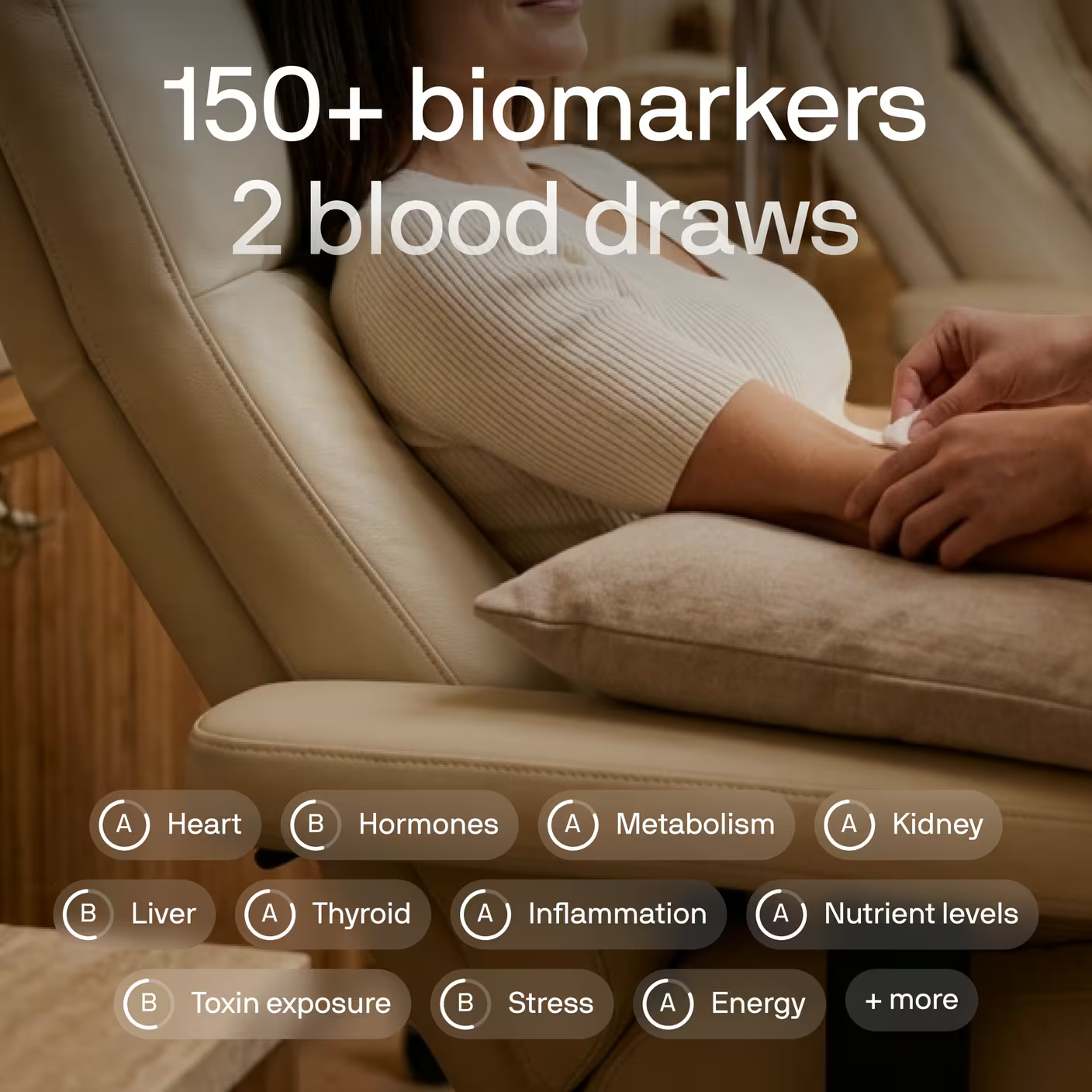
Test 150+ biomarkers
Two blood draws. A full picture of your health, explained in plain language.
Test 150+ biomarkers
Two blood draws. A full picture of your health, explained in plain language.
What "FDA-Cleared" Actually Tells You for Nasal Dilators
FDA-cleared ≠ FDA-approved. FDA approval means the agency reviewed safety and efficacy data for a specific indication. FDA clearance via the 510(k) pathway means substantial equivalence to a legally marketed predicate device for a narrow intended use, not a finding of efficacy for the broader wellness uses commonly marketed. External nasal strips (e.g. Breathe Right) are 510(k)-cleared for temporary relief of nasal congestion and snoring reduction. Internal nasal dilators (e.g. Mute, Rhinomed Turbine) are 510(k)-cleared for similar narrow indications. Neither category is FDA-approved as treatment for obstructive sleep apnea. As of May 2026.
The most commonly reported adverse effect for external strips is skin irritation from the adhesive; pulling the strip off too aggressively can also cause skin trauma. For internal devices, documented adverse effects include nasal discomfort, foreign-body sensation, and occasional epistaxis during insertion or removal, particularly with ill-fitting sizes. Long-term continuous internal-device use has not been characterized in randomized trials beyond approximately 12 weeks.
Topical retinoid users (tretinoin, adapalene) should avoid the area where an external strip adheres, because adhesive removal can lift skin. Anticoagulant users with a history of epistaxis should be cautious with internal devices. People with prior nasal surgery or trauma should clear internal-device use with an ENT before proceeding.
The Markers That Show If a Nasal Dilator Worked
Subjective impression alone is not a reliable readout. A comparable Day-0 and Day-N measurement set is, where N depends on the goal, not the device.
- Subjective snoring score (partner report or recording app). The most accessible objective-ish readout for snoring claims. RCT protocols used patient-reported and partner-reported snoring frequency over 1-2 weeks; that approach is appropriate for a self-trial.
- Epworth Sleepiness Scale (ESS). Quick screening for daytime sleepiness. A score of 10 or higher is a flag for sleep-medicine evaluation, not a prompt to try a stronger dilator.
- AHI from a sleep study: the only objective readout for whether dilators are doing anything for sleep-disordered breathing. Published trials consistently show minimal AHI change with nasal dilators. Required only if a sleep physician is overseeing; not a wearable metric.
- Overnight SpO2 trends (wearable). Useful adjunct context for nighttime breathing patterns. Trends matter more than absolute values; SpO2 is not a substitute for AHI.
- Athletic-use readouts. Rate of Perceived Exertion (RPE) is the most sensitive subjective marker in athletic nasal-dilator trials. Objective performance metrics (time-to-completion, power output) typically do not change.
If the markers move in the direction the underlying mechanism predicts (for snoring or perceived breathing effort), the device did something. If AHI doesn't move (and most published evidence says it won't for OSA), the right next step is a sleep physician, not a different brand of strip.
Reading the Retest
Easier-breathing perception is a documented effect even when objective airflow change is modest. It is a useful daily-adherence and quality-of-life check, not by itself proof the device is reducing pathology. Sleep-partner snoring report is more informative than self-report for snoring outcomes.
The trustworthy signal for OSA is AHI from a polysomnogram. Nasal dilators do not meaningfully change AHI in OSA based on the published meta-analysis evidence. Subjective snoring and sleep markers and athletic RPE can be tracked at 2-4 weeks of consistent use; AHI retest requires repeat sleep study under physician oversight.
A subjective snoring score change of less than one point on a 5-point Likert scale is within noise. A sleep-partner report of qualitative improvement maintained across 2-3 weeks is meaningful. For athletic use, RPE shifts of less than one unit on the 6-20 Borg scale are within noise. The trap to avoid: cherry-picking the single night or session that moved while ignoring the trend.
When This Needs a Sleep Physician, Not a Stronger Strip
If the reason for reaching for a nasal dilator is daytime sleepiness, witnessed apneas, gasping awakenings, treatment-resistant snoring, or chronic nasal obstruction, that is a clinical evaluation, not a device purchase. The specific pathways are a sleep-medicine consult with a formal sleep study for suspected OSA, and an ENT evaluation for structural nasal obstruction such as deviated septum or nasal valve collapse requiring surgical assessment.
Measuring the biology a device is supposed to change (before buying, then after using) is the foundation of Superpower's approach to preventive health. The device is the experiment; the snoring score, Epworth scale, or AHI is the readout.
Frequently Asked Questions
References
- Griffin JW, Hunter G, Ferguson D, Sillers MJ (1997). Physiologic effects of an external nasal dilator. *The Laryngoscope*, *107*(9), 1235-8. https://doi.org/10.1097/00005537-199709000-00014
- Dinardi RR, Ferreira CHS, Silveira GS, de Araújo Silva VE, da Cunha Ibiapina C, de Andrade CR (2021). Does the external nasal dilator strip help in sports activity? A systematic review and meta-analysis. *European archives of oto-rhino-laryngology : official journal of the European Federation of Oto-Rhino-Laryngological Societies (EUFOS) : affiliated with the German Society for Oto-Rhino-Laryngology - Head and Neck Surgery*, *278*(5), 1307-1320. https://doi.org/10.1007/s00405-020-06202-5
- Djupesland PG, Skatvedt O, Borgersen AK (2001). Dichotomous physiological effects of nocturnal external nasal dilation in heavy snorers: the answer to a rhinologic controversy?. *American journal of rhinology*, *15*(2), 95-103. https://doi.org/10.2500/105065801781543745
- Ward J, Ciesla R, Becker W, Shanga GM (2018). Randomized Trials of Nasal Patency and Dermal Tolerability With External Nasal Dilators in Healthy Volunteers. *Allergy & rhinology (Providence, R.I.)*, *9*, 2152656718796740. https://doi.org/10.1177/2152656718796740
- Gelardi M, Porro G, Sterlicchio B, Quaranta N, Ciprandi G, Group On Sonoring IS (2019). Internal and external nasal dilatator in patients who snore: a comparison in clinical practice. *Acta bio-medica : Atenei Parmensis*, *90*(2-S), 10-4. https://doi.org/10.23750/abm.v90i2-S.8096
- Pevernagie D, Hamans E, Van Cauwenberge P, Pauwels R (2000). External nasal dilation reduces snoring in chronic rhinitis patients: a randomized controlled trial. *The European respiratory journal*, *15*(6), 996-1000. https://doi.org/10.1034/j.1399-3003.2000.01504.x
- Camacho M, Malu OO, Kram YA, Nigam G, Riaz M, Song SA, Tolisano AM, Kushida CA (2016). Nasal Dilators (Breathe Right Strips and NoZovent) for Snoring and OSA: A Systematic Review and Meta-Analysis. *Pulmonary medicine*, *2016*, 4841310. https://doi.org/10.1155/2016/4841310
- Yagihara F, Lorenzi-Filho G, Santos-Silva R (2017). Nasal Dilator Strip is an Effective Placebo Intervention for Severe Obstructive Sleep Apnea. *Journal of clinical sleep medicine : JCSM : official publication of the American Academy of Sleep Medicine*, *13*(2), 215-221. https://doi.org/10.5664/jcsm.6450
- Karla Silva Pereira Gomes S, Malaguti C, Elias Filho J, Oliveira Caetano R, Vieira da Silva C, Medina Dutra de Oliveira T, Hespanhol L, Felício DC (2022). Nasal dilator and physiological parameters associated to running performance: A systematic review and meta-analysis. *Journal of sports sciences*, *40*(20), 2315-2326. https://doi.org/10.1080/02640414.2022.2151752
- Schaeffer MR, McBride E, Mitchell RA, Boyle KG, Ramsook AH, Puyat JH, Macnutt MJ, Guenette JA (2021). Effects of the Turbine™ on Ventilatory and Sensory Responses to Incremental Cycling. *Medicine and science in sports and exercise*, *53*(1), 192-199. https://doi.org/10.1249/MSS.0000000000002427
- Valsamidis K, Printza A, Valsamidis N, Constantinidis J, Triaridis S (2024). Improvement of the aerobic performance in endurance athletes presenting nasal valve compromise with the application of an internal nasal dilator. *American journal of otolaryngology*, *45*(1), 104059. https://doi.org/10.1016/j.amjoto.2023.104059
- Wheatley JR, Amis TC, Lee SA, Ciesla R, Shanga G (2019). Objective and Subjective Effects of a Prototype Nasal Dilator Strip on Sleep in Subjects with Chronic Nocturnal Nasal Congestion. *Advances in therapy*, *36*(7), 1657-1671. https://doi.org/10.1007/s12325-019-00980-z
- Gelardi M, Intiglietta P, Porro G, Quaranta VN, Resta O, Quaranta N, Ciprandi G (2019). Internal nasal dilator in patients with obstructive sleep apnea syndrome and treated with continuous positive airway pressure. *Acta bio-medica : Atenei Parmensis*, *90*(2-S), 24-7. https://doi.org/10.23750/abm.v90i2-S.8100
- Spielmann PM, White PS, Hussain SS (2009). Surgical techniques for the treatment of nasal valve collapse: a systematic review. *The Laryngoscope*, *119*(7), 1281-90. https://doi.org/10.1002/lary.20495

























 Heart & Vascular Health
 Metabolic Health
 Energy
 Liver Health
 Kidney
 Sex Hormones
 Thyroid Health
 Nutrients
 Immune System
 Inflammation