.svg)





What blood type test kit means
A blood type test kit analyzes your red blood cells to determine two critical characteristics: your ABO blood group and Rh factor status. Think of it as a biological identification card written in your cellular structure.
The ABO system divides blood into four main types based on antigens (protein markers) present on red blood cell surfaces. Type A blood carries A antigens, type B carries B antigens, type AB carries both, and type O carries neither. Your plasma contains antibodies that attack foreign antigens, creating the compatibility rules that make transfusions possible or dangerous.
The Rh factor adds another layer. If you have the Rh protein, you're Rh-positive. Without it, you're Rh-negative. This creates eight possible combinations: A+, A-, B+, B-, AB+, AB-, O+, and O-.
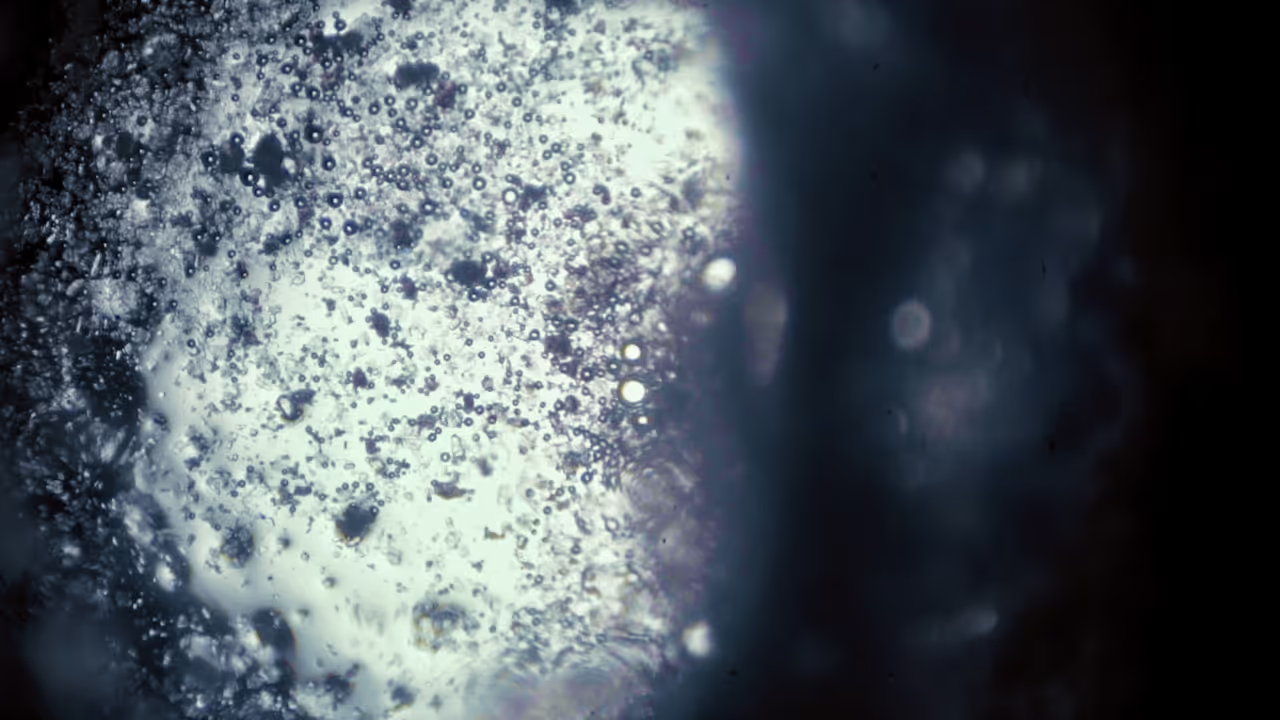
Most home blood type test kits use a simple antibody reaction method. You place blood drops on testing areas treated with specific antibodies. Clumping (agglutination) occurs when antibodies meet their matching antigens, revealing your type through visible reactions.
This information matters beyond medical emergencies. Your blood type influences which blood products you can safely receive, affects pregnancy planning for Rh-negative mothers, and may even correlate with certain health conditions and dietary responses, though research on these connections remains evolving.
How to interpret blood type test kit results
Reading your blood type test kit results requires understanding the clumping patterns that appear in each testing area. Most kits provide three or four testing zones containing different antibodies.
Anti-A zone clumping means you have A antigens (Type A or AB). Anti-B zone clumping indicates B antigens (Type B or AB). Both zones clumping reveals AB blood, while neither clumping indicates Type O. The Rh testing area follows the same principle: clumping means Rh-positive, no reaction means Rh-negative.
Clear, obvious clumping appears as visible chunks or granules in the blood sample, distinctly different from smooth, uniform mixing. Weak or questionable reactions require retesting, as they often indicate user error or kit problems rather than valid results.
Document your results immediately, including the kit brand, expiration date, and testing time. Take photos if possible. Many people test multiple times or use different kit brands to verify results, especially if planning to rely on the information for medical decisions.
Remember that home test results should be considered preliminary. Medical facilities will always perform their own typing before transfusions or procedures, regardless of your stated blood type or home test results.
What can influence blood type test kit accuracy
Several factors can compromise your blood type test kit results, leading to false or unclear readings that may give you incorrect information about your type.
Temperature extremes affect antibody function. Testing in very cold or hot conditions can interfere with proper reactions or create false clumping. Room temperature (65-75°F) provides optimal results. Similarly, expired reagents lose potency, potentially missing reactions or creating weak, ambiguous results.
Sample quality dramatically impacts accuracy. Insufficient blood volume, dried samples, or contamination with water or other substances interfere with antibody reactions. Using the wrong finger (avoid recently injured or heavily calloused areas) or inadequate cleaning can introduce variables that skew results.
Technique errors account for many false results. Mixing blood and reagents too vigorously can create false clumping, while insufficient mixing prevents proper reactions. Reading results too early or too late also affects accuracy, as reactions develop over specific timeframes.
Certain medical conditions complicate testing. Recent blood transfusions, bone marrow transplants, or specific medications can temporarily alter your apparent blood type. Pregnancy, autoimmune conditions, and some infections may also influence results through various mechanisms affecting red blood cell surface markers or antibody production.
Related context that changes the picture
Your blood type connects to broader health patterns and considerations that extend far beyond basic identification, influencing everything from disease susceptibility to pregnancy planning.
Pregnancy considerations become critical for Rh-negative mothers carrying Rh-positive babies. This incompatibility can trigger maternal antibody production that threatens future pregnancies through hemolytic disease of the newborn. Professional blood typing and monitoring throughout pregnancy ensures appropriate medical interventions.
Disease associations show interesting correlations, though not definitive causation. Observational studies suggest individuals with Type O (approximately 44-45% of the US population) may have modestly lower coronary heart disease risk but higher peptic ulcer susceptibility. Type A (approximately 34-40% of the US population) associates with a slightly higher rate of heart disease, while some research has linked Type AB (approximately 4% of the US population) to higher cognitive impairment risk — though larger studies have not consistently replicated this finding, so the evidence should be considered preliminary. These connections inform health awareness rather than predicting individual outcomes.
Rare blood variants complicate simple ABO/Rh typing. Subgroups like A1, A2, or rare antigens (Duffy, Kidd, Diego systems) don't appear in basic home tests and can matter in specific transfusion or compatibility scenarios. Professional laboratory testing identifies these variants crucial for complex medical procedures.
Universal donor and recipient concepts provide emergency guidance but oversimplify real transfusion medicine. O-negative blood works for most emergency situations, but hospitals prefer exact matching when time permits. AB-positive individuals can typically receive any ABO/Rh type, but other blood group systems may still create complications.
Take control of your complete health picture
While knowing your blood type provides one piece of health information, understanding your complete blood health requires comprehensive biomarker analysis that reveals metabolic function, cardiovascular risk, immune status, and much more.
Superpower's professional-grade blood panels deliver the detailed insights that basic blood type test kits can't provide. Instead of wondering about a single characteristic, you get a complete picture of your health through 97+ biomarkers analyzed in certified laboratories using clinical-grade methodology.
Ready to move beyond basic blood typing to comprehensive health insights? Order your Superpower Blood Panel and discover what your blood can tell you about optimizing your health and longevity.


FAQs
Yes, home blood type test kits are available and can determine your ABO blood group and Rh factor. Accuracy varies by product, technique, and storage conditions — the best-studied consumer kit (Eldoncard) achieved approximately 99% concordance with reference-lab testing in controlled studies, though real-world accuracy can be lower. Results should be considered preliminary rather than definitive for medical decisions.
EldonCard is the most-studied home kit; a 2023 Transfusion study found approximately 99% concordance with reference laboratory RhD typing in controlled conditions. However, real-world accuracy depends on technique, storage, and rare blood variants, and all home kits carry higher error risk than professional laboratory testing.
No, O+ is actually the most common blood type, found in about 37-39% of the US population. O- (universal donor) is much rarer at only 6-7% of people, while AB- is the rarest at less than 1% of the population.
You may find your blood type in medical records from previous hospital visits, blood donations, military service, or pregnancy records. Contact your doctor's office, local blood bank, or check any medical documentation you have. If unavailable, professional testing is more reliable than home kits.
Most home blood type test kits provide results within 2-10 minutes. The antibody reactions that determine your blood type happen quickly, but you should read results within the timeframe specified by your kit's instructions for accuracy.
Common causes of inaccurate home kit results include testing at extreme temperatures, using expired reagents, applying insufficient blood volume, mixing too vigorously or not enough, and reading results outside the specified time window. Certain medical conditions such as recent transfusions, autoimmune disorders, or bone marrow transplants can also alter apparent blood type results.
References
- Younes, R., Spinella, P. C., Shea, S. M., Bailey-Kroll, L., Neal, M. D., Leeper, C., & Yazer, M. H. (2023). A rapid ABO and RhD test demonstrates high fidelity to blood bank testing for RhD typing. Transfusion, 63 Suppl 3, S208-S212. https://doi.org/10.1111/trf.17326
- Abegaz, S. B. (2021). Human ABO Blood Groups and Their Associations with Different Diseases. BioMed research international, 2021, 6629060. https://doi.org/10.1155/2021/6629060
- Raud, L., Férec, C., & Fichou, Y. (2017). From genetic variability to phenotypic expression of blood group systems. Transfusion clinique et biologique : journal de la Societe francaise de transfusion sanguine, 24(4), 472-475. https://doi.org/10.1016/j.tracli.2017.06.011
- Bienek, D. R., & Charlton, D. G. (2011). Accuracy of user-friendly blood typing kits tested under simulated military field conditions. Military medicine, 176(4), 454-60. https://doi.org/10.7205/milmed-d-10-00339
- Daurat, G. (2008). [Yes, we should keep ABO agglutination test within bedside transfusion checks]. Transfusion clinique et biologique : journal de la Societe francaise de transfusion sanguine, 15(5), 322-6. https://doi.org/10.1016/j.tracli.2008.09.029
- Li, G., Chen, F., Wang, N., Zhang, M., Lu, X., Chen, H., & Wang, X. (2023). A study of blood group conversion in patients with ABO incompatible hematopoietic stem cell transplantation-A decade survey. Transfusion and apheresis science : official journal of the World Apheresis Association : official journal of the European Society for Haemapheresis, 62(2), 103576. https://doi.org/10.1016/j.transci.2022.103576
- Jones, A. D., Moayeri, M., & Nambiar, A. (2021). Impact of new myeloma agents on the transfusion laboratory. Pathology, 53(3), 427-437. https://doi.org/10.1016/j.pathol.2021.01.001
- Pandey, P., Kumari, S., Mandal, S., Sawhney, A., & Jain, R. (2023). A case of severe hemolytic disease of newborn due to alloimmunization in primigravida. Transfusion clinique et biologique : journal de la Societe francaise de transfusion sanguine, 30(1), 5-7. https://doi.org/10.1016/j.tracli.2022.08.004
- Jiang, C., Huang, J., & Cong, H. (2026). Blood Types May Be Involved in the Occurrence of Coronary Heart Disease Through Serum Lipids. BioMed research international, 2026(1), e6113514. https://doi.org/10.1155/bmri/6113514
- Alkebsi, L., Ideno, Y., Lee, J. S., Suzuki, S., Nakajima-Shimada, J., Ohnishi, H., Sato, Y., & Hayashi, K. (2018). Gastroduodenal Ulcers and ABO Blood Group: the Japan Nurses' Health Study (JNHS). Journal of epidemiology, 28(1), 34-40. https://doi.org/10.2188/jea.JE20160204
- Alexander, K. S., Zakai, N. A., Gillett, S., McClure, L. A., Wadley, V., Unverzagt, F., & Cushman, M. (2014). ABO blood type, factor VIII, and incident cognitive impairment in the REGARDS cohort. Neurology, 83(14), 1271-6. https://doi.org/10.1212/WNL.0000000000000844
- Hazarika, R., Basu, S., & Kaur, P. (2011). Subgrouping of A and AB blood groups in Indian blood centres: is it required?. Journal of the Indian Medical Association, 109(8), 561-2. https://pubmed.ncbi.nlm.nih.gov/22315863/
- Mazières, S., Temory, S. A., Vasseur, H., Gallian, P., Di Cristofaro, J., & Chiaroni, J. (2013). Blood group typing in five Afghan populations in the North Hindu-Kush region: implications for blood transfusion practice. Transfusion medicine (Oxford, England), 23(3), 167-74. https://doi.org/10.1111/tme.12038
- Garratty, G., Glynn, S. A., McEntire, R., & Retrovirus Epidemiology Donor Study (2004). ABO and Rh(D) phenotype frequencies of different racial/ethnic groups in the United States. Transfusion, 44(5), 703-6. https://doi.org/10.1111/j.1537-2995.2004.03338.x






























.avif)
.svg)
.svg)

