.svg)


The FDA’s approval of Isembyld (apitegromab-mtsn) marks a significant advance in spinal muscular atrophy treatment, while emerging research published in Nature Medicine suggests that apitegromab may also have potential for preserving lean muscle mass during weight loss.
On September 11, 2026, the FDA approved Isembyld (apitegromab-mstn), developed by Scholar Rock, to treat spinal muscular atrophy (SMA) in adults and children aged 2 and older who are already receiving an SMN2-targeted therapy.
The approval is a milestone in neuromuscular medicine: Isembyld is the first FDA-approved SMA treatment that directly targets muscle loss rather than the underlying genetic mechanism. By inhibiting myostatin, a protein that limits muscle growth, it offers a complementary way to improve motor function in people living with SMA.
What is Isembyld, and how does it work?
SMA is a rare genetic disorder marked by progressive degeneration of motor neurons, the nerve cells that control voluntary movement. As these neurons deteriorate, patients develop muscle weakness and wasting and struggle with sitting, standing, walking, and breathing.
Existing disease-modifying treatments such as nusinersen and risdiplam work by increasing production of functional survival motor neuron (SMN) protein. These therapies have improved outcomes, but many patients still experience muscle weakness and functional limitations.
Apitegromab-mstn is a monoclonal antibody that selectively binds precursor forms of myostatin and prevents their activation. Because myostatin naturally restricts skeletal muscle growth, inhibiting it aims to support muscle development and function. Isembyld is not meant to replace SMN2-targeted therapies. Instead, it is approved as an additional treatment for patients already receiving those medications. It is given by intravenous infusion over roughly 60 to 120 minutes.
What clinical evidence supported approval?
Approval was based on the phase 3 SAPPHIRE trial, a randomized, double-blind, placebo-controlled study of apitegromab in patients with SMA receiving background SMN2-targeted treatment. The study enrolled 188 nonambulatory participants aged 2 to 21 (128 on apitegromab, 60 on placebo), with the main efficacy analysis focused on children aged 2 to 12.
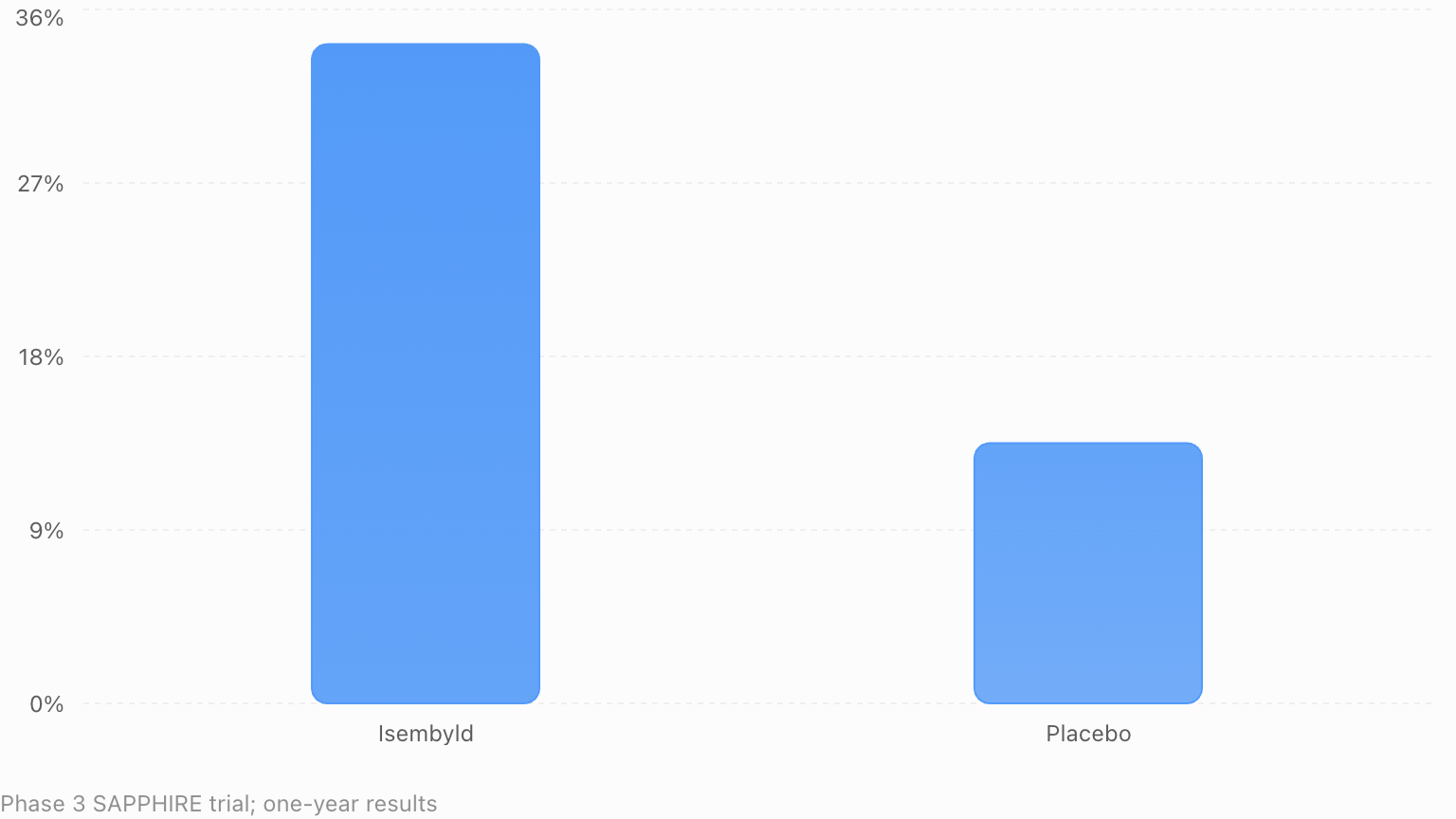
Motor function was measured with the Hammersmith Functional Motor Scale-Expanded (HFMSE), a 66-point assessment of abilities such as sitting and standing. At the recommended 10 mg/kg dose, patients aged 2-12 showed a 2.2-point benefit over placebo after about one year, according to the press release. Additionally, 34.2% of treated patients improved by at least three points on the HFMSE, versus 13.5% on placebo.
These results suggest targeting muscle directly can add functional benefit beyond SMN2-targeted treatment alone, though the magnitude may vary and the primary efficacy population was younger than the full approved population.
What are the potential side effects and safety concerns?
Isembyld's labeling flags several safety considerations. The most significant warning concerns fractures, including serious fractures; clinicians are advised to use caution in patients with low bone density or a history of multiple fractures.
Other common adverse reactions include upper respiratory tract infections, vomiting, cough, viral infections, headache, gastroenteritis, pharyngitis, and hypersensitivity reactions. The prescribing information also warns that Isembyld may cause fetal harm and may affect reproductive function, based on animal studies.
Patients and caregivers should discuss risks, fracture history, reproductive considerations, and monitoring with their care team before starting treatment.
New Nature Medicine study highlights potential beyond SMA
Apitegromab has also drawn interest for preserving muscle during pharmacologic weight loss. A study published June 8, 2026, in Nature Medicine — reporting results from the phase 2 EMBRAZE trial — tested whether apitegromab could reduce lean body mass loss in adults taking tirzepatide for weight management. The trial randomized 102 adults with overweight or obesity to tirzepatide plus apitegromab or tirzepatide plus placebo for 24 weeks.
Participants on apitegromab lost less lean mass despite similar overall weight loss:
- About 1.6 kg of lean mass lost, versus 3.5 kg on placebo — roughly 54.9% less lean mass loss, or an additional 1.9 kg preserved.
- Total weight loss was broadly similar: about 11.2 kg versus 12.5 kg.
- Adverse events occurred in 76% of the apitegromab group and 71% of placebo, with one serious event in each; most were mild and resolved.
These findings provide early evidence that selective myostatin inhibition may help preserve lean tissue during treatment with incretin-based weight-loss medications.
.png)
Why the EMBRAZE findings matter
Medications such as tirzepatide produce substantial weight loss, but some of that loss comes from lean tissue rather than fat. Preserving muscle matters because it contributes to strength, mobility, glucose metabolism, and long-term function. EMBRAZE suggests pairing a myostatin inhibitor with a weight-loss drug may improve the composition of weight lost.
Important limits remain: the study was small, ran only 24 weeks, and did not establish meaningful gains in physical function. Also, lean mass on body-composition testing is not the same as strength. Isembyld is not approved for obesity, weight management, or preventing muscle loss during GLP-1 or tirzepatide treatment. The EMBRAZE findings are exploratory, not an extension of the approved indication.




.png)





.jpg)