


Understand what your hormone testing results really mean
See your biomarkers in context with a comprehensive panel.
- CLIA-certified labs
- HIPAA compliant
- Personalized health protocol
What a heavy lifting session does to testosterone
Lifting weights raises testosterone in two distinct ways. Acutely, testosterone peaks in the bloodstream approximately 15 to 30 minutes after a session ends and returns to baseline within 60 to 90 minutes in most individuals. Over months and years, consistent resistance training is associated with higher resting testosterone than sedentary living — real, but modest. The connection is well-documented and frequently overstated in both directions: exercise does produce a genuine hormonal response, but that response varies substantially between individuals and does not translate automatically into long-term testosterone changes for everyone. Individual variability is wide enough that the population average tells you relatively little about your own response.
The hormonal cascade behind a training session
Within minutes of beginning a resistance training session, mechanical and metabolic stress on muscle tissue triggers an anabolic hormone cascade that includes testosterone, growth hormone, and IGF-1. The magnitude of that acute response is shaped by exercise selection: compound, multi-joint movements involving large muscle groups — squats, deadlifts, rows — combined with shorter rest periods and moderate-to-high intensity relative to one-repetition maximum produce a larger response than isolation exercises or low-intensity sessions. This reflects the greater total metabolic demand placed on the body, not a fundamentally different hormonal mechanism.
Body composition adds a second, slower-acting pathway. Visceral fat produces aromatase, the enzyme that converts testosterone to estradiol, reducing circulating testosterone. Resistance training reduces visceral fat, which in turn reduces aromatase activity and limits testosterone-to-estradiol conversion — supporting a more favorable net free testosterone environment over time. This means the metabolic effects of training on body composition may contribute as much to long-term testosterone levels as the direct hormonal response to exercise itself. For a comparison of how high-intensity cardiovascular exercise drives a similar acute hormonal response through overlapping but distinct mechanisms, see does sprinting increase testosterone.
How much testosterone actually rises after lifting
The acute increase following a resistance training session is measurable immediately at the end of exercise and within the first 30 minutes, with moderate-to-high intensity sessions driving the response and levels no longer significantly elevated beyond that 30-minute window. This figure comes from controlled exercise studies including work cited in PubMed 15831061 and reflects sessions involving compound movements at moderate-to-high intensity.
For chronic adaptation, a 2023 analysis in Communications Medicine examining genetically determined testosterone levels found complex links between testosterone and metabolic health markers, with physical activity as a consistently beneficial modifier. The Endocrine Society clinical practice guideline notes that exercise supports testosterone levels but is unlikely to restore clinical deficiency to normal without additional medical management.
Age attenuates both effects. Total testosterone falls approximately 1 to 2 percent per year after age 30, and men over 40 typically show blunted acute hormonal responses to resistance training compared to younger men. The magnitude of chronic adaptation is also smaller in older men.
These are population averages; the spread is wide — see the next section.
Why two lifters get different hormonal responses
The 15 to 25 percent acute spike is a population average. Some lifters barely move; others spike into the upper reference range. The biology behind that gap is measurable. Age and body composition are two major contributors — older men show blunted acute hormonal responses, and higher visceral fat increases aromatase activity, limiting net free testosterone availability even when total testosterone rises. But several circulating markers explain individual variation more precisely:
- Total testosterone: Baseline production; the starting point — higher baseline means less room for relative upward shift from the same training stimulus.
- Free testosterone: The biologically active fraction; when SHBG is elevated, the acute spike in total testosterone translates to less functional free testosterone.
- SHBG: Determines what fraction of total testosterone is bioavailable; high SHBG blunts the effective testosterone response to training even when total rises.
- LH: Pituitary signal driving testicular testosterone production; distinguishes whether low responses reflect primary testicular dysfunction or central HPG suppression.
- Estradiol (E2): Converted from testosterone via aromatase; elevated E2 indicates increased aromatase activity — often from higher body fat — which limits net free testosterone availability.
- hs-CRP: Chronic systemic inflammation suppresses testosterone production through HPG axis interference; a high hs-CRP can explain a blunted training-testosterone response.
Testosterone testing should be performed in the morning, when levels are at their daily peak. A 2025 study in JCEM establishing age-stratified reference ranges for directly measured free testosterone highlighted the importance of timing and methodology in clinical interpretation. A single result should be interpreted alongside SHBG, LH, and clinical symptoms before any conclusions are drawn.
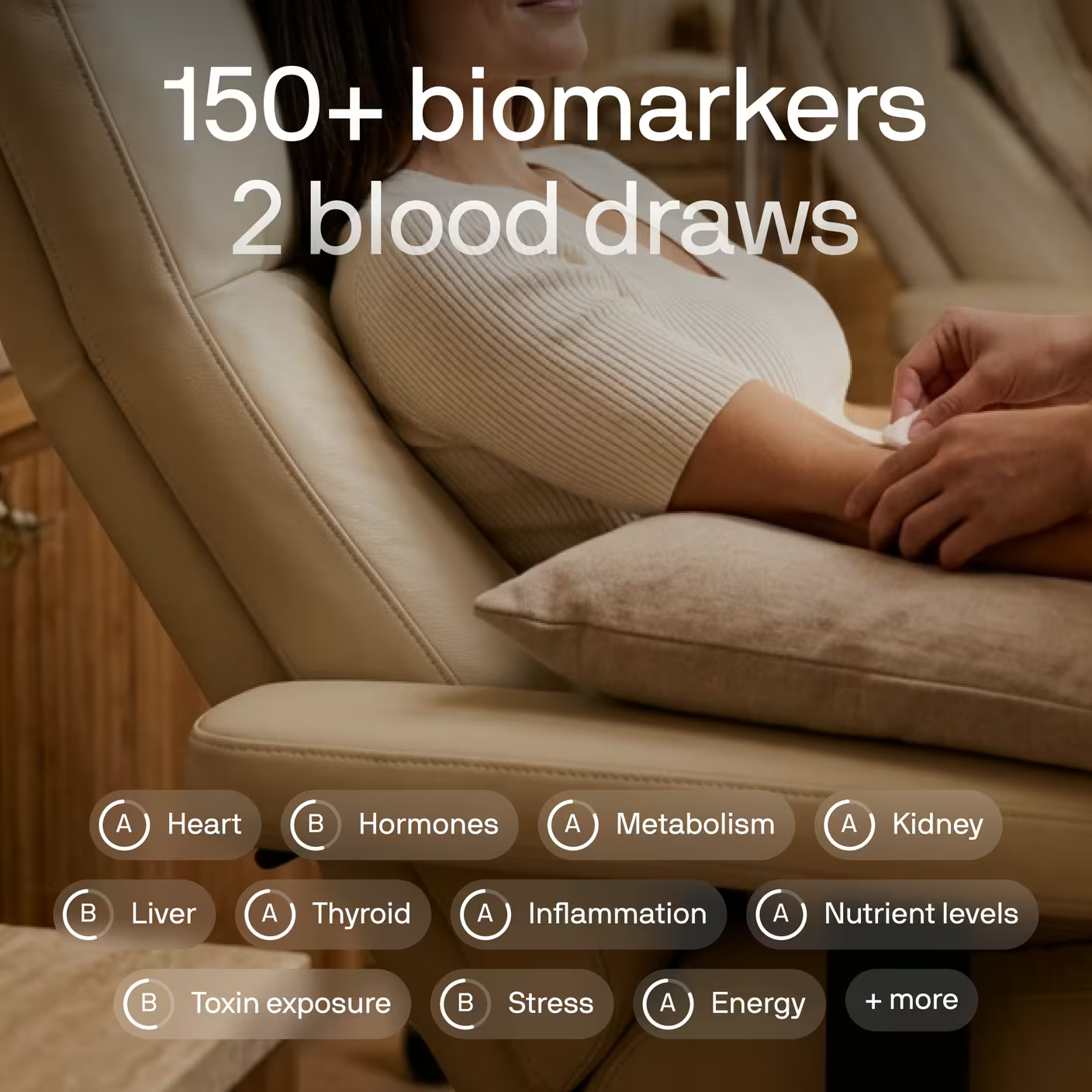
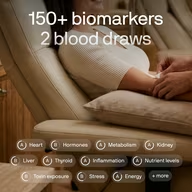
Test 150+ biomarkers
Two blood draws. A full picture of your health, explained in plain language.
Test 150+ biomarkers
Two blood draws. A full picture of your health, explained in plain language.
Training signals that suggest hormonal trouble
Symptoms consistent with low testosterone include reduced energy, decreased libido, difficulty building or maintaining muscle despite consistent training, increased body fat particularly around the abdomen, mood changes, and poor sleep quality. These symptoms are nonspecific and overlap with thyroid dysfunction, iron deficiency, vitamin D deficiency, and overtraining. Blood testing distinguishes between these possibilities.
If testosterone results are below the reference range, a provider will typically assess LH and FSH to determine whether the issue originates at the testicular level or the pituitary level, and will rule out reversible causes before recommending any further management. The presence of these symptoms alongside a high training load is a signal that warrants testing rather than simply adding more volume. Reference ranges vary by laboratory and individual; results should always be interpreted by a qualified provider in context.
When more training suppresses testosterone instead
Excessive training without adequate recovery produces the opposite of what most lifters expect. Overtraining syndrome is associated with elevated cortisol, reduced testosterone, and a worsened testosterone-to-cortisol ratio. This state impairs recovery, reduces muscle synthesis, and over time can suppress hypothalamic-pituitary function — meaning the brain's signaling to the testes is itself diminished, driving testosterone below baseline rather than above it.
High-frequency training without adequate recovery can suppress rather than raise testosterone through this same mechanism. Overtraining elevates cortisol and can reduce the testosterone-to-cortisol ratio to a range associated with impaired recovery and hormonal suppression. Structured periodization with planned rest days supports the hormonal adaptations that benefit testosterone more effectively than maximum-frequency training.
If fatigue, declining performance, and mood changes accompany high training volume, testing testosterone alongside cortisol provides useful diagnostic context. The pattern of below-baseline testosterone and above-baseline cortisol is a recognizable hormonal signature of insufficient recovery — one that more training will worsen, not resolve.
When a testosterone question belongs with a clinician
If persistent symptoms — low energy, reduced libido, difficulty maintaining muscle, mood changes — are accompanying your training, that is a clinical evaluation, not a programming question. Testing gives you and your provider a factual foundation rather than a symptomatic one to work from.
Understanding the markers behind your hormonal response is the foundation of Superpower's approach to preventive health.
Frequently Asked Questions
References
- D'Andrea S, Spaggiari G, Barbonetti A, Santi D (2020). Endogenous transient doping: physical exercise acutely increases testosterone levels-results from a meta-analysis. *Journal of endocrinological investigation*, *43*(10), 1349-1371. https://doi.org/10.1007/s40618-020-01251-3
- Kraemer WJ, Ratamess NA (2005). Hormonal responses and adaptations to resistance exercise and training. *Sports medicine*, *35*(4), 339-61. https://doi.org/10.2165/00007256-200535040-00004
- Gray A, Feldman HA, McKinlay JB, Longcope C (1991). Age, disease, and changing sex hormone levels in middle-aged men: results of the Massachusetts Male Aging Study. *The Journal of clinical endocrinology and metabolism*, *73*(5), 1016-25. https://doi.org/10.1210/jcem-73-5-1016
- Bhasin S, Brito JP, Cunningham GR, Hayes FJ, Hodis HN, Matsumoto AM, Snyder PJ, Swerdloff RS, Wu FC, Yialamas MA (2018). Testosterone Therapy in Men With Hypogonadism: An Endocrine Society Clinical Practice Guideline. *The Journal of clinical endocrinology and metabolism*, *103*(5), 1715-1744. https://doi.org/10.1210/jc.2018-00229
- Cadegiani FA, Kater CE (2019). Basal Hormones and Biochemical Markers as Predictors of Overtraining Syndrome in Male Athletes: The EROS-BASAL Study. *Journal of athletic training*, *54*(8), 906-914. https://doi.org/10.4085/1062-6050-148-18
- Cohen PG (2001). Aromatase, adiposity, aging and disease. The hypogonadal-metabolic-atherogenic-disease and aging connection. *Medical hypotheses*, *56*(6), 702-8. https://doi.org/10.1054/mehy.2000.1169





















 Heart & Vascular Health
 Metabolic Health
 Energy
 Liver Health
 Kidney
 Sex Hormones
 Thyroid Health
 Nutrients
 Immune System
 Inflammation