Test details
- Sample type:
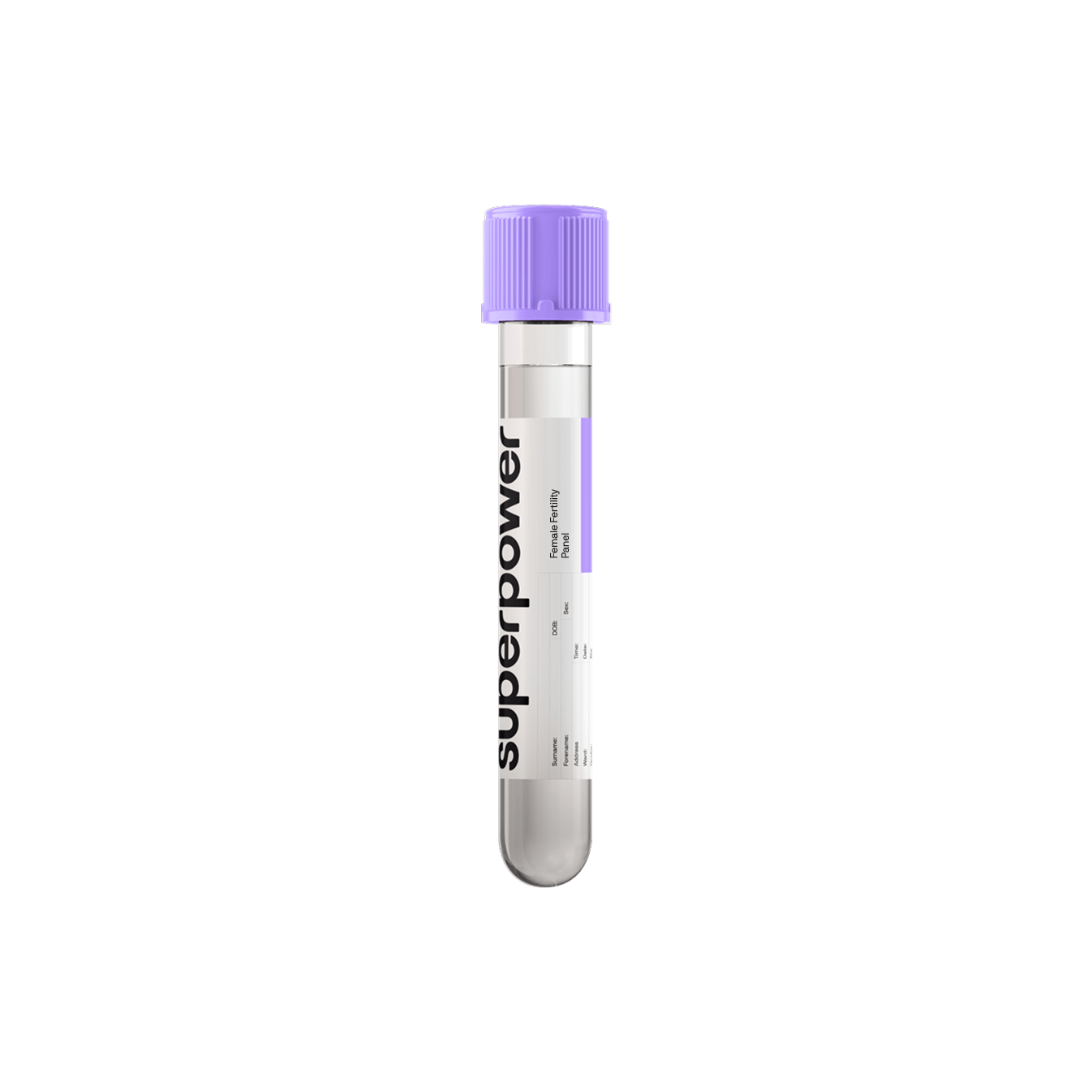
- Single blood draw (blood only)
- Location:
- In-person at local lab / At-home phlebotomist visit (+$119)
- Availability:
- Available in 39 states and Washington, D.C.
- Turnaround:
- Results typically within 20 days, once every marker in the bundle is complete
- Preparation:
- Fast for 10 hours beforehand, water onlyNote the first day of your last periodPause supplements for 72 hours and skip strenuous exercise for 48 hours
About the Extended Women's Health Bundle
The Extended Women's Health Bundle is a blood test that reads hormone biomarkers from a single draw: ovarian reserve, the cycle and adrenal-pathway hormones behind ovulation, and the pituitary signals sitting above both. It is an add-on to your Superpower Baseline panel rather than a replacement for it.
It suits someone who wants reserve, ovulation, and the upstream signals read together rather than one test at a time. Buyers arrive calling it a female hormone bundle, a fertility hormone panel, or simply an AMH or ovarian reserve test. The marker list is the same whichever name brings you here.
What this panel measures
The bundle draws its biomarkers from three component panels: Ovarian Egg Reserve, the Progesterone Add-on, and Pituitary & Growth Hormones.
| Marker | What it reflects |
|---|---|
| Anti-Mullerian Hormone | Made by the follicles inside the ovaries, so the level tracks the size of your ovarian reserve. |
| 17-Hydroxyprogesterone | A hormone produced by the adrenal glands and the sex glands, which is why a raised result moves the question upstream of the ovaries. |
| Progesterone | Made mainly by the ovaries, and it rises after an ovary releases an egg in the second half of the cycle. |
| Insulin-like Growth Factor 1 (IGF-1) | Carries the effects of growth hormone, and is a reliable way to track that activity. |
| Prolactin | A pituitary hormone whose main role is signaling breast tissue to make milk, so levels are normally low outside pregnancy and breastfeeding. |
What the bundle does not carry is estradiol, luteinizing hormone, follicle-stimulating hormone, testosterone, or thyroid biomarkers, which raises a fair question about overlap with the panel you already have.
What this bundle adds to your Baseline panel
Your Superpower Baseline panel already measures estradiol, follicle-stimulating hormone, and luteinizing hormone. These biomarkers are additional rather than a repeat, and each one reaches something that set does not.
- Ovarian reserve — AMH reflects the supply of eggs remaining, which no Baseline hormone measures.
- Whether a given cycle released an egg — A progesterone result helps a provider see whether the ovaries are ovulating normally.
- The signals sitting above the ovaries — A high prolactin can affect how the ovaries work, and IGF-1 stays more stable through the day than growth hormone itself.
These results are read alongside a Baseline result rather than instead of one, and for one of them the day of the draw changes the answer.
Cycle timing changes what these results mean
Two of these biomarkers are read against where you are in your cycle. The rest can be collected on any cycle day.
| Marker | When it is drawn | Why the timing matters |
|---|---|---|
| Anti-Mullerian Hormone | Any cycle day | The result speaks to the size of your ovarian reserve rather than to a phase of the cycle. |
| Progesterone | The second half of the cycle, after ovulation | Progesterone begins to rise only once an ovary has released an egg, so an earlier draw cannot speak to ovulation. Knowing the first day of your last period can matter for reading the number. |
| 17-Hydroxyprogesterone | Read against your cycle phase | In adult women, the normal range differs across the cycle, and many medicines interfere with the result. |
| Prolactin and IGF-1 | Any cycle day | A single prolactin reading can sit above its usual level for ordinary reasons, so a provider may suggest repeat testing. |
A result read without its timing is a common way these biomarkers get misread. AMH carries a second misreading of its own.
What AMH can and cannot tell you
Ovarian reserve is the supply of eggs still held in your ovaries, and AMH is the biomarker that estimates it. The hormone comes from the small follicles holding immature eggs, so a higher level means a larger supply, and levels fall with age until menopause.
What AMH does not do is forecast. The test tells you the size of your reserve, but it cannot tell you about egg health and it cannot predict whether you will be able to get pregnant. This bundle is not a complete fertility evaluation either. What it gives your provider is a starting point, and that matters most in a handful of specific situations.
Who benefits from testing
Testing earns its place when your questions sit across more than one level of the hormone system.
- You are planning a pregnancy or weighing egg freezing, and want reserve, ovulation, and the upstream signals from one draw.
- Your cycles are irregular and nobody has explained why — Low progesterone outside pregnancy may be linked to not ovulating normally.
- Hair is growing where adult men grow it, alongside cycle changes. That is the pattern in which 17-hydroxyprogesterone may be recommended for women with absent menses or excess hair growth.
- Fatigue, low libido, or cycle changes persist while estradiol and follicle-stimulating hormone came back unremarkable. A higher-than-normal prolactin is associated with menstrual problems and infertility.
Your Superpower care team and your own provider decide whether any of it changes your plan, starting with what the numbers show.
What your results reveal
Your report gives a measured value for each biomarker beside its reference range. At the ovarian level, AMH places your reserve against what is expected for your age, and a progesterone drawn in the luteal phase helps a provider see whether the ovaries are releasing eggs.
Above the ovary, a raised 17-hydroxyprogesterone moves the question toward the adrenal glands, where the test may help identify people who develop symptoms later in life. A raised prolactin may indicate a reason behind cycle and fertility changes that the ovarian biomarkers alone would not explain. IGF-1 sits beside them as the read on growth hormone, whose effects it manages in the body.
One limit is worth stating plainly. A prolactin result cannot show the cause of a high level, though it helps a provider decide which tests come next. Read together, these biomarkers point to the level of the system worth working on.
Reference ranges vary by lab and individual. This bundle does not diagnose infertility, PCOS, or any other condition. Your Superpower care team and your provider will interpret your specific results in context.
How to prepare
Preparation is the standard Superpower blood-draw routine, with one extra note for the cycle-dependent marker.
- Fast for 10 hours beforehand, water only.
- Skip caffeine, and avoid alcohol and heavy, fatty meals the day before.
- Hydrate well the night before and the morning of your draw.
- Avoid strenuous exercise for 48 hours beforehand.
- Pause supplements for 72 hours.
- Continue prescribed medications unless the prescribing clinician advises otherwise.
- Note the first day of your last period, and any hormonal contraception you use, so your results can be read in context.
Rest beforehand, and tell your care team if the morning was stressful or rushed, since small prolactin increases can be caused by stress, exercise, and sex. If you are unwell with a cold, flu, or fever, reschedule the draw.
How it works
- Order online — No doctor's visit or referral is required, and the order is reviewed by a qualified provider as part of the process.
- Give your blood sample — One draw, either in-lab at a local site or through an at-home phlebotomist visit.
- Review your results — They land in your Superpower dashboard approximately 20 days after the draw, once every biomarker in the bundle is complete, with your care team available to walk through them.
Frequently asked questions
Biomarkers tested
Anti-Müllerian Hormone (AMH) is a protein hormone produced by the small, developing follicles in a woman’s ovaries.
Learn moreMethod: FDA-cleared clinical laboratory assay performed in CLIA-certified, CAP-accredited laboratories. Used to aid clinician-directed evaluation and monitoring. Not a stand-alone diagnosis.


























 Heart & Vascular Health
 Metabolic Health
 Energy
 Liver Health
 Kidney
 Sex Hormones
 Thyroid Health
 Nutrients
 Immune System
 Inflammation