Ovarian Egg Reserve

$79+$349 membership
New York / New Jersey

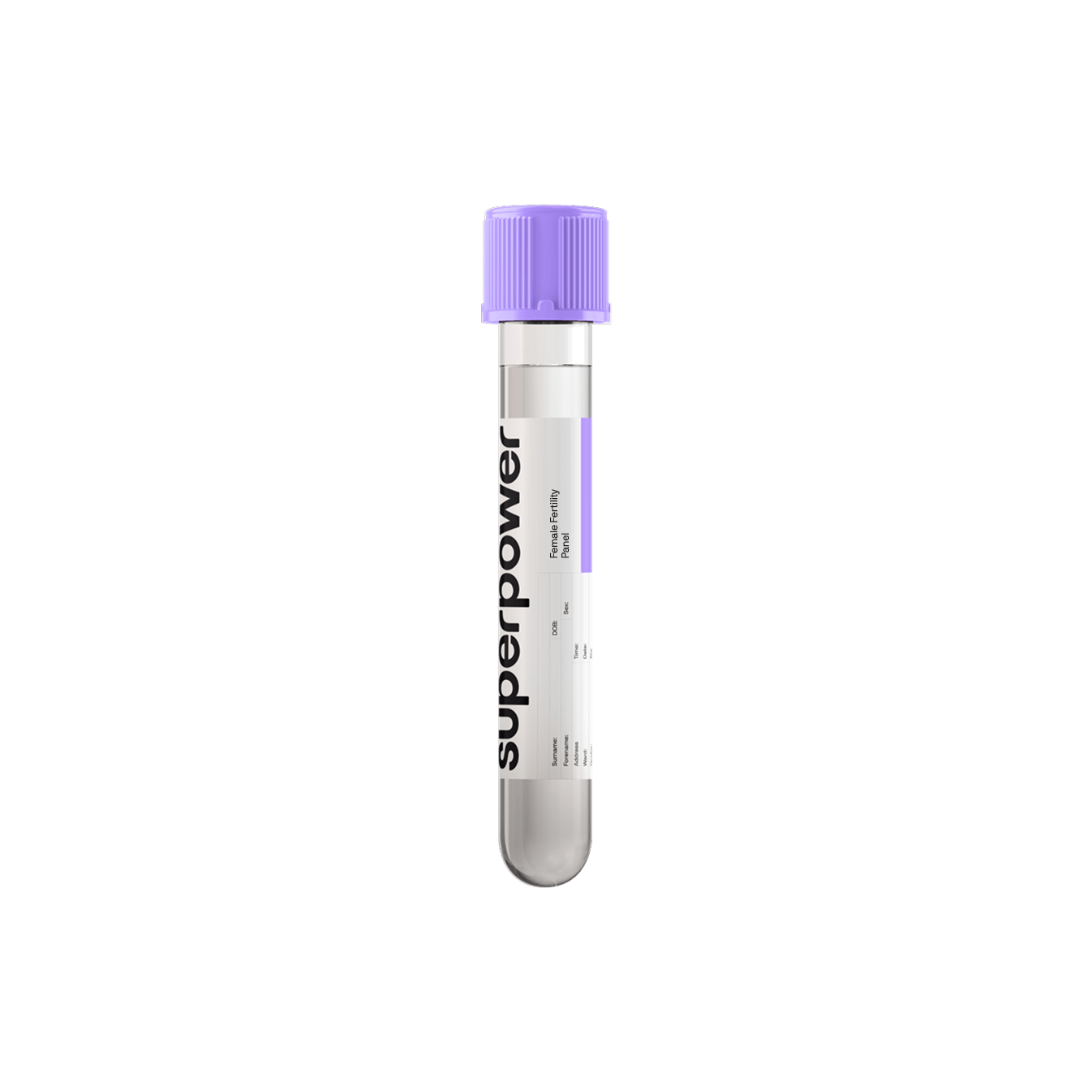
Tests Anti-Müllerian Hormone (AMH), the key marker of how many eggs remain in your ovarian reserve, to inform conversations about fertility timing.

See details →

Test details

Sample type:
Single blood draw (blood only)
Location:
In-person at local lab / At-home phlebotomist visit (+$119)
Availability:
Available in 39 states and Washington, D.C.
Turnaround:
Results typically within 10 days
Preparation:
No cycle-day timing requiredStop biotin-containing supplements at least 48 hours before your drawStay well hydrated before your appointment

There is a question a lot of people hold for years before they act on it: do I have time? It is not always about trying to conceive right now. Sometimes it is about understanding the window, and knowing whether the option to wait is still open. The Ovarian Egg Reserve panel measures Anti-Müllerian Hormone (AMH) in a single blood draw, the most reliable marker of how many eggs you have remaining. It gives you a clearer biological foundation for conversations about timing and next steps, with results delivered to your dashboard, typically within 10 days.

This panel is for informational purposes only and does not constitute medical advice. It does not diagnose infertility or any condition, and it does not predict pregnancy outcomes. Results should be reviewed with a qualified healthcare provider.

What this panel measures

Anti-Müllerian Hormone (AMH)

AMH is produced by the small follicles in your ovaries, and it is one of the most reliable markers of ovarian reserve, meaning how many eggs you have remaining. Unlike other fertility markers, AMH stays relatively stable throughout your cycle, so it can be tested on any day. What it reflects is the size of your remaining follicle pool, one important variable in a larger picture. It does not measure egg quality, and it does not predict whether you will conceive. A lower-than-expected AMH in your 20s or early 30s may indicate that your fertility window is shorter than you assumed: useful context for a planning conversation, not a verdict.

Who benefits from testing

  • Anyone considering egg freezing in the next one to three years who wants a current AMH baseline before making a timing decision
  • People who are starting to try to conceive and want foundational fertility data alongside their clinical workup
  • Those in their late 20s or 30s who want to understand where their ovarian reserve stands relative to age-based ranges, not because anything is wrong, but because they want to know
  • People with a family history of early menopause or diminished ovarian reserve who want to assess their own reserve at an earlier age
  • People already working with a fertility specialist who want to add a current AMH baseline to their existing workup

What your results will tell you

Your results will show one value.

AMH level, measured against age-referenced ranges. Where your ovarian reserve stands relative to your age helps inform decisions about timing. If AMH is lower than expected, it does not mean you cannot get pregnant, but it may mean moving sooner or exploring preservation options is worth discussing with a provider. A result in range can provide reassurance about reserve for your age group, while a higher-than-expected result may sometimes be associated with PCOS patterns. It does not confirm PCOS, which requires clinical evaluation.

Reference ranges vary by lab and individual. Your Superpower care team and your provider will interpret your specific results in context.

How to prepare

  • Cycle timing — AMH is relatively stable throughout the menstrual cycle, so you can collect this sample on any day, and no specific cycle-day timing is required.
  • Hormonal contraceptives — If you are currently using hormonal contraception, your AMH result may reflect a suppressed level rather than your natural ovarian reserve. This is worth noting when you review your results with a provider.
  • Supplements — Stop any supplement containing biotin (multivitamins, B-complex, and hair, skin, and nail formulas) at least 48 hours before your draw. Continue all prescribed medications as normal.
  • Stay well hydrated before your appointment.

How it works

  1. Order online — Add the Ovarian Egg Reserve panel to your Superpower account or order it as a standalone add-on.
  2. Schedule — Book at a local clinic near you, or arrange an optional at-home visit with a trained phlebotomist (+$119).
  3. Get your blood drawn — A single blood sample, with no cycle-day restrictions for AMH.
  4. Review your results in your dashboard, with your Superpower care team available to walk through them.

Accuracy and privacy

  • Processed in a CLIA-certified laboratory
  • Your Superpower care team is available to help you understand your results
  • Optional at-home phlebotomist visit (+$119) available in most major metros
  • Your data is private and never sold

Frequently asked questions

Frequently asked questions

Biomarkers tested

Anti-Müllerian Hormone (AMH) is a protein hormone produced by the small, developing follicles in a woman’s ovaries.

Learn more

Method: FDA-cleared clinical laboratory assay performed in CLIA-certified, CAP-accredited laboratories. Used to aid clinician-directed evaluation and monitoring. Not a stand-alone diagnosis.
Led by doctors with 40 years of health and longevity expertise

Dr. Anant Vinjamoori

Dr. Anant Vinjamoori, MD

Chief Longevity Officer, Superpower

Dr. Leigh Erin Connealy

Dr. Leigh Erin Connealy, MD

Clinician & Founder of The Centre for New Medicine

Dr. Robert Lufkin

Dr. Robert Lufkin, MD

Physician & UCLA Medical School Professor, NYT bestselling author

Dr. Abe Malkin

Dr. Abe Malkin, MD

Founder & Medical Director of Concierge MD

Biological age 32 — a Superpower member portraitA health system built around you — test, understand, optimize150+ biomarkers across 2 blood drawsWhat to expect with Superpower — week 1 to month 3Trusted by 64,000+ customers — member reviewsBetter than the status quo — Superpower vs the old way60% of members found something a doctor missed — member survey
Daniel OSuperpower memberDavid LSuperpower memberRachel DSuperpower memberCamelia VSuperpower member

4.6 · 64,000+ members

Superpower health membership

Find early signs of 1,000+ conditions - then act, retest, and see what changed.

$349

/year*

150+ biomarkers annually across baseline + retest

Personalized plan that turns results into action

Superpower AI and on-demand care team

Results in 10 days or less

At-home or 2,000+ labs nationwide**

Yearly membership$0.96 / dayHSA/FSA eligible

*Pricing may vary for members in New York and New Jersey

**At-home labs for an additional cost

What we test

TestosteroneFree T4Vitamin DApoBHbA1cThyroid (TSH)hs-CRPFerritinCortisolFasting insulin

60%

found something a doctor missed

93%

rated it more useful than their checkup

77%

found something new in their results

Superpower member survey, 90 days post action plan (n=143).

How does the Superpower membership work?

We test 150+ biomarkers annually across two blood draws. Your baseline test paints a comprehensive picture of your health, and your dashboard shows what’s working, what needs attention, and what to do next. Superpower AI and your care team help you take action across lifestyle, supplements, and treatments. Then we retest to track your progress and continue refining your plan.

Can I cancel anytime?

Yes. You can cancel anytime, no fees. Your membership stays active through the end of your paid year.

How often should I test?

Your membership includes two blood tests per year: one to establish your baseline, and one to see whether your plan improved biomarkers that were out of range or not yet optimized. You can add other diagnostics anytime through the app or with help from your care team.

When will I get my results?

Book your draw at any of 2,000+ partner labs or at-home. Results are typically ready in about a week and land in the Superpower app.

What the 100+ panel measures

All 101 markers in your annual baseline draw, organized by system. Nothing here is an upsell.

Heart & Vascular Health

26

  • Apolipoprotein B
  • Atherogenic Coefficient
  • Atherogenic Index of Plasma
  • Castelli Risk Index I
  • Castelli Risk Index II
  • HDL Cholesterol
  • LDL Cholesterol
  • LDL/HDL Ratio
  • Cholesterol, Total
  • Non-HDL Cholesterol
  • Cholesterol/HDL Ratio
  • Carbon Dioxide, Total
  • High-sensitivity CRP
  • hsCRP-to-Albumin Ratio (CAR)
  • GGT-to-HDL Cholesterol Ratio
  • LDL-C to Apolipoprotein B Ratio (LDL-C/ApoB)
  • LDL Cholesterol / Total Cholesterol (Mass Ratio)
  • Monocyte-to-HDL Ratio (MHR)
  • Neutrophil-to-HDL Cholesterol Ratio (NHR)
  • Non-HDL Cholesterol-to-Apolipoprotein B Ratio (Non-HDL-C/ApoB)
  • NON-HDL Total Cholesterol Ratio
  • Triglyceride HDL Molar Ratio
  • Triglycerides
  • Triglyceride-to-Apolipoprotein B Ratio (TG/ApoB)
  • TyG Index
  • Uric Acid

Metabolic Health

4

  • Estim. Avg Glu (eAG)
  • Eag (mmol/l)
  • Glucose
  • Hemoglobin A1c

Energy

1

  • Cortisol

Liver Health

15

  • Albumin/Globulin Ratio
  • Albumin
  • Alkaline Phosphatase (ALP)
  • Alanine Aminotransferase (ALT)
  • Aspartate Aminotransferase (AST)
  • Bilirubin Direct
  • Bilirubin Indirect
  • Bilirubin, Total
  • Bilirubin-to-Albumin Ratio
  • Ferritin
  • Ferritin-to-Albumin Ratio
  • y-Glutamyl Transferase (GGT)
  • Globulin, Total
  • Indirect-to-Direct Bilirubin Ratio
  • Protein, Total

Kidney

11

  • Calcium
  • Chloride
  • Corrected Calcium (Albumin-adjusted)
  • Creatinine
  • Estimated Glomerular Filtration Rate (eGFR)
  • Potassium
  • Sodium
  • BUN/Creatinine Ratio
  • Blood Urea Nitrogen (BUN)
  • Urea-to-Creatinine Ratio
  • Uric Acid-to-HDL Cholesterol Ratio (UHR)

Sex Hormones

7

  • DHEA-Sulfate (DHEA-S)
  • Free Androgen Index
  • Sex Hormone Binding Globulin (SHBG)
  • Free Testosterone
  • Testosterone, Bioavailable
  • Testosterone, Total
  • Testosterone-to-Estradiol Ratio (T/E₂)

Thyroid Health

4

  • Free Thyroxine Index
  • T3 Uptake
  • T4 (thyroxine) Total
  • Thyroid-Stimulating Hormone (TSH)

Nutrients

13

  • Vitamin D
  • Red Cell Dist Width (RDW)
  • Hematocrit
  • Hemoglobin
  • Total Iron Binding Capacity (TIBC)
  • Iron
  • Iron Saturation
  • Mean Cell Hemoglobin (MCH)
  • Mean Corpuscular Hemoglobin Concentration (MCHC)
  • Mean Cell Volume (MCV)
  • Platelet-to-WBC Ratio (PWR)
  • Red Blood Cells
  • RDW MCV Ratio

Immune System

12

  • Basophils
  • Baso (Absolute)
  • Eosinophils
  • Eos (Absolute)
  • Lymphocytes
  • Lymphs (Absolute)
  • Monocytes
  • Monocytes (Absolute)
  • Neutrophils
  • Neutrophils (Absolute)
  • Mean Platelet Volume
  • Platelet Count

Inflammation

8

  • Lymphocyte-to-Monocyte Ratio (LMR)
  • Monocyte-to-Lymphocyte Ratio (MLR)
  • Neutrophil-to-Lymphocyte-Platelet Ratio (NLPR)
  • Neutrophil-to-Lymphocyte Ratio (NLR)
  • Platelet-to-Lymphocyte Ratio (PLR)
  • Systemic Immune-Inflammation Index
  • Systemic Inflammation Response Index (SIRI)
  • White Blood Cells
Get my health baseline

The full list of 100+ markers and 8 specialty add-ons available at superpower.com/biomarkers.

Ovarian Egg ReserveSchedule your test today