

Understand what your iron blood health results really mean
See your biomarkers in context with a comprehensive panel.
- CLIA-certified labs
- HIPAA compliant
- Personalized health protocol
RDW: A plain-language definition of the marker
Red cell distribution width (RDW) measures the variation in size among your red blood cells, expressed as a percentage. A low RDW means your red cells are uniform and stable; a high RDW means they vary widely in size, suggesting uneven production or turnover. RDW does not measure average cell size — that is MCV (mean corpuscular volume). When some cells are large and others small, it often points to bone marrow stress or nutrient deficiencies that affect red cell formation. This size heterogeneity is called anisocytosis.
Why size variation among red cells matters
Think of your bone marrow as a red blood cell factory. When everything is in balance — iron, B12, folate, and energy supply — the factory produces consistently sized cells. When resources are scarce or the machinery is disrupted by inflammation or oxidative stress, production becomes uneven. You start getting a mix of old, small cells and new, oversized ones. That variation is what drives RDW up.
One of RDW's most important clinical properties is its timing: RDW rises before hemoglobin drops. In a developing deficiency, the bone marrow begins producing abnormal cells while the total red cell count remains sufficient to keep hemoglobin in range. RDW captures that early disruption, making it a sensitive early-warning signal for nutrient insufficiency and metabolic stress.
A critical nuance involves mixed deficiencies. Iron deficiency causes cells to shrink, lowering MCV, while B12 or folate deficiency causes cells to enlarge, raising MCV. When both deficiencies coexist, their opposing effects on cell size can cancel out, leaving MCV deceptively normal. RDW rises regardless, because the red cell population now contains both abnormally small and abnormally large cells. This mixed-deficiency pattern is one of the most clinically important reasons to interpret RDW alongside MCV rather than in isolation.
Beyond nutrition, research shows that higher RDW predicts increased risk of cardiovascular disease, diabetes, and all-cause mortality independent of hemoglobin or anemia status. Because RDW tracks the body's capacity for consistent cellular repair, it functions as both a hematologic and a metabolic marker — a microscopic indicator of macroscopic resilience.
Reading your RDW percentage in context
Lab-specific cutoffs vary slightly, so always interpret your result against the reference range on your report. That said, the typical adult range is 11.5–14.5%. Within that window, lower is generally better — indicating steady red cell turnover and nutrient sufficiency. Mild fluctuations are normal during recovery, illness, or pregnancy, but sustained elevation signals chronic imbalance.
When RDW runs high
High RDW means your red blood cells vary significantly in size — a signal that something is interrupting normal production. High RDW most often reflects iron deficiency, vitamin B12 or folate insufficiency, or chronic inflammation, each of which disrupts red cell production in ways that create a mixed-size population. Oxidative stress from smoking, poor diet, or metabolic dysfunction, as well as bone marrow stress from infection or systemic illness, can also contribute.
Pairing RDW with MCV helps narrow the cause: high RDW with low MCV points to iron deficiency; high RDW with high MCV points to B12 or folate insufficiency; high RDW with normal MCV suggests a mixed deficiency in which both patterns are present simultaneously.
When RDW runs low
Low RDW simply means uniform red cells — good news. If all your red cells are healthy and consistent, your bone marrow is doing its job efficiently. Extremely low values are rare and typically not clinically meaningful.
Factors that widen the RDW distribution
Confirmed deficiencies in iron, B12, or folate are the primary modifiable drivers of elevated RDW. Each nutrient plays a distinct role in red cell synthesis: iron is required for hemoglobin assembly, while B12 and folate support the DNA replication that allows precursor cells to mature correctly. Copper also supports erythropoiesis indirectly. When any of these are insufficient, the bone marrow produces a heterogeneous mix of cell sizes.
Inflammation is a separate and independent driver. Chronic inflammatory states — including autoimmune conditions, metabolic syndrome, and kidney disease — can raise RDW through mechanisms distinct from nutritional deficiency, including altered iron recycling and shortened red cell lifespan. Certain medications, such as chemotherapy agents or antivirals, may also alter red cell dynamics.
Physical training load matters as well. Regular moderate exercise supports healthy red cell turnover, but overtraining — particularly with inadequate recovery or low iron intake — can temporarily spike RDW. Chronic stress and poor sleep disrupt the hormonal axis that governs red cell production, particularly via cortisol and erythropoietin, adding further variability.
Because red cells live approximately 120 days, RDW reflects conditions averaged over that entire lifespan. Changes in any of these factors take months to fully register in the RDW value.
Pairing RDW with MCV and nutrient markers
RDW is most informative when interpreted alongside the markers below. Each pairing resolves a specific ambiguity that RDW alone cannot answer.
- MCV — MCV pairs with RDW to identify the deficiency type: high RDW with low MCV points to iron deficiency; high RDW with high MCV points to B12 or folate insufficiency; high RDW with normal MCV suggests mixed deficiency.
- Ferritin — ferritin confirms iron-store status; a low ferritin alongside high RDW identifies iron deficiency as the driver before hemoglobin falls.
- Vitamin B12 — B12 deficiency produces large, immature red cells; a high RDW with normal MCV and low B12 confirms B12 as a contributor to the size heterogeneity.
- Hemoglobin — hemoglobin falls after RDW rises in developing deficiencies; tracking both together shows where a person sits on the deficiency progression curve.
- hs-CRP — chronic inflammation drives anemia of chronic disease and can raise RDW independently of nutritional deficiency; a high hs-CRP alongside high RDW distinguishes inflammatory from nutritional causes.
Test 150+ biomarkers
Two blood draws. A full picture of your health, explained in plain language.
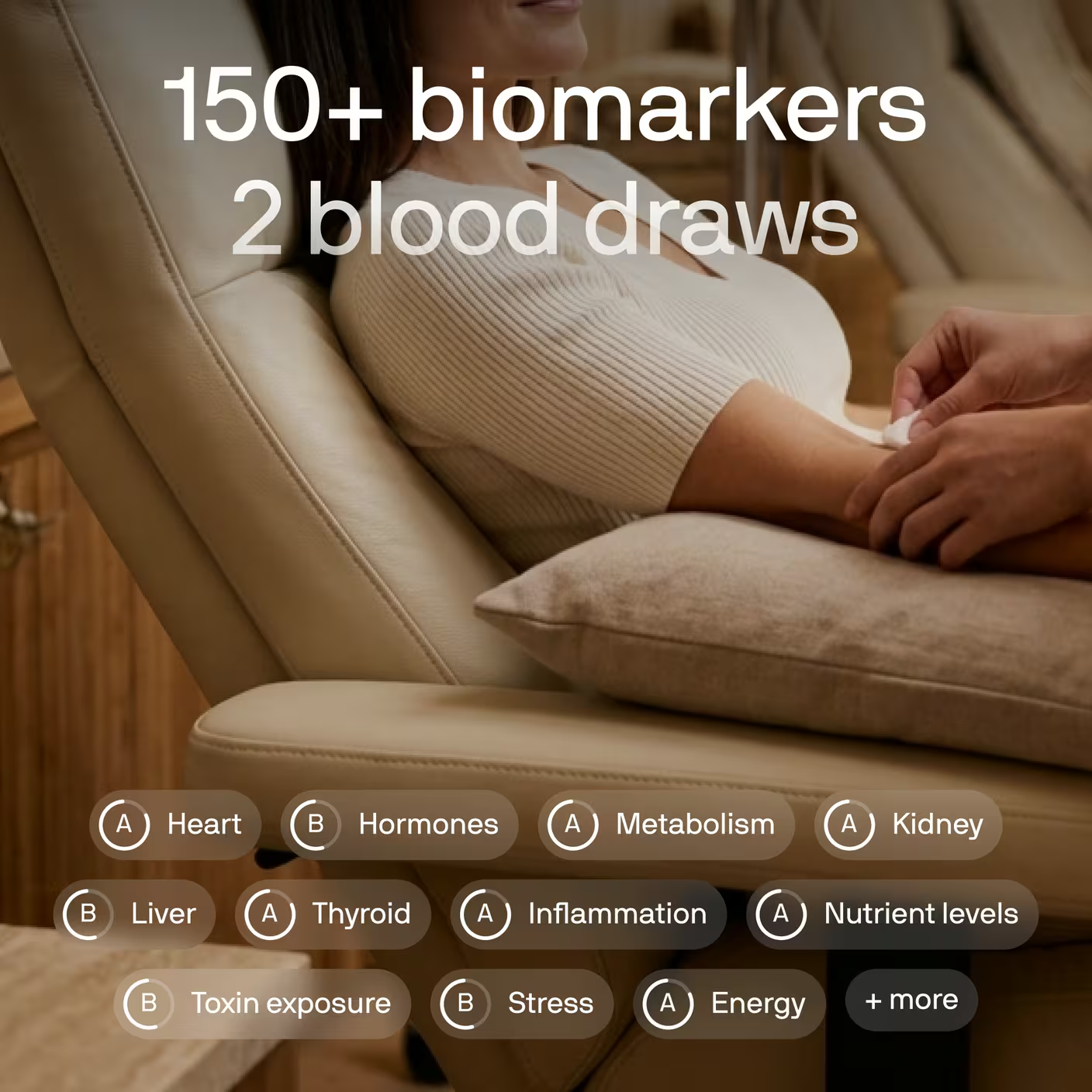
Test 150+ biomarkers
Two blood draws. A full picture of your health, explained in plain language.
Why RDW moves on a slow timeline
Red blood cells live approximately 120 days, which means RDW reflects an average of conditions over roughly four months. A retest at 8–12 weeks is generally premature unless active hematinic therapy is underway, because not enough of the old cell population will have turned over to show a meaningful shift.
For monitoring a confirmed deficiency during correction — iron repletion, for example, or B12 supplementation — a 12-week retest captures enough new-cell turnover to reveal a real trend. For general surveillance without active treatment, retesting every 6–12 months is appropriate.
Note that RDW can lag behind hemoglobin normalization: hemoglobin may recover before the full red cell population has been replaced by uniformly sized new cells. Allow the complete response window before concluding that RDW has not responded. For consistency, use the same laboratory and the same fasting conditions at each retest.
When elevated RDW warrants a closer look
RDW is included in every complete blood count, yet it is often overlooked. Tracking it over time can catch subtle shifts in nutrient status or inflammation before fatigue, weakness, or anemia appear. A persistently elevated RDW — particularly when paired with abnormal MCV, low ferritin, low B12, or elevated hs-CRP — warrants further evaluation to identify the underlying driver. High RDW accompanying chronic disease, unexplained fatigue, or abnormal bone marrow function deserves deeper clinical investigation. Never interpret RDW in isolation; it is a pattern piece, not a verdict.
A stable, low-normal RDW is a quiet hallmark of cellular stability and a signal that your metabolic foundation is strong. Superpower's comprehensive biomarker panel includes RDW alongside iron, ferritin, B12, folate, and inflammation markers — connecting the dots between nutrient metabolism and energy levels so you can see not just how healthy your blood looks, but how efficiently your body renews itself. Learn more about the approach at our manifesto.
Frequently Asked Questions
References
- Patel KV, Semba RD, Ferrucci L, Newman AB, Fried LP, Wallace RB, Bandinelli S, Phillips CS, Yu B, Connelly S, Shlipak MG, Chaves PH, Launer LJ, Ershler WB, Harris TB, Longo DL, Guralnik JM (2010). Red cell distribution width and mortality in older adults: a meta-analysis. *The journals of gerontology. Series A, Biological sciences and medical sciences*, *65*(3), 258-65. https://doi.org/10.1093/gerona/glp163
- Pilling LC, Atkins JL, Kuchel GA, Ferrucci L, Melzer D (2018). Red cell distribution width and common disease onsets in 240,477 healthy volunteers followed for up to 9 years. *PloS one*, *13*(9), e0203504. https://doi.org/10.1371/journal.pone.0203504
- Huang YL, Hu ZD, Liu SJ, Sun Y, Qin Q, Qin BD, Zhang WW, Zhang JR, Zhong RQ, Deng AM (2014). Prognostic value of red blood cell distribution width for patients with heart failure: a systematic review and meta-analysis of cohort studies. *PloS one*, *9*(8), e104861. https://doi.org/10.1371/journal.pone.0104861
- Aslan D, Gümrük F, Gürgey A, Altay C (2002). Importance of RDW value in differential diagnosis of hypochrome anemias. *American journal of hematology*, *69*(1), 31-3. https://doi.org/10.1002/ajh.10011
- Semba RD, Patel KV, Ferrucci L, Sun K, Roy CN, Guralnik JM, Fried LP (2010). Serum antioxidants and inflammation predict red cell distribution width in older women: the Women's Health and Aging Study I. *Clinical nutrition*, *29*(5), 600-4. https://doi.org/10.1016/j.clnu.2010.03.001





















 Heart & Vascular Health
 Metabolic Health
 Energy
 Liver Health
 Kidney
 Sex Hormones
 Thyroid Health
 Nutrients
 Immune System
 Inflammation