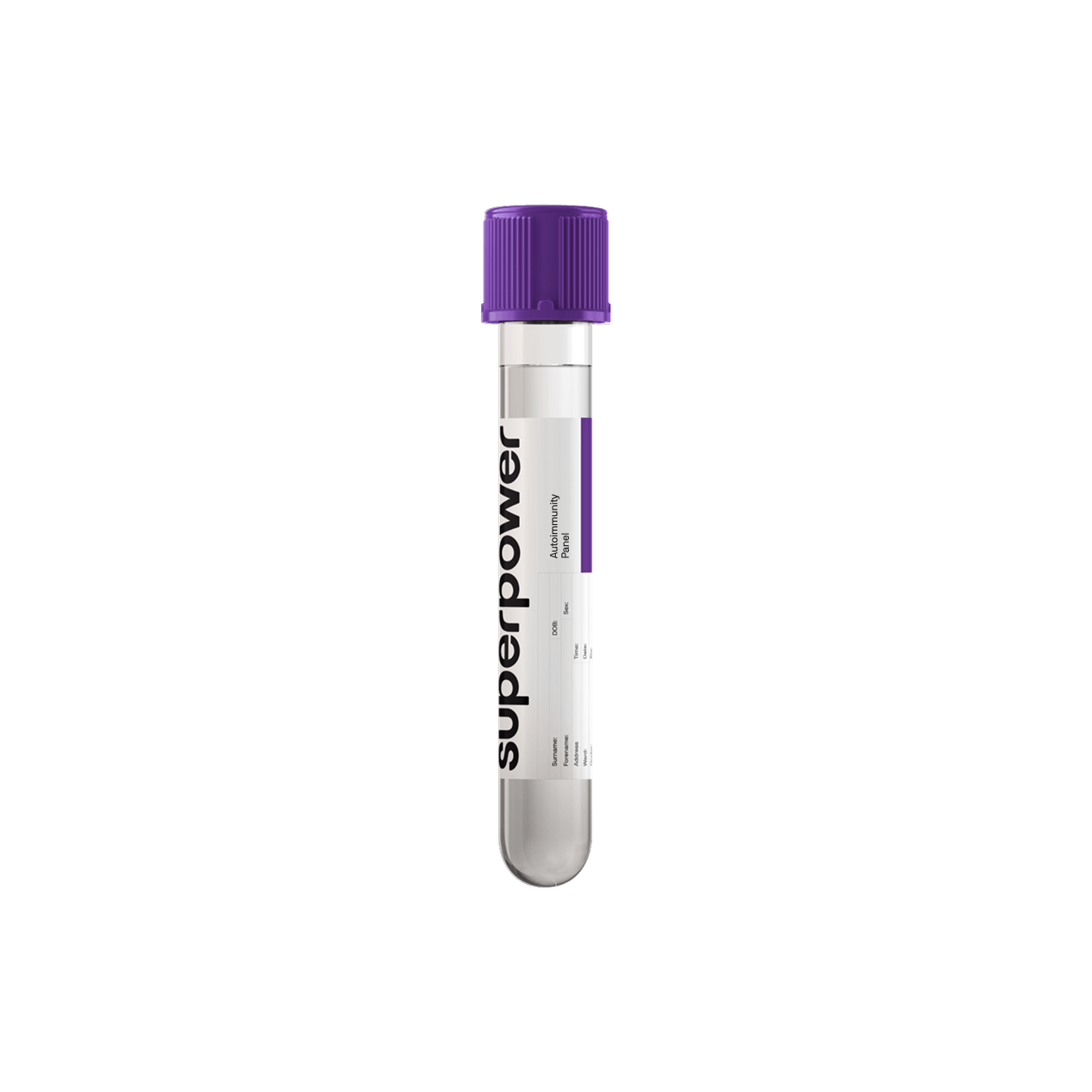
Test details
- Sample type:
- Single blood draw (blood only)
- Location:
- In-person at local lab / At-home phlebotomist visit (+$119)
- Availability:
- Available in 39 states and Washington, D.C.
- Turnaround:
- Results delivered to your dashboard within 10 days
Most thyroid testing stops at TSH, and if that number looks normal, you're told your thyroid is fine. But TSH only shows whether your brain is signaling the thyroid to work harder. It doesn't show whether your thyroid is under autoimmune attack, or whether it's converting T4 into Free T3, the active form your cells actually use. This panel checks both. It measures TPO and thyroglobulin antibodies, which are associated with autoimmune thyroid conditions including Hashimoto's thyroiditis and can be elevated for years before TSH changes, and it adds Free T3 to check hormone conversion, a step most thyroid panels skip. Measure all three, processed in a CLIA-certified lab, with results delivered to your dashboard within 10 days.
This panel screens for elevated thyroid antibodies and checks hormone conversion. It does not diagnose Hashimoto's thyroiditis, Graves' disease, or any thyroid condition.
What's tested and why it matters
TPO antibodies (quantitative)
Thyroid peroxidase is an enzyme your thyroid uses to produce hormones, and TPO antibodies are immune proteins that target it. Elevated TPO antibodies are associated with autoimmune thyroid activity, most commonly Hashimoto's thyroiditis (the most common cause of hypothyroidism) and Graves' disease in some cases. Because this is a quantitative measurement, it captures the level rather than a simple positive or negative, which is what makes tracking changes over time possible.
Thyroglobulin antibodies
Thyroglobulin is a protein your thyroid uses to store hormones, and thyroglobulin antibodies (TgAb) target it. This marker both screens for the presence of TgAb and measures its level, giving a fuller view of thyroid immune activity than a presence check alone. Some people have elevated thyroglobulin antibodies without elevated TPO antibodies, which is why measuring both alongside each other adds information that testing TPO in isolation would miss.
Free T3
Free T3 is the active, usable form of thyroid hormone. Your thyroid produces mostly T4, which has to be converted to T3 in peripheral tissues before your cells can use it. Free T3 measures how much active hormone is actually circulating, which reflects whether that conversion is producing enough usable T3. Low Free T3 alongside a normal TSH is a pattern worth discussing with a provider, and it's one a standard thyroid screen, which rarely includes Free T3, misses entirely.
Reference ranges vary by lab and individual. Your Superpower care team can help you understand your results, and your provider will interpret them in clinical context.
Who benefits from testing
- You have persistent fatigue, hair thinning, unexplained weight changes, cold sensitivity, or brain fog, symptoms commonly associated with thyroid dysfunction
- You are a woman, since women are five to eight times more likely than men to develop autoimmune thyroid conditions
- You have a first-degree family member with Hashimoto's thyroiditis, Graves' disease, or another autoimmune condition
- You already have one autoimmune condition, since having one increases the likelihood of others
- You had a TSH test come back normal but still feel something is off; antibody testing and Free T3 may reveal activity TSH alone does not capture
- You want a baseline view of your thyroid immune activity as part of a broader health picture
When TSH is normal but antibodies are elevated
A common and confusing finding is a normal TSH alongside elevated thyroid antibodies. A normal TSH means your thyroid hormone output is currently within range; elevated antibodies mean your immune system is producing proteins that target thyroid tissue. These two findings can coexist. For many people, elevated antibodies without thyroid dysfunction represent early immune activity that may or may not progress over time. Catching it at this stage establishes a baseline, prompts closer monitoring, and gives you and your provider context for ongoing thyroid health. During this window, people may experience fatigue, weight gain, hair thinning, and brain fog while being told their thyroid is fine.
Symptoms that may prompt testing
Autoimmune thyroid conditions can affect the thyroid in different directions, producing different symptom patterns.
Underactive thyroid pattern (associated with Hashimoto's): fatigue, weight gain, cold sensitivity, constipation, dry skin, hair thinning, brain fog, and a slow heart rate.
Overactive thyroid pattern (associated with Graves' disease): unexplained weight loss, rapid heartbeat, heat intolerance, tremors, anxiety, increased sweating, and frequent bowel movements. These antibodies signal general autoimmune thyroid activity; confirming Graves' specifically requires additional testing, such as TSI or TRAb, that a provider may order.
Both patterns can coexist with a normal TSH in earlier stages, which is part of why antibody testing adds useful information.
What your results reveal
Your markers work together, not in isolation. Elevated TPO or thyroglobulin antibodies may indicate that your immune system is producing proteins that target thyroid tissue, a pattern associated with autoimmune thyroid conditions. Free T3 shows whether conversion from T4 to active T3 is occurring effectively. Elevated antibodies alongside low-normal Free T3 may warrant a provider conversation about thyroid function. Elevated antibodies with normal Free T3 still has value: it establishes a baseline and may prompt closer monitoring over time. Your Superpower care team can walk you through what your results mean and when to involve a provider.
How it works
- Order online — Add the panel to your Superpower order, with no doctor's visit required.
- Get your blood drawn — At a local clinic near you, or with an optional at-home phlebotomist visit (+$119).
- Review your results in your dashboard, with your Superpower care team available to walk through them, or share your full antibody and Free T3 profile with your provider.
Frequently asked questions
Biomarkers tested
Free T3 measures the unbound, biologically active portion of circulating T3.
Learn moreMethod: FDA-cleared clinical laboratory assay performed in CLIA-certified, CAP-accredited laboratories. Used to aid clinician-directed evaluation and monitoring. Not a stand-alone diagnosis.


























 Heart & Vascular Health
 Metabolic Health
 Energy
 Liver Health
 Kidney
 Sex Hormones
 Thyroid Health
 Nutrients
 Immune System
 Inflammation