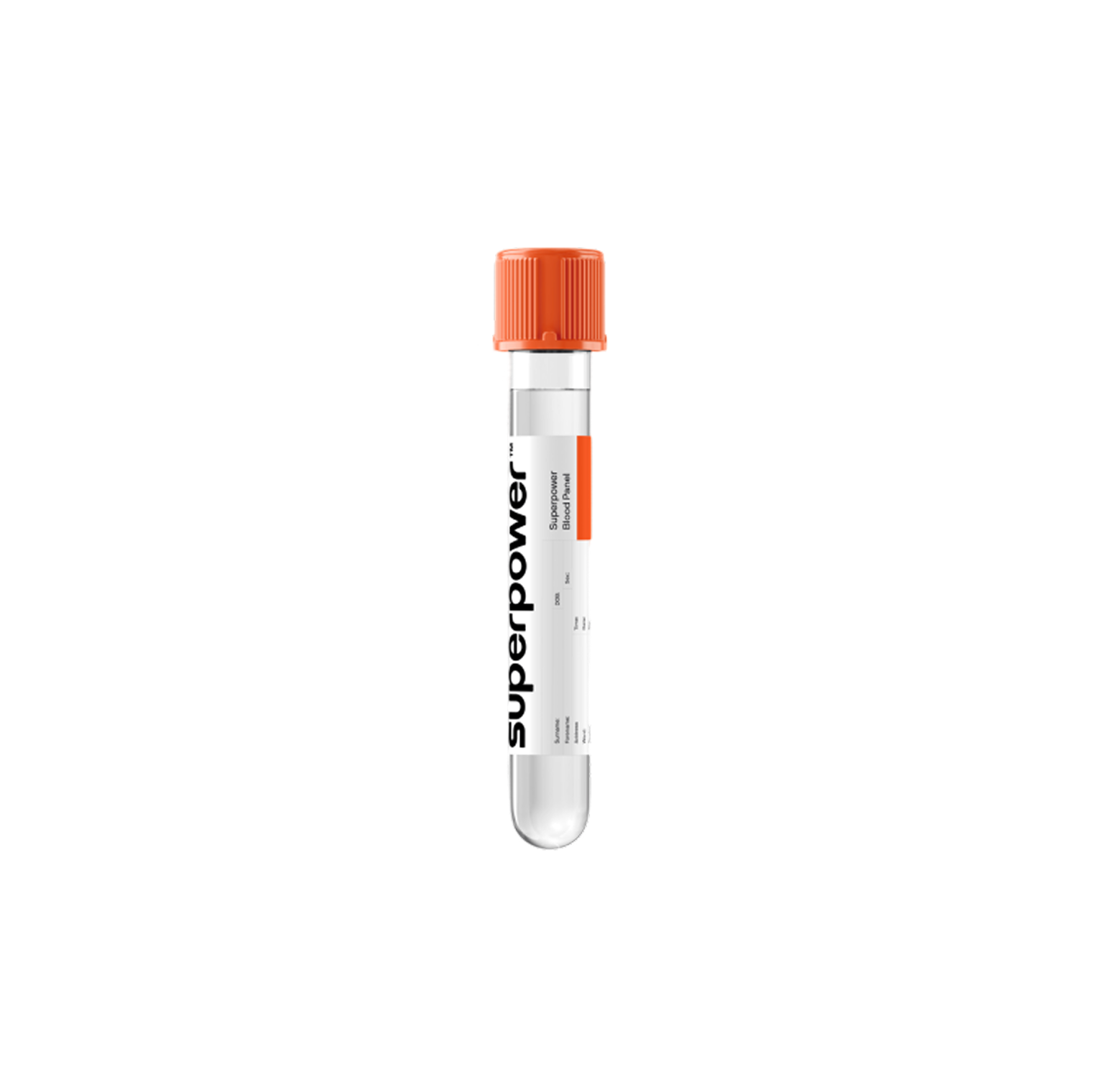
150+ biomarkers across two blood draws, the second retesting key markers. Optional at-home phlebotomist visit. Results processed in approximately 5-7 days.
In-person at local lab / At-home phlebotomist visit (+$119)
Availability:
Available in 39 states and Washington, D.C.
Turnaround:
Results processed in approximately 5-7 days
Preparation:
10-hour food and caffeine fast prior to appointmentStop taking supplements containing Biotin
About the Superpower Blood Panel
Most annual physicals check around 15 markers and tell you whether something is clearly wrong. The Superpower Blood Panel is built for a different purpose. It measures a comprehensive set of biomarkers across two blood draws and translates them into a clear picture of how your body is actually functioning right now.
Proactive testing provides targeted insight into your current health status, highlighting where function may be stronger or may need attention. You can establish a baseline or track how your body responds to your Superpower plan over time.
There is an optional at-home phlebotomist visit (+$119), and results are processed within 10 days. Every result arrives with a personalized protocol and access to your Superpower care team.
How this goes deeper than a standard checkup
This is the in-depth annual panel a routine physical is not built to be. It goes further in three areas a standard checkup usually skips.
A broader cardiovascular read — Standard panels stop at total, LDL, and HDL cholesterol. This panel adds Apolipoprotein B, the atherogenic-particle marker most basic panels omit, plus advanced lipid ratios.
A foundational hormone read — Routine physicals rarely test hormones beyond, sometimes, TSH. This covers the sex-steroid core, including testosterone, SHBG, and DHEA-S, alongside thyroid function.
Inflammation and nutrient status — Standard panels rarely include either. This adds hs-CRP, plus nutrient status through Vitamin D and the full iron panel.
How this compares to a standard blood test
A standard blood test and this panel have different goals. One is built to flag acute illness. The other is built to reveal how your body is actually functioning.
Markers tested — Roughly 15 on a standard panel, versus a far broader set here.
Cardiovascular — Basic cholesterol, versus ApoB plus advanced lipid ratios.
Hormones — Rarely included, versus the sex-steroid core plus thyroid function.
Inflammation — Usually not included, versus hs-CRP.
Nutrition — Not standard, versus Vitamin D plus the full iron panel.
Turnaround — Often 5 to 10 days, versus within 10 days.
At-home collection — Not offered, versus an optional phlebotomist visit (+$119).
Results interpretation — A report and variable follow-up, versus a personalized protocol plus care-team access.
Who benefits from testing
This panel is for people who want to understand their health from the inside, not just avoid acute illness.
Athletes and active people who want to see how training, recovery, and nutrient status show up in their blood.
Founders and professionals running on long hours who want to understand their energy, hormones, and stress at a deeper level.
People over 40 who want blood work broad enough to surface early shifts you can track and discuss with your care team.
Anyone with a family history of heart disease, diabetes, or thyroid conditions who wants a real baseline, not a guess.
Health optimizers who already track their numbers and want a deeper starting point to build from.
Anyone tired of fragmented care who wants one panel instead of separate appointments for separate tests.
No doctor's visit required. Order directly through Superpower.
What you'll learn from your results
Each biomarker is returned with context: every marker measured against its reference range, with a plain-language explanation of what it reflects. Reference ranges vary by lab and individual, so results are read in context, not in isolation.
Your results arrive alongside a personalized protocol built from the full picture, not a single flagged number. The AI-powered concierge translates the science into clear next steps, and your care team is available by text to discuss what is flagged, what is not, and what to do next.
A single panel tells you where you stand today. Retesting over time shows whether things are moving in the right direction. Results are a starting point, not a verdict.
How it works
Order online — No doctor's visit or referral needed. Your order is reviewed by a qualified provider as part of the process.
Schedule your draw — Book at a local clinic, or opt for an at-home visit from a trained phlebotomist (+$119). Samples are processed in CLIA-certified labs.
Complete your blood draws — The panel is collected across two blood draws: a first draw covering the full panel, and a second draw that retests key markers. Bring your prep checklist.
Receive your results — Results are ready within 10 days, with a personalized protocol and access to your Superpower care team and AI by text.
Frequently asked questions
The Superpower Blood Panel measures a comprehensive set of biomarkers across two blood draws, spanning heart, metabolic, liver, kidney, hormone, immune, inflammation, nutrition, and thyroid function. It includes everything in a standard comprehensive metabolic panel and CBC, plus ApoB, advanced lipid ratios, a foundational hormone set, hs-CRP, and micronutrient status that routine panels skip.
The first draw covers the full panel, including CBC, metabolic, lipid, hormone, and inflammation markers, plus a urinalysis panel. The second draw retests a subset of those markers: CBC, Comprehensive Metabolic Panel, Lipid Panel, Hemoglobin A1c, urinalysis, and hs-CRP.
A standard test checks around 15 markers and is designed to flag acute illness. This panel reads far more to reveal early patterns and areas for improvement across every major system, adding hormones, inflammation markers, and micronutrients a standard physical rarely includes.
Yes. Fast for 10 hours before your appointment. Water is fine, but skip food and caffeine. Fasting ensures accurate glucose and lipid readings.
Yes. You can book an at-home visit from a trained phlebotomist (+$119) who comes to you, or a draw at a local partner clinic. This is a blood panel, so the at-home option covers the blood draws only.
Yes. All Superpower panels are processed through CLIA-certified labs, the same certification standard used by hospital and physician-ordered testing.
Results are processed within 10 days. You receive a detailed report, a personalized protocol, and access to your care team through the Superpower platform.
Stop biotin-containing supplements, such as multivitamins, B-complex, and hair, skin, and nail formulas, before your draw, as biotin can affect certain assays. Continue all prescribed medications as normal.
Lab testing is generally eligible for HSA and FSA reimbursement. Check your specific plan for confirmation and save your receipt.
Annual testing is the standard recommendation for a healthy baseline. If you are tracking a specific change, such as a new diet, medication, or supplement, retesting at 3 to 6 months gives you meaningful trend data.
This panel is processed by Quest Diagnostics and available in 39 states and Washington, D.C. It is not offered in New York or New Jersey; residents of those states are served by the BioReference variant of this panel.
Available in:
Alabama
Arizona
California
Colorado
Connecticut
Delaware
Florida
Georgia
Idaho
Illinois
Indiana
Iowa
Kansas
Kentucky
Maine
Maryland
Massachusetts
Michigan
Minnesota
Missouri
Montana
Nebraska
Nevada
New Hampshire
New Mexico
North Carolina
Ohio
Oklahoma
Oregon
Pennsylvania
South Carolina
Tennessee
Texas
Utah
Vermont
Virginia
Washington
Washington, D.C.
West Virginia
Wisconsin
Biomarkers tested — First draw
Vitamin D is an essential and multifunctional micronutrient.
Method: Usually performed by FDA-cleared immunoassay in CLIA-certified, CAP-accredited laboratories. If an LC/MS method is used at the performing site, the assay is a laboratory-developed test (LDT) validated under CLIA and not cleared or approved by the FDA. Results support clinician interpretation and are not a stand-alone diagnosis.
Albumin is a transport protein produced by the liver. Globulins are a type of protein that is made by the liver and the immune system. The amount of albumin and globulins can be affected by a number of things, including infections, kidney or liver disease, or even dietary protein intake.
Method: Derived from FDA-cleared laboratory results. This ratio/index is not an FDA-cleared test. It aids clinician-directed risk assessment and monitoring and is not a stand-alone diagnosis. Inputs: albumin, globulin.
Albumin is a protein made by the liver that has many functions in the body, such as maintaining fluid balance, transporting substances including hormones and vitamins, regulating blood pressure, preventing blood clotting, and providing nutrition.
Method: FDA-cleared clinical laboratory assay performed in CLIA-certified, CAP-accredited laboratories. Used to aid clinician-directed evaluation and monitoring. Not a stand-alone diagnosis.
ALP is an enzyme that is found in various tissues, mainly in the liver and bone.
Method: FDA-cleared clinical laboratory assay performed in CLIA-certified, CAP-accredited laboratories. Used to aid clinician-directed evaluation and monitoring. Not a stand-alone diagnosis.
ALT is an enzyme that is mainly found in the liver cells and helps break down proteins and amino acids.
Method: FDA-cleared clinical laboratory assay performed in CLIA-certified, CAP-accredited laboratories. Used to aid clinician-directed evaluation and monitoring. Not a stand-alone diagnosis.
Apolipoprotein B (ApoB) is a protein that has many functions in the body, such as transporting lipids (fats), regulating cholesterol metabolism, maintaining blood vessel integrity, and modulating immune responses.
Method: FDA-cleared clinical laboratory assay performed in CLIA-certified, CAP-accredited laboratories. Used to aid clinician-directed evaluation and monitoring. Not a stand-alone diagnosis.
Biomarkers tested — Second draw
Albumin is a transport protein produced by the liver. Globulins are a type of protein that is made by the liver and the immune system. The amount of albumin and globulins can be affected by a number of things, including infections, kidney or liver disease, or even dietary protein intake.
Method: Derived from FDA-cleared laboratory results. This ratio/index is not an FDA-cleared test. It aids clinician-directed risk assessment and monitoring and is not a stand-alone diagnosis. Inputs: albumin, globulin.
Albumin is a protein made by the liver that has many functions in the body, such as maintaining fluid balance, transporting substances including hormones and vitamins, regulating blood pressure, preventing blood clotting, and providing nutrition.
Method: FDA-cleared clinical laboratory assay performed in CLIA-certified, CAP-accredited laboratories. Used to aid clinician-directed evaluation and monitoring. Not a stand-alone diagnosis.
ALP is an enzyme that is found in various tissues, mainly in the liver and bone.
Method: FDA-cleared clinical laboratory assay performed in CLIA-certified, CAP-accredited laboratories. Used to aid clinician-directed evaluation and monitoring. Not a stand-alone diagnosis.
ALT is an enzyme that is mainly found in the liver cells and helps break down proteins and amino acids.
Method: FDA-cleared clinical laboratory assay performed in CLIA-certified, CAP-accredited laboratories. Used to aid clinician-directed evaluation and monitoring. Not a stand-alone diagnosis.
Urine appearance describes the visual clarity of urine and reflects the presence or absence of suspended particles such as cells, bacteria, proteins, crystals, or mucus.
Aspartate aminotransferase (AST) is an enzyme that helps break down amino acids and is found in various tissues, such as the liver, heart, muscles, kidneys, and brain.
Method: FDA-cleared clinical laboratory assay performed in CLIA-certified, CAP-accredited laboratories. Used to aid clinician-directed evaluation and monitoring. Not a stand-alone diagnosis.
Superpower member survey, 90 days post action plan (n=143).
How does the Superpower membership work?
+
We test 150+ biomarkers annually across two blood draws. Your baseline test paints a comprehensive picture of your health, and your dashboard shows what’s working, what needs attention, and what to do next. Superpower AI and your care team help you take action across lifestyle, supplements, and treatments. Then we retest to track your progress and continue refining your plan.
Can I cancel anytime?
+
Yes. You can cancel anytime, no fees. Your membership stays active through the end of your paid year.
How often should I test?
+
Your membership includes two blood tests per year: one to establish your baseline, and one to see whether your plan improved biomarkers that were out of range or not yet optimized. You can add other diagnostics anytime through the app or with help from your care team.
When will I get my results?
+
Book your draw at any of 2,000+ partner labs or at-home. Results are typically ready in about a week and land in the Superpower app.
What the 100+ panel measures
All 101 markers in your annual baseline draw, organized by system. Nothing here is an upsell.
Heart & Vascular Health
26
Apolipoprotein B
Atherogenic Coefficient
Atherogenic Index of Plasma
Castelli Risk Index I
Castelli Risk Index II
HDL Cholesterol
LDL Cholesterol
LDL/HDL Ratio
Cholesterol, Total
Non-HDL Cholesterol
Cholesterol/HDL Ratio
Carbon Dioxide, Total
High-sensitivity CRP
hsCRP-to-Albumin Ratio (CAR)
GGT-to-HDL Cholesterol Ratio
LDL-C to Apolipoprotein B Ratio (LDL-C/ApoB)
LDL Cholesterol / Total Cholesterol (Mass Ratio)
Monocyte-to-HDL Ratio (MHR)
Neutrophil-to-HDL Cholesterol Ratio (NHR)
Non-HDL Cholesterol-to-Apolipoprotein B Ratio (Non-HDL-C/ApoB)


























 Heart & Vascular Health
 Metabolic Health
 Energy
 Liver Health
 Kidney
 Sex Hormones
 Thyroid Health
 Nutrients
 Immune System
 Inflammation