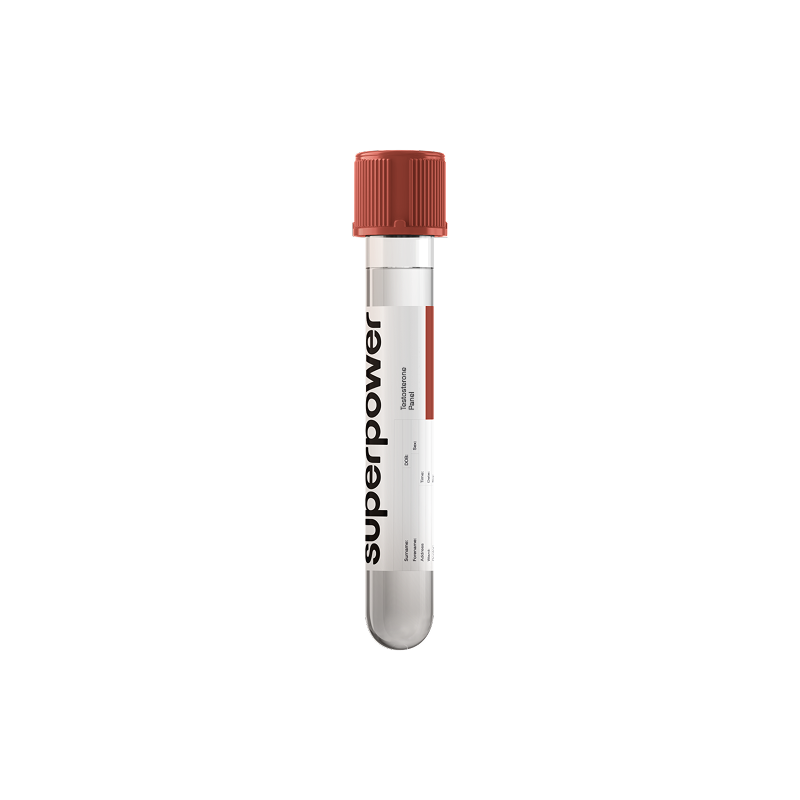
Test details
- Sample type:
- Single blood draw (blood only)
- Location:
- In-person at local lab / At-home phlebotomist visit (+$119)
- Availability:
- Available in 39 states and Washington, D.C.
- Turnaround:
- Results typically available within 10 days
- Preparation:
- Fast for 10 hours before your appointment; water is fine
About the Extended Men's Health Bundle
The Extended Men's Health Bundle combines three groups of markers in one blood draw: the prostate markers, the androgen dihydrotestosterone, and the pituitary and growth-hormone markers. These are markers ordered together as a set, not a single score, and each one comes back with its own result.
The bundle can be added to a baseline blood panel or ordered on its own. It is built for someone who already holds a testosterone number and wants the markers sitting either side of it.
What this panel measures
The markers fall into three groups: prostate, androgen, and pituitary and growth hormone. Together they cover total PSA, dihydrotestosterone, IGF-1, and prolactin.
| Marker | What it reflects |
|---|---|
| Prostate Specific Antigen (PSA) | The total amount of prostate-specific antigen circulating in blood, a protein made by prostate cells. What most people mean by a PSA test. |
| Dihydrotestosterone | DHT, the androgen the body converts testosterone into. |
| Insulin-like Growth Factor 1 (IGF-1) | The circulating marker of growth-hormone activity, and what an IGF-1 test reports. |
| Prolactin | A hormone released by the pituitary gland. |
The androgen here is dihydrotestosterone. This bundle does not return a total or free testosterone concentration, and it does not include LH, FSH, or estradiol.
DHT is the androgen this bundle measures, not testosterone
Dihydrotestosterone is the androgen the body makes from testosterone through the enzyme 5-alpha-reductase, and it is the more potent of the two androgens.
Two men with the same total testosterone may convert it at different rates. A dihydrotestosterone result reports the more potent androgen itself, rather than the raw material it came from.
A total or free testosterone figure comes from elsewhere. The baseline blood panel measures total testosterone alongside SHBG, which is why this bundle covers the markers that result does not.
Not every marker here is a hormone marker.
Why a prostate marker sits alongside the hormone markers
PSA is a protein produced by cells of the prostate gland.
A raised PSA has several possible explanations, and benign ones are common: an enlarged prostate, or inflammation of the gland. No single threshold separates a normal PSA from one worth a closer look, and values tend to rise with age.
A PSA result is read alongside your history and clinical context, never on its own. That reading belongs with your provider.
Above both the androgen and the prostate markers sit the pituitary signals that set their pace.
The pituitary and growth-hormone markers
IGF-1 is the circulating marker used to read growth-hormone activity, and its reference values are age- and sex-specific because IGF-1 falls across adult life.
Prolactin is a pituitary hormone, and it is an unexpected entry on a men's panel. A raised prolactin is associated with suppression of the signals that drive testosterone, which is what earns it a place here.
Together the three groups answer one question rather than three, which suits a particular kind of reader.
Who benefits from testing
These are situations people recognize rather than a rule about who should test. Whether this bundle makes sense for you is a conversation with your care team or your provider.
- You are already running a baseline panel and want the prostate, androgen, and pituitary markers alongside it.
- Your testosterone result came back unremarkable and the questions that prompted it did not go away.
- You would rather track these markers across draws than read a single snapshot.
- A clinician has asked about the growth-hormone axis, or about your prostate markers.
Whichever of those fits, the draw gives back the same thing: named markers with their own numbers.
What your results reveal
Your Extended Men's Health Bundle report lists each marker by name with its own result and reference interval.
Results appear in your Superpower dashboard once the panel is finalized. A few of these markers also move with what happens in the days before the draw.
Reference ranges vary by lab and individual. Discuss your specific results with your provider; your Superpower care team is available on demand for questions.
How to prepare
The draw comes with a short preparation list, and your appointment reminder carries the full version.
- Fast for 10 hours beforehand, water only, and skip caffeine that morning.
- Avoid alcohol and heavy fatty meals the day before, and hydrate well.
- Pause supplements for 72 hours, and keep taking prescribed medicines unless the prescribing clinician advises otherwise. Some prescribed medicines can affect a PSA result, so raise medicine questions with your care team first.
- Skip strenuous exercise for 48 hours, since vigorous activity shortly before a draw can raise a PSA result temporarily.
How it works
From order to results in your dashboard, the bundle runs in three steps.
- Order online — Take the bundle on its own, or add it to a baseline blood panel.
- Book the blood draw — Choose an in-lab appointment or an at-home phlebotomist visit.
- Review your results — Each marker arrives in your Superpower dashboard with its reference interval in about 10 days. Partial results are not shown before the panel is finalized, and your care team is available for questions.
Frequently asked questions
Biomarkers tested
Free PSA is the portion of PSA not bound to proteins.
Learn moreMethod: FDA-cleared clinical laboratory assay performed in CLIA-certified, CAP-accredited laboratories. Used to aid clinician-directed evaluation and monitoring. Not a stand-alone diagnosis.


























 Heart & Vascular Health
 Metabolic Health
 Energy
 Liver Health
 Kidney
 Sex Hormones
 Thyroid Health
 Nutrients
 Immune System
 Inflammation