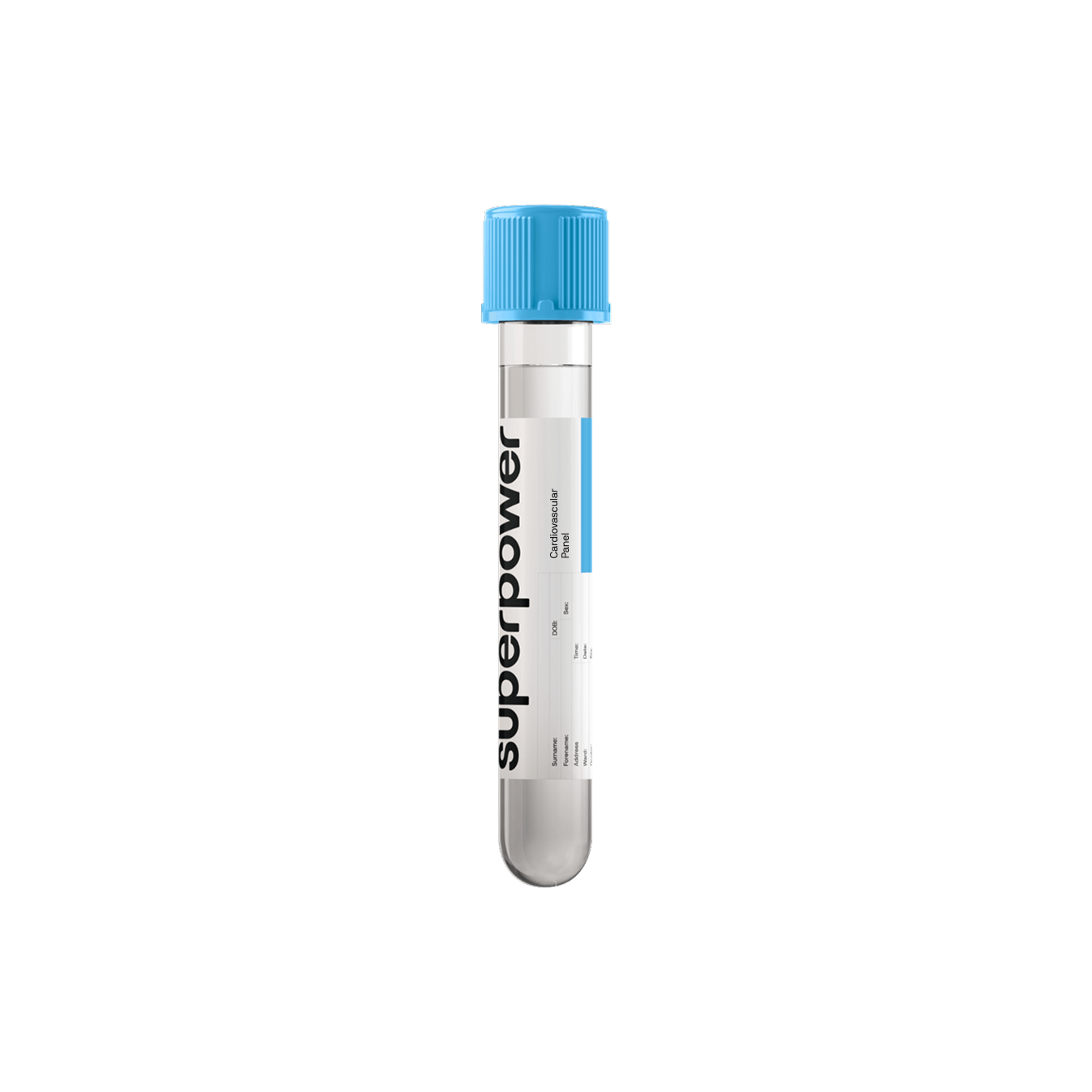
Test details
- Sample type:
- Single blood draw (blood only)
- Location:
- In-person at local lab / At-home phlebotomist visit (+$119)
- Availability:
- Available in 39 states and Washington, D.C.
- Turnaround:
- Results processed within 10 days
- Preparation:
- Fast for 10 hours before your draw (water is fine)Avoid alcohol and heavy meals the day before
About the Extended Heart Health Bundle
The Extended Heart Health Bundle is an add-on bundle of cardiovascular tests that measures lipoprotein(a) and oxidized LDL from a single blood draw.
Two things sit behind those markers: inherited cholesterol-particle risk and oxidative damage to the LDL already in circulation. The bundle runs alongside routine cholesterol testing rather than replacing it, because Lp(a) remains a risk factor when LDL is lowered. Oxidized LDL, or OxLDL, describes the same particles your lipid panel already counts, in a chemically modified form.
Each answers a different question about the same arteries.
What this panel measures
This bundle reports a deliberately small set of cardiovascular markers that a routine lipid panel does not carry.
| Marker | What it reflects |
|---|---|
| Lipoprotein (a) | A cholesterol-carrying particle, set largely by inheritance, associated with atherogenesis, inflammation, and thrombosis |
| Oxidized LDL | The share of LDL modified by oxidation, whose atherogenic potential may be key in the onset and progression of atherosclerosis |
Together they cover inherited particle risk and oxidative damage.
Where a standard cholesterol panel stops
A routine lipid panel measures how much cholesterol is being carried. These markers describe something else: what kind of particle is carrying it and whether that particle has been modified by oxidation. Cardiovascular risk remains after LDL cholesterol has been reduced, and that remaining margin is where these markers sit.
The inherited part of the gap is lipoprotein(a), which a standard lipid panel does not report. High Lp(a) is an independent and causal risk factor for atherosclerotic cardiovascular disease, so ordinary cholesterol results can read unremarkable while this particle runs high.
None of this is a verdict on anyone's risk. These are measurements that add information to a cardiovascular assessment, read with your provider against your history, your blood pressure, and the rest of your lipid picture.
Inherited risk and oxidative damage are different signals
One of these markers is set largely before birth, and the other tracks something happening now, which changes how each result gets used.
| Marker | What drives it | What a repeat test adds |
|---|---|---|
| Lipoprotein (a) | More than 90% genetically determined | Little; one lifetime measurement generally stands |
| Oxidized LDL | Ongoing oxidative modification of LDL | A current reading; cadence is set with a clinician |
No target values or cutoffs appear on this page. Lp(a) assays are not yet standardized or harmonized, so any single number is read against the assay that produced it and the rest of your record.
Who benefits from testing
This bundle is built for adults who want the cardiovascular picture their routine cholesterol results leave out. People at higher cardiovascular risk are advised to have lipoprotein(a) measured once in their lifetime, and a standard panel is not where that happens.
- Heart disease or stroke runs in your family, particularly early
- Your cholesterol came back normal and still left the question open
- You have a personal or family history of high cholesterol
- You already follow a heart-health plan and want to track it more precisely
- You have never had inherited particle risk measured
What arrives in the report is narrower and more specific than a lipid panel.
What your results reveal
Each marker is reported with its measured value in your Superpower dashboard, roughly 10 days after the blood draw. The completed panel appears once it is finalized, rather than marker by marker.
The two read together rather than one at a time. The inherited marker speaks to baseline risk that the rest of your cholesterol numbers do not carry. A raised oxidized LDL points at the oxidative side of the same problem, since elevated OxLDL is recognized as a marker of increased cardiovascular risk.
Interpretation and any next step sit with your own provider and your Superpower care team, who can walk through what each marker means alongside your other results.
Reference ranges vary by lab and individual. Your Superpower care team and your provider can help you interpret your specific results in context.
How to prepare
Preparation is the standard blood-draw routine, and it matters most for the lipid markers.
- Fast for 10 hours beforehand, water only
- Skip caffeine, and hydrate well
- Avoid alcohol and heavy, fatty meals the day before
- Pause supplements for 72 hours
- Avoid strenuous exercise for 48 hours
- Keep taking prescribed medicines unless the prescribing clinician advises otherwise
Anyone with a cold, flu, or fever before the appointment should reschedule. Questions about a medication, supplement, or fasting conflict go to your care team before the draw.
How it works
- Order online — Active members can add this bundle to their membership, independently of baseline or retest scheduling.
- Give your sample — Visit a local lab, or book an at-home phlebotomist visit, following the fasting instructions.
- Review your results — They appear in your Superpower dashboard roughly 10 days after the draw, with your care team available for questions.
Frequently asked questions
Biomarkers tested
Asymmetric dimethylarginine (ADMA) is a small molecule that comes from the normal breakdown of proteins in the body.
Learn moreMethod: Laboratory-developed test (LDT) validated under CLIA; not cleared or approved by the FDA. Results are interpreted by clinicians in context and are not a stand-alone diagnosis.


























 Heart & Vascular Health
 Metabolic Health
 Energy
 Liver Health
 Kidney
 Sex Hormones
 Thyroid Health
 Nutrients
 Immune System
 Inflammation