Test details
- Sample type:
- DEXA scan (no blood draw)
- Location:
- In-person at a partner facility
- Availability:
- Available in 41 states and Washington, D.C.
- Turnaround:
- Results typically available within two business days
- Preparation:
- No food for two to four hours beforehandWear clothing without metal, and remove jewelry and watches
About the DEXA Body Composition scan
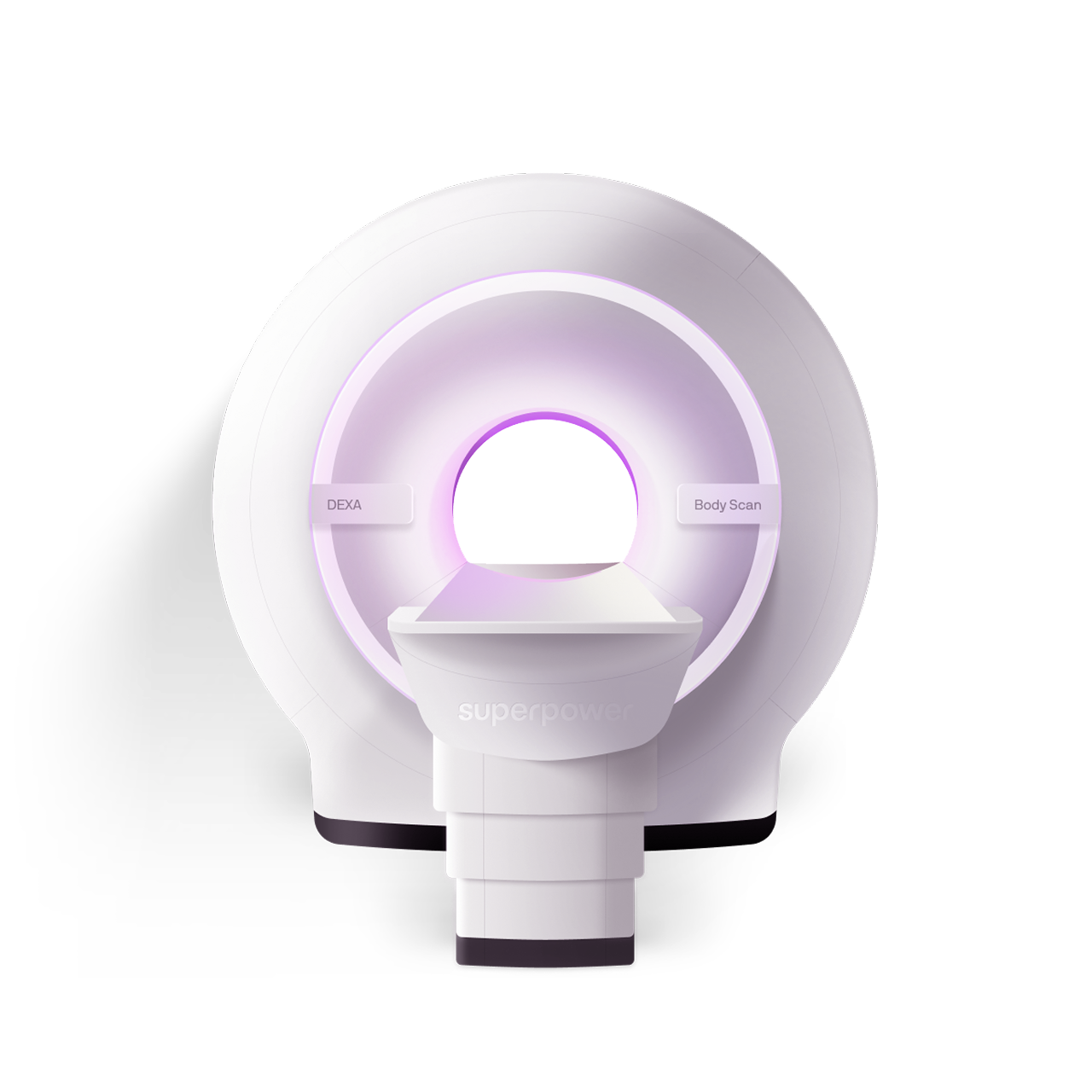
DEXA stands for dual-energy X-ray absorptiometry, sometimes written DXA. The scan sends two X-ray beams at different energy levels through the body to separate fat, lean tissue, and bone. Your weight comes back split into the compartments it is made of, rather than as a single number.
The DEXA Body Composition scan is an in-person appointment rather than a blood draw. You lie still on an open table for roughly ten minutes while the scanner arm passes above you. There is no enclosed tube and no injection.
What this panel measures
Eleven measures come back from one pass of the scanner. The same image that produces a whole-body figure also derives android, gynoid, and visceral indices.
| Measure | What it reflects |
|---|---|
| Body Fat Percentage | The share of your total mass that is fat tissue |
| Body Fat Percentile | Where that share sits against a reference population of your age and sex |
| Lean Mass Percentage | The share that is lean tissue, which includes muscle, organs, and water rather than muscle alone |
| Android Fat Percentage | Fat carried in the android region, meaning the abdomen |
| Android Lean Percentage | Lean tissue carried in that same abdominal region |
| Gynoid Fat Percentage | Fat carried in the gynoid region, meaning the hips and thighs |
| Visceral Adipose Tissue Mass | The weight of the deep fat stored around your organs |
| Visceral Adipose Tissue Volume | The space that same deep abdominal fat occupies |
| Total Body BMD | Bone mineral density measured across the whole skeleton |
| Total Body BMD Percentile | Where that density sits against a reference population |
| Z-Score | Your bone density expressed as a comparison with peers |
What a scan shows that BMI and a smart scale cannot
Body mass index is arithmetic rather than measurement. It takes height and weight and cannot tell fat from lean tissue. Two people at the same index can be built very differently. The distinction is worth having, because abdominal fat carries risk independent of body mass index.
- A scale gives you one number for everything you are carrying. A scan gives you fat, lean tissue, and bone as separate figures.
- An impedance scale estimates composition from a signal passed through the body. Its readings track the scan at group level, while individual results do not line up.
- The scan also splits fat by region, giving separate figures for the abdomen, the hips and thighs, and the fat held deep around your organs.
Body composition scan or bone density scan: which one this is
This is the body composition scan. It reports total-body bone mineral density, a percentile for that density, and a Z-score. It stops there: no hip or spine measurements, no T-score, and no fracture-risk estimate. The two scores answer different questions. A Z-score compares you with people of your age, sex, and ethnicity. A T-score instead compares you against a healthy young adult, and is the score used in osteoporosis assessment. Arrived with a bone-health question? The DEXA bone density scan is the product built to answer it.
Who benefits from testing
Body composition is most useful to someone with a reason to watch it change:
- You want a baseline beyond scale weight, and a starting set of figures to measure later ones against.
- You are partway through a nutrition or training plan, and want to see which compartment is moving.
- You are losing weight — Lean tissue comes off alongside fat during calorie restriction, and adding resistance exercise attenuates that loss.
- You care where fat sits, not only how much of it there is.
- Your weight has been stable for years, which can still hide a slow trade of lean tissue for fat.
- You want figures to bring to a conversation with your provider or a qualified professional.
What your results reveal
Your report speaks in three kinds of number. A percentage is a share of your total mass, so fat and lean figures always read against the whole. A percentile places your value beside a reference population of the same age and sex. A Z-score does the same kind of work for bone. It compares density with others of your age rather than with a young-adult standard.
Regional and visceral figures are reported separately from total fat for a reason. The android region is your abdomen, the gynoid region your hips and thighs. Visceral adipose tissue estimates the fat around your internal organs, associated with poor cardiovascular outcomes independently of overall size. Those numbers describe distribution, not a stand-alone diagnosis. Bring them to your provider or your Superpower care team alongside the rest of your history.
Reference ranges vary by lab and individual. Your Superpower care team and your provider can help you interpret your specific results in context.
How to prepare
A short screening step clears you first. The rest of the preparation keeps your figures comparable, both to the reference population and to your own next scan.
- Skip food for two to four hours beforehand.
- Drink water as you normally would, without loading up immediately before the appointment.
- Leave out intense exercise, saunas, and steam rooms for the twelve hours before.
- Wear comfortable clothing with no metal or hard plastic, and take off jewelry, watches, and hair clips.
- For a repeat scan, hold time of day, clothing, food, and water intake steady.
- Pregnancy, or any chance of it, means the scan cannot go ahead.
- A barium exam or a contrast or radioisotope injection in the previous seven days means waiting until that window passes.
- Metal implants are disclosed during screening for partner physician review, and are not an automatic exclusion.
How it works
Three steps, from checkout to the numbers in your app.
- Order online — Choose the scan and a location, answer the screening questions, give radiation-acknowledgment consent, and pick a time slot. A partner physician reviews your answers and confirms the appointment, usually within a couple of hours and up to forty-eight hours.
- Attend your appointment — Bring photo ID, arrive a few minutes early, and lie still on the open table while the scanner passes over you.
- Review your results — They arrive in the Superpower app within two business days, with the option of a free call with a partner physician to walk through the numbers.
Frequently asked questions
Biomarkers tested
Android fat percentage is the share of the tissue in the android region — around the middle / abdomen (an apple-shaped pattern) — that is fat.
Learn moreMethod: Dual-energy X-ray absorptiometry (DEXA), performed by Fitnescity for personal wellness only and not for use in diagnosing illness or disease. Results are not a stand-alone diagnosis.


























 Heart & Vascular Health
 Metabolic Health
 Energy
 Liver Health
 Kidney
 Sex Hormones
 Thyroid Health
 Nutrients
 Immune System
 Inflammation