Test details
- Sample type:
- Low-dose DEXA scan of the hip and lumbar spine (no blood draw)
- Location:
- In-person at a partner facility
- Availability:
- Available in 41 states and Washington, D.C.
- Turnaround:
- Results typically available within two business days
- Preparation:
- Avoid eating for two to four hours beforehand; drink water normallyWear clothing with no metal or hard plastic, and remove jewelry
About the DEXA Bone Density scan
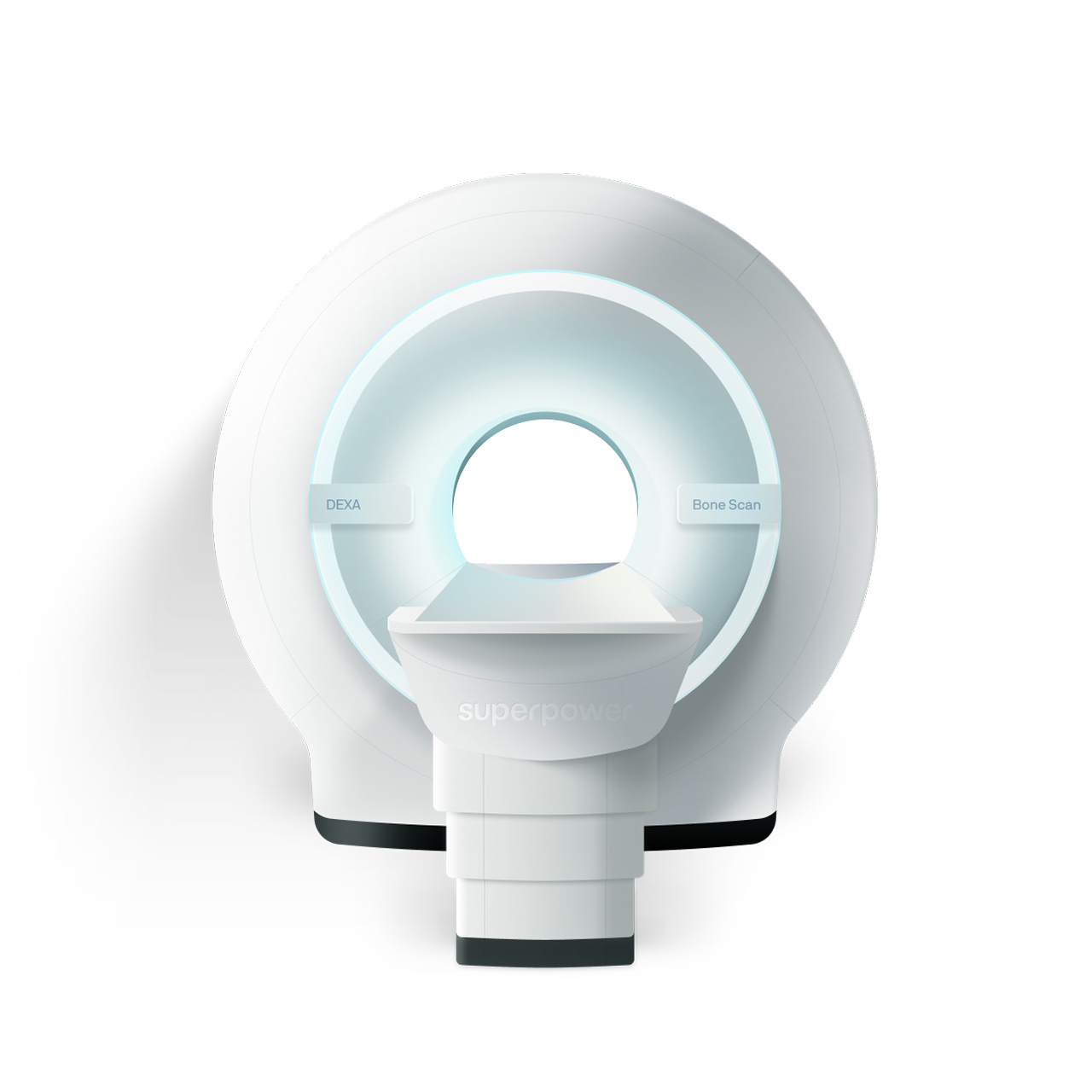
DEXA Bone Density is a low-dose, dual-energy X-ray scan of the hip and lumbar spine. It measures how much mineral is packed into bone. The report returns density at each site, plus comparisons against a young-adult and an age-matched reference. It also returns bone-health percentiles and your estimated chance of fracture over 10 years.
The scan, also known as a DXA, takes about 10 minutes on an open table at an in-person appointment. Results arrive in the Superpower app within two business days.
What this panel measures
One scan of the hip and lumbar spine produces 29 results. They fall into four kinds of information about your skeleton.
| Group | Results included | What it reflects |
|---|---|---|
| Overall density and percentiles | Bone Mineral Density, BMD Percentile, Bone Health Percentile, Z-Score | How much mineral is packed into the bone measured, and where that sits against a reference group |
| Lumbar spine, vertebra by vertebra | Lumbar L1 BMD, Lumbar L1 T-Score, Lumbar L1 Z-Score, Lumbar L2 BMD, Lumbar L2 T-Score, Lumbar L2 Z-Score, Lumbar L3 BMD, Lumbar L3 T-Score, Lumbar L3 Z-Score, Lumbar L4 BMD, Lumbar L4 T-Score, Lumbar L4 Z-Score, Lumbar Spine Total T-Score, Lumbar Spine Total Z-Score | Density at each lumbar vertebra separately, and across the spine as a whole |
| Hip and femoral neck | Total Hip BMD, Total Hip T-Score, Total Hip Z-Score, Femoral Neck BMD, Femoral Neck T-Score, Femoral Neck Z-Score, Neck Total BMD, Neck Total T-Score, Neck Total Z-Score | Density at the hip sites, measured separately from the spine |
| 10-year fracture-risk estimates | FRAX Major Osteoporotic Fracture Risk, FRAX Hip Fracture Risk | A calculated estimate built from density plus personal risk factors, not a measured value |
Density itself is reported in grams per square centimeter.
T-scores, Z-scores, and FRAX: what each number compares you to
Only one kind of number in the report is measured — density itself — and the rest are comparisons built from it. The T-score compares density with a healthy young adult at peak bone mass. It is the result reported for postmenopausal women and men 50 and older. The Z-score compares density with an age-, sex-, and ethnicity-matched average. That is the result reported for premenopausal women and men under 50.
| Result type | Compared against | What it is |
|---|---|---|
| T-score | A healthy young adult at peak bone mass | A standardized comparison, reported for postmenopausal women and men 50 and older |
| Z-score | Others of the same age, sex, and ethnicity | A standardized comparison, reported for premenopausal women and men under 50 |
| FRAX | Your own density plus your personal risk factors | An estimate of fracture chance over the next 10 years, not a measurement |
FRAX takes the measured density and combines it with age, sex, height, weight, and a short set of clinical questions. From those it estimates your chance of fracture over the next decade. An estimate is a probability, not a forecast that a break will happen.
This is the bone scan, not the body composition scan
Two different scans are sold as a DEXA, and they answer different questions. This is the bone scan. It measures bone mineral density at the hip and lumbar spine. Back come density values, T-scores, Z-scores, percentiles, and two 10-year fracture-risk estimates.
It does not return body-fat percentage, regional lean mass, or visceral fat. Those belong to DEXA Body Composition, a separate scan. Worth confirming which scan you booked before looking for results this one does not return.
Radiation dose, and what screening asks about
Two low-level X-ray beams pass through the body during the scan. The exposure is far less than a cross-country airplane flight. You acknowledge the dose on the consent form, alongside a short screening questionnaire, before the appointment is confirmed.
- Pregnancy — Anyone who is or may be pregnant does not have a bone density scan.
- Recent contrast — A barium exam, or a contrast or radioisotope injection, within seven days of the appointment means rebooking once that window has passed.
- Metal implants — Implants are disclosed during screening and reviewed by a physician, and they do not automatically rule out a scan.
All three are settled during screening, so nothing is discovered on the day.
Who benefits from testing
Bone loss is quiet. There are typically no symptoms until a bone breaks. Osteoporosis is the major cause of fractures in postmenopausal women and older men. Certain situations bring people to a scan sooner:
- A parent with osteoporosis or a hip fracture, which raises your own risk.
- Menopause or another hormone transition, including low estrogen or low testosterone.
- A bone broken after age 50, at any site.
- Long-term use of medicines that can affect bone density, such as corticosteroids.
- No particular concern at all, and a wish for a baseline that later scans can be measured against.
What your results reveal
Your report shows measured density at each lumbar vertebra and hip site. The T-score and Z-score sit beside them. It adds bone-health percentiles and two 10-year fracture-risk estimates.
A single site can read differently from the total. That is why per-vertebra and per-site values sit beside the spine and hip totals. The two risk figures are estimated probabilities over a 10-year window, not a verdict on whether a fracture will happen.
Interpreting them belongs with a clinician who weighs them against your age, prior fractures, and other risk factors. Every scan also includes an optional call with a physician from the testing partner to walk through your numbers. That call does not cover personalized nutrition or fitness plans. Broader questions go to your Superpower care team in the app.
A DEXA report returns density values, standardized scores, percentiles, and fracture-risk estimates rather than lab reference ranges. Your Superpower care team and your provider will interpret your specific results in context.
How to prepare
A few things before the appointment keep the scan clean and comparable.
- Avoid eating for two to four hours beforehand. Drink water normally, and skip excessive fluids right before the scan.
- Skip intense exercise, saunas, and steam rooms for 12 hours beforehand.
- Wear comfortable clothing with no metal or hard plastic, and remove jewelry, watches, hair clips, and metal-clasp or underwire garments.
- Tell the administrator about any implants.
- Arrive five minutes early with photo ID and your appointment confirmation. Guests and children are not brought to the appointment.
- For a repeat scan, keep time of day, clothing, and food and water intake consistent, so the two scans compare cleanly.
How it works
Three steps, from booking to results in the app.
- Order online — Choose the scan and a location, then answer a short set of health questions and complete consent, including the radiation acknowledgment.
- Get cleared and booked — A board-certified physician reviews your screening answers and authorizes the scan. Your appointment is confirmed once you are cleared, usually within a couple of hours, and up to 48 hours.
- Attend the scan and read your results — About 10 minutes on an open table, with no enclosed tube and no injection, and results in the Superpower app within two business days.
Rescheduling and cancellation are free up to 24 hours before the appointment. Inside that window, or for a missed appointment, the full test fee applies.
Frequently asked questions
Biomarkers tested
Bone Mineral Density (BMD) is the headline number of a DEXA bone scan: how much mineral — chiefly hydroxyapatite, the calcium-based crystals that make bone hard — is packed into a given area of bone, reported in grams per square centimeter (g/cm²).
Learn moreMethod: Dual-energy X-ray absorptiometry (DEXA), performed by Fitnescity for personal wellness only and not for use in diagnosing illness or disease. Results are not a stand-alone diagnosis.


























 Heart & Vascular Health
 Metabolic Health
 Energy
 Liver Health
 Kidney
 Sex Hormones
 Thyroid Health
 Nutrients
 Immune System
 Inflammation