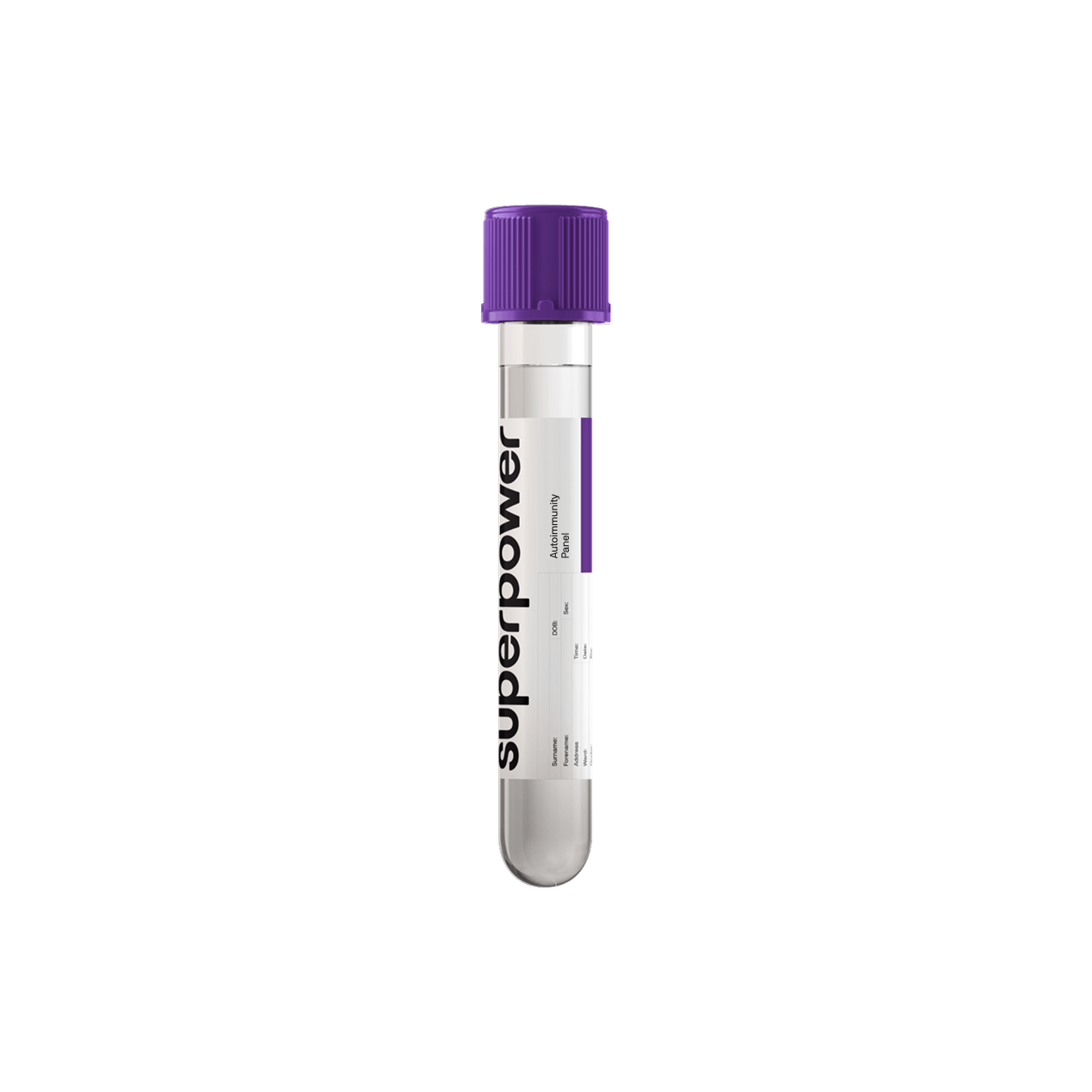
Test details
- Sample type:
- Single blood draw (blood only)
- Location:
- In-person at local lab / At-home phlebotomist visit (+$119)
- Availability:
- Available in 39 states and Washington, D.C.
- Turnaround:
- Results typically ready within 10 days
- Preparation:
- Keep eating gluten-containing foods until after your drawNo fasting requiredPause biotin supplements at least 2 days before your draw
If you have chronic bloating, ongoing digestive discomfort, persistent fatigue, or a family history of celiac, this panel screens for the antibody patterns associated with celiac disease, one of the most underdiagnosed yet most testable conditions in the United States. It covers the relevant antibody markers in a single blood draw, with no fasting required.
Celiac disease vs. gluten sensitivity: what this panel tests
These two conditions are often used interchangeably, but they are clinically distinct. The difference matters for understanding what this panel can and cannot tell you.
Celiac disease is an autoimmune condition. When someone with celiac consumes gluten, the immune system produces specific antibodies, particularly tTG-IgA, and the resulting immune response damages the lining of the small intestine over time. These antibodies are measurable in blood, and this panel screens for them.
Non-celiac gluten sensitivity describes a real experience of symptoms in response to gluten, such as bloating, fatigue, brain fog, and digestive discomfort, that resolves when gluten is removed. Unlike celiac disease, it does not involve the same autoimmune antibodies or the same intestinal damage. As of June 2026, no validated blood test exists for non-celiac gluten sensitivity.
This panel screens for celiac disease patterns. A negative result does not confirm or rule out non-celiac gluten sensitivity; it means the celiac antibody (tTG-IgA) was not detected at measurable levels. If your symptoms persist despite a negative result, that conversation belongs with your provider.
What this panel measures
Celiac disease is an autoimmune reaction to gluten that damages the lining of the small intestine. When someone with celiac eats gluten, their immune system produces antibodies that attack the intestinal villi, the tiny projections that absorb nutrients from food. Over time, this leads to malabsorption, nutrient deficiencies, and a cascade of symptoms that extend far beyond digestion.
The tTG-IgA test detects the primary antibody associated with celiac disease. IgA is measured alongside it because a small percentage of people are IgA-deficient, which would cause a false negative on the tTG test. Together, they provide a reliable screen.
Many people who have celiac disease never connect their symptoms to gluten, which is part of why it goes unrecognized for so long.
| Marker | What it is | Why it's included |
|---|---|---|
| Total IgA | Your total immunoglobulin A level | Selective IgA deficiency is a condition where the body produces little to no IgA, which would make the tTG-IgA test unreliable. Total IgA is checked first to confirm the primary test will be accurate. |
| tTG-IgA (Tissue Transglutaminase IgA) | The primary antibody marker for celiac disease | Elevated tTG-IgA is the most sensitive and specific blood marker for celiac disease currently available, which is why it anchors the screen. |
Note: If your Total IgA level is low (selective IgA deficiency), your provider may recommend tTG-IgG testing, which does not rely on IgA and can screen for celiac patterns in IgA-deficient individuals.
Symptoms and high-risk groups
An estimated 1 in 100 people worldwide has celiac disease, but roughly 80% are undiagnosed. Symptoms range from obvious digestive distress to subtle systemic signs, and a meaningful number of people with celiac have no digestive symptoms at all.
Symptoms that may prompt celiac screening include:
- Chronic abdominal pain, bloating, or gas
- Diarrhea, constipation, or alternating patterns
- Nausea or vomiting
- Unexplained fatigue or low energy
- Iron-deficiency anemia that does not respond to supplementation
- Unexplained weight loss
- Headaches or brain fog
- Joint pain
- Skin rash, particularly dermatitis herpetiformis, a blistering rash associated with celiac
- Mouth ulcers
- Delayed growth or puberty in children and adolescents
- Numbness or tingling in the extremities
Higher-risk groups who may want to screen proactively:
- First-degree relatives of people with celiac disease — Research suggests first-degree relatives have roughly ten times the chance of also having celiac disease compared to the general population.
- People with Type 1 diabetes — There is a documented association between Type 1 diabetes and celiac disease, as both are autoimmune conditions.
- People with autoimmune thyroid conditions — Hashimoto's thyroiditis and Graves' disease share an autoimmune basis with celiac disease.
- People with Down syndrome or Turner syndrome — Both are associated with higher rates of celiac disease.
- Anyone with unexplained iron, folate, or vitamin deficiencies — Celiac disease impairs nutrient absorption in the small intestine, and nutrient deficiencies are often the presenting finding.
Before you test: the gluten rule
For accurate results, you must be actively consuming gluten at the time of testing.
tTG-IgA antibodies are produced in response to gluten exposure. When gluten is removed from the diet, antibody levels begin to fall, and over several weeks to a few months of a gluten-free diet they may become undetectable. A person with celiac disease who has been eating gluten-free for several weeks may receive a false negative result.
If you have already removed gluten from your diet, discuss timing with your provider before ordering this test. Testing while maintaining a gluten-containing diet, even if your symptoms suggest you should stop, is necessary for a meaningful result.
This guidance applies to testing only. Do not make changes to your diet based on this panel alone. If you receive a positive result, your provider will guide next steps.
What your results mean
What this panel reveals is whether your immune system is reacting to gluten at a measurable antibody level.
A result above the reference range for tTG-IgA is a significant finding. It indicates that celiac antibodies are present at detectable levels and is consistent with celiac disease. It is not, by itself, a diagnosis. The current clinical standard for confirming celiac disease is an intestinal biopsy, performed by a gastroenterologist, which directly assesses the condition of the small intestinal lining. A blood test that shows elevated antibodies is the appropriate reason to pursue that evaluation, not the final answer on its own.
If the test comes back positive, your provider will likely recommend a confirmation biopsy. A confirmed celiac diagnosis means a gluten-free diet is the medically recommended ongoing management approach, and in many people, removing gluten resolves symptoms that have persisted for years.
If the test is negative and you are not IgA-deficient, celiac disease is much less likely (valuable information on its own), though it does not completely exclude it, especially if symptoms persist.
Your Superpower care team can help you understand your results and identify the right questions to bring to your provider or gastroenterologist.
Reference ranges vary by lab and individual. Your Superpower care team and your provider will interpret your specific result in context.
How it works
- Order your panel — Select Celiac and Gluten Sensitivity when setting up your Superpower order. No doctor's visit or referral required.
- Schedule your draw — Book at a local clinic or opt for an at-home visit from a trained phlebotomist (+$119). Remember: you must be consuming gluten at the time of your draw.
- Complete your blood draw — A single blood draw at a local clinic, or via at-home phlebotomy (+$119), covers both markers. No urine sample is needed.
- Receive your results — Your results arrive in your dashboard within 10 days, with flagged values explained and your Superpower care team available to walk through them.
Preparation guide
- Consume gluten-containing foods in the days leading up to your test — See the section above for why this matters.
- No fasting is required for this panel.
- Continue all prescribed medications unless your provider advises otherwise.
- Pause biotin supplements at least 2 days before your draw, since biotin can affect certain antibody assays.
Frequently asked questions
Biomarkers tested
Immunoglobulin A (IgA) is one of the body’s main types of antibodies and plays a central role in the immune defenses that protect the body’s mucosal surfaces: the thin, moist linings of the gut, airways, mouth, and eyes.
Learn more


























 Heart & Vascular Health
 Metabolic Health
 Energy
 Liver Health
 Kidney
 Sex Hormones
 Thyroid Health
 Nutrients
 Immune System
 Inflammation