

Get tested for vitamin D and iron in one draw
100+ biomarkers in a single draw, vitamin D and ferritin included.
- CLIA-certified labs
- HIPAA compliant
- Personalized health protocol
Three ways to get tested for vitamin deficiency
You can get tested for a vitamin deficiency through a primary care doctor, by ordering your own vitamin blood test online, or with an at-home finger-prick kit. All three end with a lab measuring nutrients in your blood.
In national survey data, nearly 80% of Americans aged 6 and older showed no deficiency risk across seven vitamins. Roughly 1 in 5 was at risk of at least one.
| Detail | Primary care doctor | Online lab order | At-home kit |
|---|---|---|---|
| Who orders the test | Your doctor | A clinician working with the service | You, by buying the kit |
| Where the sample is taken | A clinic or affiliated lab | A patient service center | At home, then mailed to a lab |
| Sample type | Blood from an arm vein | Blood from an arm vein | A few drops from a finger prick |
| How it is usually paid | Insurance or self-pay | Self-pay | The kit price, at purchase |
| Who explains the results | Your doctor | The service's clinician or an online report | An online report |
The most familiar route starts with a primary care doctor.
Getting tested through your primary care doctor
A primary care doctor can order vitamin blood tests when symptoms, risk factors, or a medical condition give a reason.
- Book a visit with your doctor.
- Describe symptoms and risk factors, such as a vegetarian or vegan diet; a digestive condition or stomach surgery; long-term metformin or acid-reducing medicine; or limited sun exposure or darker skin.
- Ask for tests by name.
- Have blood drawn from a vein in your arm.
- Review the results with your doctor.
A routine checkup usually skips vitamin tests, and for vitamin D deficiency, evidence is insufficient to screen adults without symptoms. Guidance also suggests against routine vitamin D testing, so ask your insurer about coverage, or order the test yourself.
Ordering your own vitamin blood test online
You can order your own vitamin blood test online and skip the doctor visit.
You pay online, a clinician working with the service usually signs the order, and a patient service center (a lab-run draw site) takes blood from your arm. Costs come out of pocket, so ask whether HSA or FSA funds apply. Self-ordering isn't available in every state, so check yours first.
You still need someone to review a low result. Some services skip the draw site and mail a collection kit instead.
Testing at home with a finger-prick kit
You can test vitamin levels at home by pricking a finger, mailing the blood to a lab, and reading results online.
Self-collected capillary samples, such as a finger prick, agree strongly with arm-vein draws for most biomarkers, though not all. For vitamin D read from dried blood spots (drops dried on a card), 90% of results landed within 20% of a venous result after correction.
Hair analysis has proved unreliable for judging nutritional status. One sample sent to six labs returned results that differed more than 10-fold for 12 minerals.
An out-of-range result still needs follow-up with a clinician. A kit also measures only the nutrients it lists, so check which tests it includes.
Vitamin and mineral tests to ask for by name
No single blood test checks every vitamin, so the best blood test for vitamin deficiency is a separate test for each nutrient.
- Vitamin D: 25-hydroxyvitamin D, the main indicator of vitamin D status, not the "active" 1,25-dihydroxyvitamin D
- Vitamin B12: serum B12, plus methylmalonic acid (which builds up when B12 is low) when B12 reads 150 to 399 pg/mL
- Folate: serum folate for recent intake, red blood cell folate for longer-term status
- Iron: ferritin for iron stores, though inflammation can raise ferritin and mask low stores
- Magnesium: requested separately, since routine electrolyte testing skips it and under 1% of body magnesium is in serum
A comprehensive micronutrient panel, sometimes sold as a full vitamin deficiency test, bundles several of these into one draw. Ask which tests it includes and whether any need fasting.
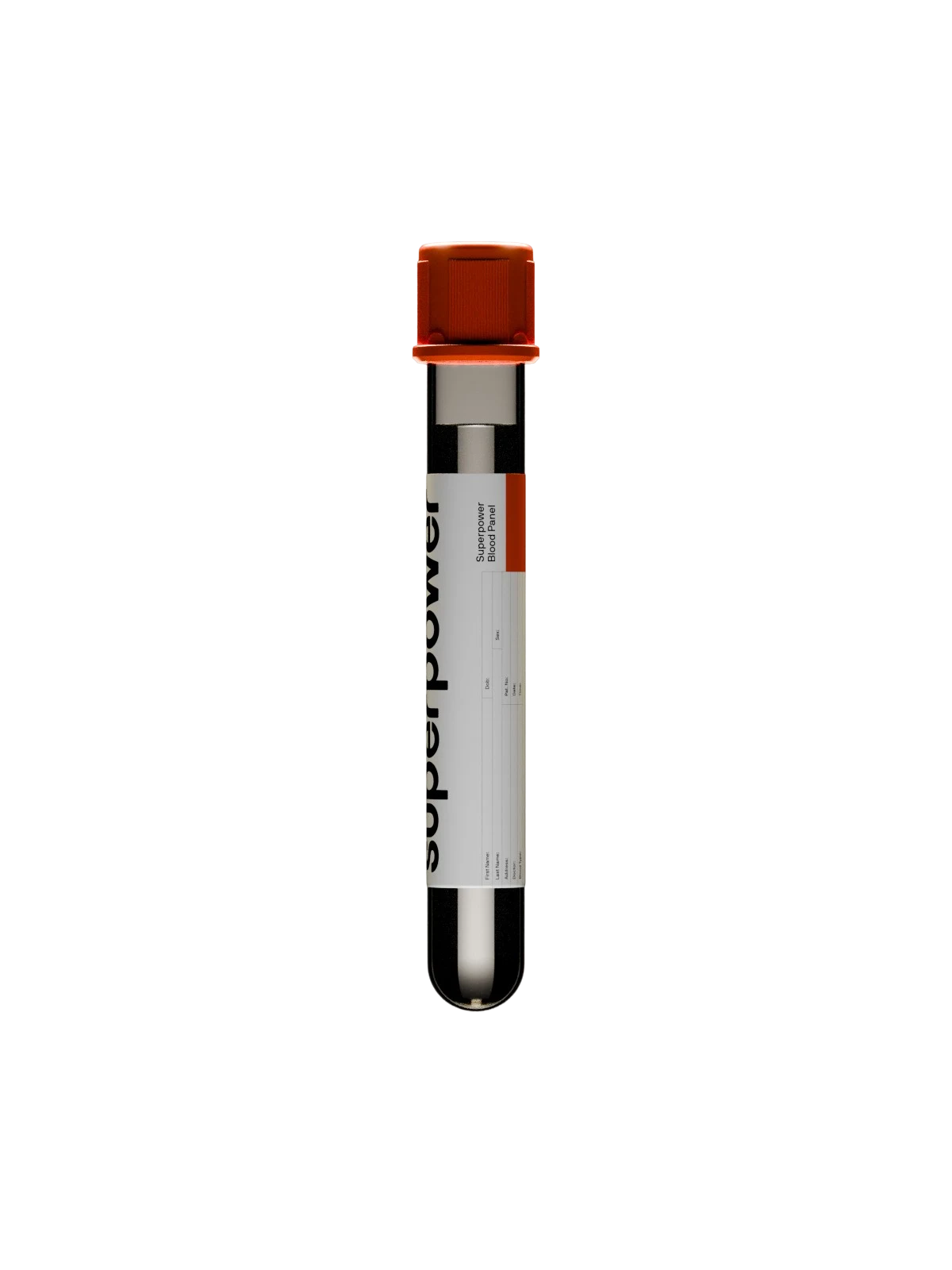
Get 100+ biomarkers tested in-lab or at home
One blood draw a year. A full picture of your health, explained in plain language.
Get 100+ biomarkers tested in-lab or at home
One blood draw a year. A full picture of your health, explained in plain language.
Preparing for the test and acting on results
Prepare by following the lab's fasting instructions and listing your supplements, then have a clinician confirm a low result before acting on it.
Some vitamin B blood tests may require fasting for several hours, but a vitamin D test needs no special preparation. Mention all vitamins and supplements you take, especially biotin, which can skew some biomarker results at high doses.
A low result starts a conversation about cause, whether diet, absorption, or a medicine. Checking several markers in one draw saves repeat trips to the lab.
Check your vitamin levels with Superpower
Getting tested for vitamin deficiency starts with a comprehensive blood test that reads vitamin D, ferritin, and iron together. A Superpower membership includes 100+ biomarkers in a single draw, among them vitamin D, ferritin, and iron. As your home for health, Superpower measures those markers and supports you in improving them.
Your own numbers are the clearest place to begin. Start your Superpower membership and get your baseline in one draw.
References
- Pfeiffer CM, Sternberg MR, Schleicher RL, Haynes BM, Rybak ME, Pirkle JL (2013). The CDC's second national report on biochemical indicators of diet and nutrition in the U.S. population is a valuable tool for researchers and policy makers. *The Journal of Nutrition*, *143*(6), 938S–947S. https://doi.org/10.3945/jn.112.172858
- MedlinePlus (2024). At-home medical tests. National Library of Medicine.
- MedlinePlus (2026). Vitamin B test. National Library of Medicine.
- National Institutes of Health Office of Dietary Supplements (2025). Vitamin B12: fact sheet for health professionals. NIH.
- National Institutes of Health Office of Dietary Supplements (2025). Vitamin D: fact sheet for health professionals. NIH.
- US Preventive Services Task Force, Krist AH, Davidson KW, et al (2021). Screening for vitamin D deficiency in adults: US Preventive Services Task Force recommendation statement. *JAMA*, *325*(14), 1436–1442. https://doi.org/10.1001/jama.2021.3069
- Demay MB, Pittas AG, Bikle DD, et al (2024). Vitamin D for the prevention of disease: an Endocrine Society clinical practice guideline. *The Journal of Clinical Endocrinology & Metabolism*, *109*(8), 1907–1947. https://doi.org/10.1210/clinem/dgae290
- Schröder D, Hafke A, Hummers E, et al (2025). Comparison of laboratory results and pain perception in self-sampled capillary blood versus venous blood sampling: a systematic review and meta-analysis. *Clinical Biochemistry*, *138*, 110965. https://doi.org/10.1016/j.clinbiochem.2025.110965
- Heughebaert L, Ghesquière R, Stove CP (2026). Clinical validation of a DBS-based LC-MS/MS method for 25-hydroxyvitamin D: from lab sampling to home sampling. *Clinical Chemistry and Laboratory Medicine*, *64*(4), 866–879. https://doi.org/10.1515/cclm-2025-1002
- Seidel S, Kreutzer R, Smith D, McNeel S, Gilliss D (2001). Assessment of commercial laboratories performing hair mineral analysis. *JAMA*, *285*(1), 67–72. https://doi.org/10.1001/jama.285.1.67
- National Institutes of Health Office of Dietary Supplements (2022). Folate: fact sheet for health professionals. NIH.
- National Institutes of Health Office of Dietary Supplements (2025). Iron: fact sheet for health professionals. NIH.
- National Institutes of Health Office of Dietary Supplements (2026). Magnesium: fact sheet for health professionals. NIH.
- MedlinePlus (2024). Vitamin D test. National Library of Medicine.
- MedlinePlus (2024). How to prepare for a lab test. National Library of Medicine.
- Bowen R, Benavides R, Colón-Franco JM, et al (2019). Best practices in mitigating the risk of biotin interference with laboratory testing. *Clinical Biochemistry*, *74*, 1–11. https://doi.org/10.1016/j.clinbiochem.2019.08.012

























 Heart & Vascular Health
 Metabolic Health
 Energy
 Liver Health
 Kidney
 Sex Hormones
 Thyroid Health
 Nutrients
 Immune System
 Inflammation