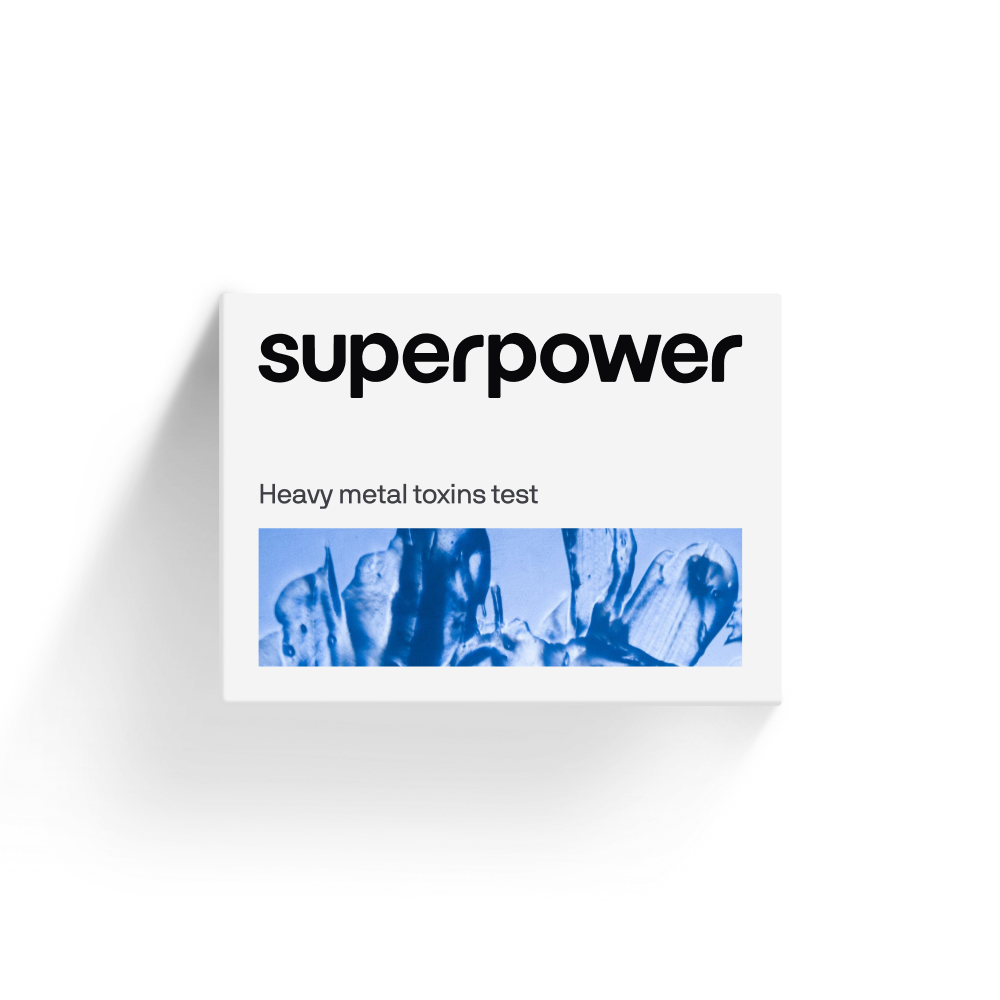
Test details
- Sample type:
- First-morning urine sample (no blood draw)
- Location:
- Mail-in collection kit
- Availability:
- Available in 40 states (not offered in NY or NJ)
- Turnaround:
- Results in 10 to 14 days
- Preparation:
- Avoid all seafood for 48 hours before collectionAvoid mineral supplements for 48-72 hours before collectionNo fasting required
What this test measures
This panel measures a quantitative level for each of 20 heavy metals (including lead, mercury, arsenic, and cadmium) from a single urine sample. These are metals that may accumulate from environmental, dietary, and occupational exposure. Urine is the standard sample for assessing recent and ongoing exposure, reflecting roughly the past one to two weeks. The test is run by Mosaic Diagnostics, a CAP-accredited, CLIA-certified, ISO 15189-accredited lab, using ICP-MS for trace and toxic element measurement. Your results are compared against Mosaic's reference ranges and arrive with an updated Action Plan.
The 20 metals measured
| Metal | Metal |
|---|---|
| Lead (Pb) | Mercury (Hg) |
| Arsenic (As) | Cadmium (Cd) |
| Aluminum (Al) | Antimony (Sb) |
| Barium (Ba) | Beryllium (Be) |
| Bismuth (Bi) | Cesium (Cs) |
| Gadolinium (Gd) | Nickel (Ni) |
| Palladium (Pd) | Platinum (Pt) |
| Tellurium (Te) | Thallium (Tl) |
| Thorium (Th) | Tin (Sn) |
| Tungsten (W) | Uranium (U) |
These metals fall into a few broad groups. The most widely recognized environmental exposures, lead, mercury, arsenic, and cadmium, tend to come from older plumbing and paint, certain fish, contaminated soil, and cigarette smoke. Others, such as nickel, tungsten, and thallium, are more often associated with industrial or occupational settings. Gadolinium reflects a medical-imaging context, as it is used in MRI contrast agents. Grouping the metals this way helps you recognize which ones may be most relevant to your own history.
Common sources of exposure
Exposure to heavy metals is part of modern life, and understanding your personal exposure level is useful context for your overall health picture. Common sources include:
- Tap water, particularly where older infrastructure, lead pipes, or agricultural runoff are present.
- Fish and seafood, especially large predatory fish like tuna, swordfish, and shark, and shellfish, which can carry mercury and arsenic.
- Older housing, especially homes built before 1978, where lead paint and lead pipes may still be present.
- Occupational settings such as welding, manufacturing, agriculture, mining, and electronics work.
- Certain herbal or Ayurvedic supplements, which may contain elevated levels of lead or arsenic.
- Dental amalgam fillings, which contain mercury.
- MRI contrast agents, which contain gadolinium.
- Cigarette smoke, which is a source of cadmium and lead.
Signs that may prompt testing
Some people order this panel because of something they've noticed in their bloodwork:
- Low hemoglobin or hematocrit
- Iron panel imbalances (iron, ferritin, TIBC)
- Abnormal kidney or liver function markers
- Elevated uric acid
- Unexplained neurological symptoms
Others order it because of symptoms or exposure history:
- Fatigue, muscle weakness, numbness or tingling, digestive issues, or memory and concentration problems
- Living in an older home with possible lead pipes or paint
- High seafood consumption
- Occupational exposure such as welding, manufacturing, or mining
These are situations worth investigating, not a checklist that confirms exposure. Many of these signals have been associated with heavy metal accumulation, but they can have a wide range of other explanations. Testing isn't only for people who feel unwell. It's also a way to understand your baseline exposure and bring clear information to your provider.
Who benefits from testing
- You eat fish or seafood regularly, a few times a week or more
- You live in, or grew up in, housing built before 1978
- You rely on well water in an agricultural or industrial area
- You have occupational exposure through welding, manufacturing, agriculture, electronics, or battery and chemical work
- You use certain herbal, Ayurvedic, or traditional supplements
- You've had multiple MRI scans with contrast agents
- You smoke or have heavy secondhand smoke exposure
- You want a baseline environmental exposure snapshot as part of proactive health monitoring
- You have unexplained symptoms and want to understand whether exposure may be a contributing factor worth discussing with your provider
How to prepare
- Avoid all seafood for 48 hours before collection. Fish, shellfish, and seaweed contain a form of arsenic (arsenobetaine) that is naturally present in seafood and not harmful, but it will temporarily elevate your arsenic reading. A seafood meal the day before testing can produce a misleading result. This is the most important preparation step.
- Avoid mineral supplements for 48-72 hours before collection. Selenium, zinc, and other mineral supplements can influence your readings.
- No fasting required. You do not need to avoid food before this test.
- Collect a urine sample. This panel uses urine, not a blood draw. You'll receive a collection kit from Mosaic Diagnostics, and first-morning urine is preferred. Detailed collection instructions are included in your kit and available in the Superpower member portal.
The lab: Mosaic Diagnostics
Your sample is analyzed by Mosaic Diagnostics. The lab is accredited by the College of American Pathologists (CAP), the gold standard for laboratory quality assurance, and is CLIA-certified, the federal requirement for U.S. diagnostic labs. It is also ISO 15189-accredited, the international standard for medical laboratories. Mosaic measures trace and toxic elements using ICP-MS (Inductively Coupled Plasma Mass Spectrometry), the analytical standard for this kind of testing. These accreditations reflect the quality controls behind your results.
What your results show
Your results show a quantitative level for each of the 20 metals, compared against reference ranges drawn from Mosaic Diagnostics' population data. Some metals have established clinical reference ranges, while others reflect emerging research. A result above the reference range is a signal worth discussing with your provider, not a diagnosis of metal poisoning or toxicity. Your results also come with an updated Action Plan, and your Superpower care team is available to help you review your numbers. Knowing your levels gives you and your provider a clearer picture of your exposure so you can take targeted steps to address them together.
Reference ranges are based on Mosaic Diagnostics' population data and may vary. Your Superpower care team and your provider will interpret your specific results in context.
How it works
- Order online. No doctor's visit required.
- Receive your collection kit. Mosaic Diagnostics ships a urine collection kit to your address, including all instructions and a prepaid return label.
- Collect your sample. Follow the instructions in your kit. First-morning urine is preferred. Return the sample using the prepaid label.
- Review your results. Your results arrive in your Superpower dashboard in 10 to 14 days after Mosaic receives your sample and include an updated Action Plan. Your care team is available to walk through your numbers.
Frequently asked questions
Biomarkers tested
Aluminum is a common environmental metal with no biological role in humans.
Learn moreMethod: ICP-MS (Inductively Coupled Plasma Mass Spectrometry) with creatinine normalization by Jaffe Reaction (CLIA 14D0646470); not cleared or approved by the FDA. Results in µg/g creatinine; reference intervals based on NHANES population data under non-provoked conditions. Not a stand-alone diagnosis; should be interpreted in clinical context.


























 Heart & Vascular Health
 Metabolic Health
 Energy
 Liver Health
 Kidney
 Sex Hormones
 Thyroid Health
 Nutrients
 Immune System
 Inflammation