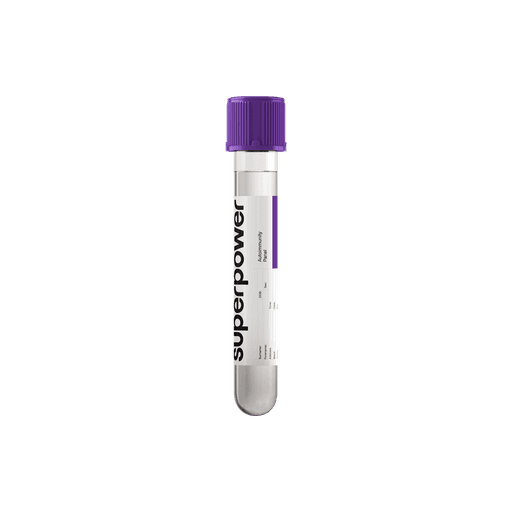
Test details
- Sample type:
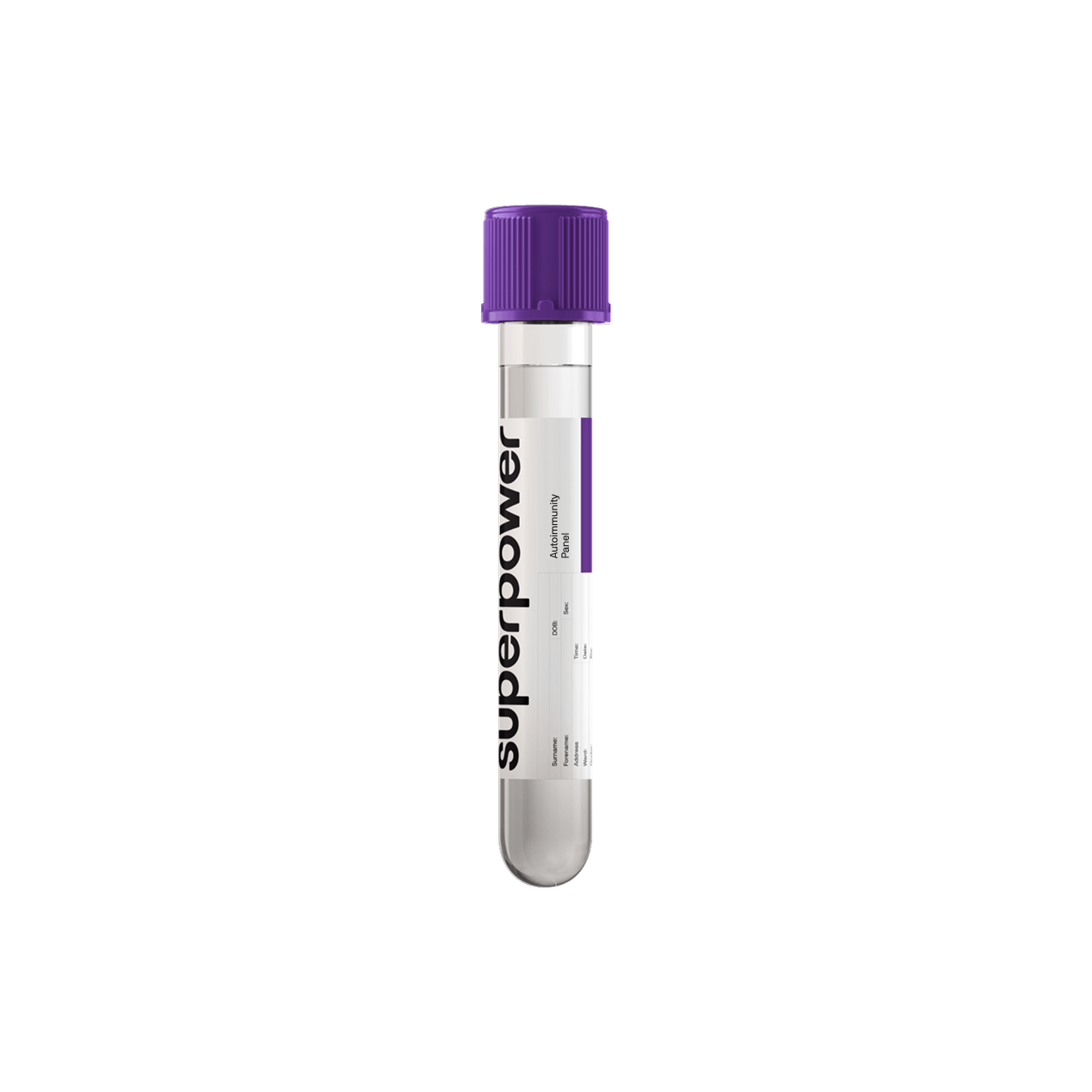
- Single blood draw (blood only)
- Location:
- In-person at local lab / At-home phlebotomist visit (+$119)
- Availability:
- Available in 40 states
- Turnaround:
- Results typically posted within 10 days
- Preparation:
- No fasting required
About the Extended Autoimmune Health Panel
Autoimmune diseases happen when your immune system attacks your own tissues. These conditions affect millions of Americans, but diagnosis takes an average of 4 to 5 years, because symptoms like fatigue, joint pain, brain fog, digestive issues, and skin changes overlap with so many other conditions.
This panel tests blood markers associated with several of the most common autoimmune conditions: rheumatoid arthritis, lupus, Hashimoto's thyroiditis, and celiac disease. Many of these conditions are detectable through antibody testing years before symptoms become severe enough for a clinical diagnosis, which is what makes early screening meaningful.
Standard blood work rarely includes specific autoimmune antibody testing. This panel fills that gap. It does not produce a diagnosis: antibody testing requires clinical interpretation in context. It gives you and your provider a detailed picture of which, if any, autoimmune pathways are showing activity.
Conditions this panel screens for
The panel covers four categories of autoimmune activity, each identified by specific antibody or protein markers.
Rheumatoid arthritis
Cyclic citrullinated peptide (CCP) antibodies and rheumatoid factor are the primary markers associated with rheumatoid arthritis. CCP antibodies are highly specific to RA and can appear years before joint symptoms develop.
Markers: Cyclic Citrullinated Peptide Antibody, Rheumatoid Arthritis Factor (RF).
Lupus and connective-tissue autoimmunity
The antinuclear antibody (ANA) test is the broad first-line marker associated with lupus and related connective-tissue conditions. This panel reports ANA together with its titer and staining pattern, which help characterize the strength and type of any antibody activity detected.
Markers: Antinuclear Antibodies (ANA).
Hashimoto's thyroiditis
Thyroid peroxidase (TPO) antibodies and thyroglobulin antibodies are the primary markers associated with autoimmune thyroid disease. Free T3 is included to assess thyroid hormone activity alongside antibody status.
Markers: Thyroid Peroxidase (TPO) Ab, Thyroglobulin Antibodies, Free T3 (Triiodothyronine).
Celiac disease autoimmunity
Tissue transglutaminase (tTG) antibody is the primary antibody marker associated with celiac disease. Total immunoglobulin A (IgA) is included because IgA deficiency can make a tTG-IgA result difficult to interpret.
Markers: Tissue Transglutaminase Ab, Immunoglobulin A.
Who benefits from testing
- You have a family history of autoimmune disease: thyroid conditions, lupus, rheumatoid arthritis, celiac disease, or type 1 diabetes.
- You have persistent, unexplained symptoms: fatigue, joint pain, morning stiffness, brain fog, digestive problems, or skin rashes that have not resolved with standard care.
- You have been told your standard blood work is "normal" while your symptoms persist.
- You have thyroid symptoms (fatigue, cold sensitivity, hair thinning) alongside other systemic symptoms and want to check for autoimmune thyroid activity.
- You have digestive symptoms that have led you to suspect celiac disease or gluten sensitivity.
- You are a woman between 20 and 50. Autoimmune conditions are significantly more common in this demographic, and early identification gives you and your provider more options.
- You want a wide-ranging screen as part of a proactive health baseline, even without current symptoms.
Proactive testing does not replace clinical evaluation. It gives you and your provider more to work from.
What your results reveal
Your results show whether your immune system is producing antibodies against your own tissues, and which ones. Each marker is reported as either positive or negative (for qualitative antibody tests) or as a measured titer or concentration (for quantitative tests), interpreted against standard clinical reference points.
If antibodies are present, you will know which specialists to see and which conditions to monitor. Detecting these signals early gives you and your provider more time to discuss next steps.
A positive antibody result means that marker is detectable in your blood at a level above the reference threshold. It does not confirm a diagnosis: clinical significance depends on the pattern of results, the specific titer, and your symptoms. Your Superpower care team can help you understand what your results mean in context, and help identify next steps for any markers that warrant further evaluation.
How it works
- Add to your Superpower order. The Extended Autoimmune Health Panel is added to your blood draw appointment.
- Get your blood drawn. This test uses a standard blood sample, collected at a local clinic or via an optional at-home visit from a trained phlebotomist (+$119). Your sample is processed in a CLIA-certified lab.
- No fasting required.
- Receive your results. Results are typically processed and posted to your Superpower dashboard within 10 days of your blood draw.
- Review with your care team. Your Superpower care team or AI-powered concierge can help you interpret results and identify any next steps.
Frequently asked questions
Biomarkers tested
Cyclic Citrullinated Peptide (CCP) antibodies are autoantibodies that target proteins in the body that have undergone a process called citrullination.
Learn more