


Understand what your specialty supplements results really mean
See your biomarkers in context with a comprehensive panel.
- CLIA-certified labs
- HIPAA compliant
- Personalized health protocol
Quick answer: Liquid vitamin D3 and capsule/softgel forms are both effective ways to supplement vitamin D. Liquid formulations may offer advantages in dose flexibility and potentially faster absorption, but both forms raise serum 25-OH vitamin D levels effectively when taken with fat. The most important factor is knowing your baseline 25-OH vitamin D level before supplementing, as appropriate dosing varies significantly by individual.
Why vitamin D status matters
Vitamin D functions less like a traditional vitamin and more like a hormone. After activation in the liver and kidney, the active form (1,25-dihydroxyvitamin D) binds to vitamin D receptors present in virtually every tissue in the body — influencing calcium absorption, immune regulation, muscle function, and inflammatory pathways. Deficiency is widespread: global estimates suggest that approximately 40% of adults have insufficient vitamin D levels, with higher rates in northern latitudes, darker skin tones, and individuals with limited sun exposure.
A large prospective study from the UK Biobank found that vitamin D deficiency was associated with significantly increased all-cause mortality risk, even after adjustment for confounding factors. These findings support routine assessment of vitamin D status as part of a general health panel.
Liquid versus capsule vitamin D: What the evidence shows
Forms of vitamin D available
Vitamin D supplements come in two primary active forms:
- Vitamin D3 (cholecalciferol): The form produced in the skin under UV light and found in animal-derived foods. More potent at raising serum 25-OH vitamin D than D2 in comparative studies.
- Vitamin D2 (ergocalciferol): Derived from plant or fungal sources; often used in prescription-strength preparations and fortified vegan foods. Raises 25-OH vitamin D but is generally considered less potent per IU than D3.
Both forms are available in liquid, softgel, capsule, and tablet preparations. Liquid formulations are also available as drops suspended in oil (most common), water-dispersible sprays, or emulsified solutions.
Does liquid vitamin D absorb better?
Vitamin D is a fat-soluble nutrient, which means it requires dietary fat for optimal absorption in the small intestine. Softgel capsules containing vitamin D in an oil base (typically olive oil or sunflower oil) and oil-based liquid drops address this requirement directly. Both formats deliver vitamin D in a fat-soluble matrix, which is why they are generally equivalent in absorption efficiency when taken with a meal containing fat.
Where liquid formulations may offer a practical advantage is in situations where capsule swallowing is difficult (relevant for children, elderly individuals, or those with swallowing difficulties) and in dose flexibility. A liquid dropper allows incremental dosing adjustments that are not possible with fixed-dose capsules, which is relevant when titrating toward a target serum level under provider guidance.
Water-dispersible or micellar liquid vitamin D preparations have been proposed for individuals with fat malabsorption conditions (such as Crohn's disease, cystic fibrosis, or short bowel syndrome), where standard fat-soluble formulations may absorb poorly. Some evidence suggests improved 25-OH vitamin D response with water-dispersible forms in these specific populations, though the benefit is less clear in individuals with normal fat absorption.
Oil-based drops versus softgels
For individuals with normal gut function, oil-based vitamin D drops and softgel capsules are functionally equivalent when taken with food. Both deliver vitamin D in a lipid matrix. The practical differences are dose flexibility (drops allow more precise titration), storage (drops must be kept appropriately to prevent oxidation), and personal preference for those who dislike swallowing capsules.
Vitamin D dosage: Why individual variation matters
Why dosing is not one-size-fits-all
The serum 25-OH vitamin D response to a given supplement dose varies substantially between individuals, influenced by body weight and body fat percentage (vitamin D distributes into adipose tissue, reducing circulating levels in people with higher body fat), baseline vitamin D status, skin melanin content, age (vitamin D production declines with age), and dietary fat intake alongside the supplement. This variability is the core reason why testing before supplementing — and testing again after 8 to 12 weeks — provides more useful guidance than any fixed-dose recommendation.
General reference ranges
The Endocrine Society defines vitamin D sufficiency as a serum 25-OH vitamin D level greater than 30 ng/mL (75 nmol/L), with a preferred range of 40 to 60 ng/mL in most adults for optimal health outcomes. Levels below 20 ng/mL are generally classified as deficient. Optimal thresholds remain debated across clinical guidelines, and the appropriate target may vary by individual health context. Reference ranges also vary between laboratories; results should be interpreted in context with a provider.
Commonly used supplement doses
Over-the-counter vitamin D supplements most commonly provide 1,000 to 5,000 IU per serving. Higher doses (up to 10,000 IU daily) are used in clinical practice for correction of significant deficiency under medical supervision. Vitamin D toxicity (hypervitaminosis D) is possible with very high supplemental doses over extended periods, producing hypercalcemia — elevated blood calcium — with associated symptoms. Toxicity is rare at doses below 10,000 IU/day in adults, but regular monitoring of 25-OH vitamin D is advisable during extended high-dose supplementation.
Vitamin K2 and vitamin D co-supplementation
There is growing clinical interest in combining vitamin D3 with vitamin K2 (particularly the MK-7 form of menaquinone). The rationale is that vitamin D increases calcium absorption, and vitamin K2 directs calcium deposition into bone (through activation of osteocalcin) rather than soft tissues (through activation of matrix Gla protein). While the evidence for this combination is not definitive, many clinicians and integrative health practitioners recommend K2 alongside D3 supplementation, particularly at higher doses. This remains an area of active research.
Test 150+ biomarkers
Two blood draws. A full picture of your health, explained in plain language.
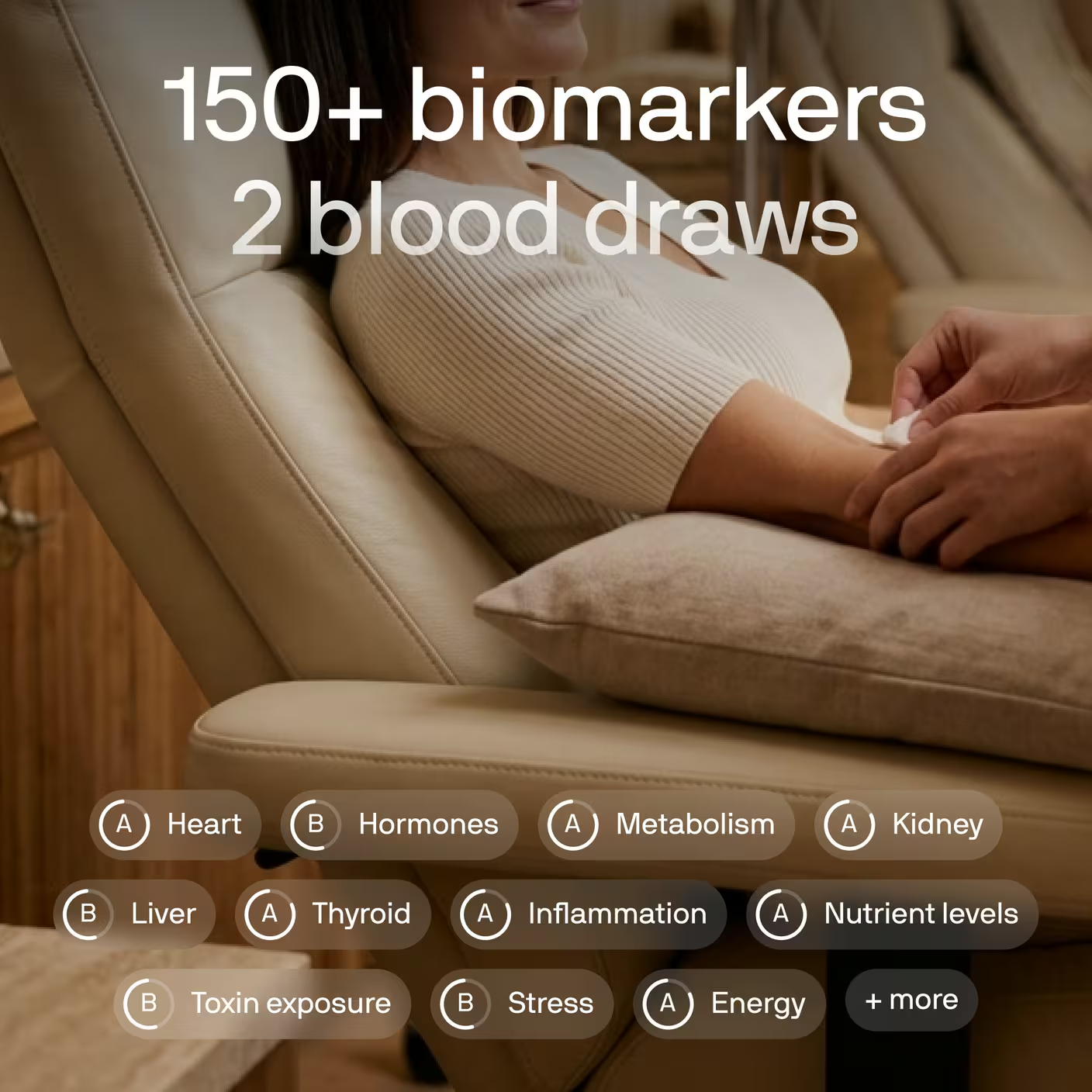
Test 150+ biomarkers
Two blood draws. A full picture of your health, explained in plain language.
Testing vitamin D status
Serum 25-hydroxyvitamin D is the standard clinical marker for assessing vitamin D status. It reflects both dietary intake and sun-derived synthesis and has a half-life of approximately two to three weeks, making it a stable indicator of overall vitamin D stores rather than acute fluctuations.
- <20 ng/mL — Deficient. Associated with increased risk of bone loss, immune dysfunction, and other health outcomes
- 20–29 ng/mL — Insufficient. Below the Endocrine Society sufficiency threshold; supplementation commonly recommended
- 30–39 ng/mL — Sufficient (lower range). Within the defined sufficient range; many clinicians target higher
- 40–60 ng/mL — optimal per the Endocrine Society preferred range. Associated with best health outcomes in most population studies
- >100 ng/mL — Potentially excessive. Regular monitoring advisable; toxicity risk increases above this level with sustained high-dose supplementation
Superpower's Baseline Blood Panel includes 25-OH vitamin D as a standard component. Testing at baseline and after 8 to 12 weeks of supplementation allows for informed dose adjustments.
Frequently asked questions
For most adults with normal gut function, oil-based liquid drops and softgel capsules are equivalent in their ability to raise serum 25-OH vitamin D. Liquid forms offer dose flexibility and ease of use for people who find swallowing capsules difficult. Water-dispersible liquid forms may have an advantage in individuals with fat malabsorption conditions. The most important factor is ensuring the preparation is taken with dietary fat for optimal absorption.
Serum 25-OH vitamin D typically rises within 4 to 8 weeks of consistent daily supplementation. The rate of increase depends on the starting level, the dose, individual absorption, and body composition. Testing at 8 to 12 weeks after beginning or adjusting supplementation is a practical interval for assessing response.
Yes. Vitamin D toxicity (hypervitaminosis D) produces elevated blood calcium levels (hypercalcemia), which can cause nausea, weakness, kidney stones, and in severe cases, cardiac arrhythmia. Toxicity is rare at doses below 10,000 IU/day in adults but becomes more plausible with sustained very high doses. Regular monitoring of 25-OH vitamin D levels during extended high-dose supplementation is advisable.
Vitamin D3 (cholecalciferol) is generally preferred for supplementation because it is more potent per IU at raising serum 25-OH vitamin D than vitamin D2 (ergocalciferol). D2 remains appropriate in certain clinical contexts, including prescription-strength repletion protocols. For everyday supplementation, D3 — whether in liquid or capsule form — is the standard recommendation.
Vitamin D is best absorbed when taken with a meal containing fat, as it is a fat-soluble nutrient. There is no strong evidence that time of day affects its efficacy, but some individuals report that taking vitamin D in the evening affects sleep — possibly through interaction with melatonin pathways — and prefer morning or midday administration. Consistency of timing matters more than the specific time chosen.
This article is for informational purposes only and does not constitute medical advice. Always consult a qualified healthcare provider before beginning any supplement regimen. Superpower offers blood panels that include the biomarkers discussed in this article. Links to individual tests are provided for informational context.
Frequently Asked Questions
References
- Amrein K, Scherkl M, Hoffmann M, Neuwersch-Sommeregger S, Köstenberger M, Tmava Berisha A, Martucci G, Pilz S, Malle O (2020). Vitamin D deficiency 2.0: an update on the current status worldwide. *European journal of clinical nutrition*, *74*(11), 1498-1513. https://doi.org/10.1038/s41430-020-0558-y
- Sutherland JP, Zhou A, Hyppönen E (2022). Vitamin D Deficiency Increases Mortality Risk in the UK Biobank : A Nonlinear Mendelian Randomization Study. *Annals of internal medicine*, *175*(11), 1552-1559. https://doi.org/10.7326/m21-3324
- Balachandar R, Pullakhandam R, Kulkarni B, Sachdev HS (2021). Relative Efficacy of Vitamin D. *Nutrients*, *13*(10). https://doi.org/10.3390/nu13103328
- Dawson-Hughes B, Harris SS, Lichtenstein AH, Dolnikowski G, Palermo NJ, Rasmussen H (2015). Dietary fat increases vitamin D-3 absorption. *Journal of the Academy of Nutrition and Dietetics*, *115*(2), 225-230. https://doi.org/10.1016/j.jand.2014.09.014
- Silva MC, Furlanetto TW (2018). Intestinal absorption of vitamin D: a systematic review. *Nutrition reviews*, *76*(1), 60-76. https://doi.org/10.1093/nutrit/nux034
- Holick MF, Binkley NC, Bischoff-Ferrari HA, Gordon CM, Hanley DA, Heaney RP, Murad MH, Weaver CM, Endocrine Society (2011). Evaluation, treatment, and prevention of vitamin D deficiency: an Endocrine Society clinical practice guideline. *The Journal of clinical endocrinology and metabolism*, *96*(7), 1911-30. https://doi.org/10.1210/jc.2011-0385
- Marcinowska-Suchowierska E, Kupisz-Urbańska M, Łukaszkiewicz J, Płudowski P, Jones G (2018). Vitamin D Toxicity-A Clinical Perspective. *Frontiers in endocrinology*, *9*, 550. https://doi.org/10.3389/fendo.2018.00550
- Aaseth JO, Finnes TE, Askim M, Alexander J (2024). The Importance of Vitamin K and the Combination of Vitamins K and D for Calcium Metabolism and Bone Health: A Review. *Nutrients*, *16*(15). https://doi.org/10.3390/nu16152420
- Tripkovic L, Lambert H, Hart K, Smith CP, Bucca G, Penson S, Chope G, Hyppönen E, Berry J, Vieth R, Lanham-New S (2012). Comparison of vitamin D2 and vitamin D3 supplementation in raising serum 25-hydroxyvitamin D status: a systematic review and meta-analysis. *The American journal of clinical nutrition*, *95*(6), 1357-64. https://doi.org/10.3945/ajcn.111.031070
- Huiberts LM, Smolders KCHJ (2021). Effects of vitamin D on mood and sleep in the healthy population: Interpretations from the serotonergic pathway. *Sleep medicine reviews*, *55*, 101379. https://doi.org/10.1016/j.smrv.2020.101379

























 Heart & Vascular Health
 Metabolic Health
 Energy
 Liver Health
 Kidney
 Sex Hormones
 Thyroid Health
 Nutrients
 Immune System
 Inflammation