


Understand what your emerging health topics results really mean
See your biomarkers in context with a comprehensive panel.
- CLIA-certified labs
- HIPAA compliant
- Personalized health protocol
What Are Somatic Exercises?
Somatic exercises are body-based movement practices designed to influence the nervous system. The category spans Somatic Experiencing delivered by a trauma-therapy modality trained, licensed clinician, to viral TikTok routines marketed for nervous-system regulation and trauma release. The evidence varies sharply across that spectrum.
Peter Levine's Somatic Experiencing emerged in the 1990s as a structured clinical protocol. Thomas Hanna's Hanna Somatics dates to 1988. The broader term "somatic exercises" exploded on TikTok between 2022 and 2024, driven by wellness creators promising nervous-system resets in minutes. Post-pandemic interest in stress regulation, the popularization of polyvagal theory (a contested model of how the vagus nerve regulates stress) in wellness content, and a cultural appetite for therapy-adjacent self-help all accelerated the trend.
Proponents associate somatic exercises with four outcomes:
- Releasing stored trauma from the body.
- Regulating the nervous system via polyvagal mechanisms.
- Reducing chronic stress and anxiety.
- Improving vagal tone and heart-rate variability (HRV).
Breaking Down the Clinical Evidence
The claims behind somatic exercises cover clinically delivered Somatic Experiencing for trauma, the "release stored trauma in 5 minutes" TikTok framing, polyvagal nervous-system regulation, and chronic stress and anxiety. These four claims map to meaningfully different evidence bases.
Clinically delivered Somatic Experiencing for trauma: Limited
The clinical version of Somatic Experiencing is not the same thing as a TikTok body-shake routine. In a randomized controlled trial, Somatic Experiencing produced significant PTSD symptom reduction across up to 15 sessions in 63 participants. A subsequent systematic review confirmed SE as a defined body-oriented modality with emerging evidence. The key word is "clinical": trained therapists, structured protocols, months of work. That context is absent from most online somatic content.
Releasing stored trauma in 5 minutes via TikTok routines: Anecdotal
The viral claim is that a brief body-based sequence can release trauma stored in the nervous system. The trauma literature does not support this framing. Established trauma treatments, including prolonged exposure, CPT, and EMDR, require trained therapists and structured clinical containment to produce meaningful outcomes. A network meta-analysis of psychological PTSD treatments confirms evidence-based therapies sit at the top of the hierarchy for a reason. A five-minute body-shake video is not a clinical intervention. Conflating the two is not just inaccurate, it can delay appropriate care.
Regulating the nervous system via polyvagal mechanisms: Limited
Polyvagal theory, developed by Stephen Porges, proposes that the autonomic nervous system uses hierarchical vagal pathways to mediate social engagement and threat response. His more recent work frames it as a science of safety and connection. However, the neuroanatomical claims at the core of polyvagal theory, particularly the proposed ventral-vagal complex, have been formally challenged on multiple empirical grounds. A 2026 multi-author critique goes further, arguing that the polyvagal framework is untenable as currently stated. Porges has responded to these critiques directly, addressing the vagal paradox and defending core elements of the theory. This is an actively debated scientific framework, not settled neuroscience.
Reducing chronic stress and anxiety: Moderate
The strongest adjacent evidence comes from mindfulness-based stress reduction (MBSR), not from somatic exercises specifically. MBSR has a well-established evidence base for stress outcomes across multiple meta-analyses. A meta-analysis of MBSR in healthy individuals found consistent reductions in stress, anxiety, and depression. Body-scan and breath-focused practices within MBSR also show measurable effects on cortisol and other physiological stress markers. This is the legitimate adjacent literature, it supports mindful movement for mild-to-moderate stress, not the trauma-release marketing of viral somatic content.
A Body-Based Stress Practice You Can Actually Use
For readers interested in body-based stress reduction, the protocol with the most evidence behind it looks closer to mindful movement than to viral somatic routines. The goal is nervous-system regulation through consistent, low-intensity practice, not a single dramatic release.
Start with 5 to 10 minutes of gentle body-scan practice, three to five days per week. Slow, deliberate attention to physical sensation activates interoceptive pathways tied to emotional regulation. Layer in slow diaphragmatic breathing at roughly four to six breath cycles per minute. That pace sits in the resonance-frequency range associated with HRV training and autonomic flexibility. For readers who prefer movement over stillness, mindful walking, yoga, or qigong offer body-awareness entry points with their own evidence base for stress. Track subjective stress and sleep quality alongside objective HRV using a consistent wearable protocol (same time of day, same conditions, every morning). At week eight, compare HRV trend and any available biomarker data against baseline. Without that comparison, it is impossible to distinguish a real physiological response from placebo or natural fluctuation.
Where These Routines Go Wrong
Here is where the viral version of the practice can mislead you. The gap between viral framing and what actually moves the needle is wide. These are the most common failure modes.
- Treating viral routines as trauma therapy. Self-administered body-movement sequences are not a substitute for licensed trauma therapy, when trauma symptoms are the underlying issue, a trained clinician is the appropriate first step.
- Surfacing intrusive material without therapist containment. If body-based practice triggers intrusive memories, dissociation, or emotional flooding, the appropriate response is to pause and contact a clinician before continuing.
- Replacing first-line anxiety treatment with body-work. CBT and pharmacotherapy carry substantially stronger evidence for clinical anxiety than any body-based practice; body-work is an adjunct, not a replacement.
- Over-relying on polyvagal language as evidence. Polyvagal theory is an actively debated scientific framework, invoking it as a mechanism does not validate a specific practice.
Who Benefits, and Who Should Be Cautious
The reader most likely to benefit from body-based practice is someone with mild-to-moderate everyday stress, stable mental health, and an interest in adding mindful movement to an otherwise solid routine. Think of it as a complement to sleep hygiene, exercise, and nutrition. It is not a standalone intervention. The evidence supports it in that lane.
People with diagnosed PTSD, complex trauma histories, dissociative disorders, or active psychiatric distress should not use unsupervised TikTok somatic protocols. Clinical guidelines place structured, therapist-delivered treatments at the top of the PTSD evidence hierarchy for good reason. Readers with a trauma history who do not currently have a therapist can reach the 988 Suicide and Crisis Lifeline by calling or texting 988, and the SAMHSA National Helpline at 1-800-662-4357. Both are free, confidential, and available 24/7.
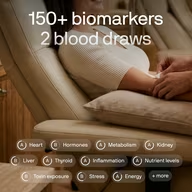
Test 150+ biomarkers
Two blood draws. A full picture of your health, explained in plain language.
Test 150+ biomarkers
Two blood draws. A full picture of your health, explained in plain language.
Biomarkers You Can Track
Subjective sense of calm is not a reliable outcome measure. A Day 0 / Day 90 panel and a consistent HRV trend give something concrete to interpret.
- AM cortisol: Morning cortisol reflects HPA-axis tone, the biological signature of chronic stress load. Cortisol is an established chronic-stress biomarker with well-characterized diurnal patterns. A baseline reading orients the picture; a retest at week 8 to 12 shows whether anything shifted.
- Heart-rate variability (HRV). HRV is the functional nervous-system metric most directly relevant to autonomic regulation. HRV reflects far more than cardiac rhythm, it indexes autonomic balance across multiple systems. Absolute values matter less than the within-person trend tracked on identical morning-protocol mornings over weeks.
- hs-CRP (optional): Systemic inflammation and chronic-stress physiology overlap significantly, HPA-axis dysregulation and glucocorticoid receptor resistance both drive inflammatory signaling, making hs-CRP a useful add-on when chronic stress is the primary concern.
- Thyroid panel (TSH, free T4) (optional): When persistent anxiety is the presenting complaint, thyroid hyperfunction is a straightforward rule-out worth capturing before attributing everything to nervous-system tone.
Baseline biomarkers are the prerequisite for interpreting any response to a body-based practice. Without a Day 0 measurement, a change in cortisol or HRV at week 12 is indistinguishable from regression to the mean, seasonal variation, or placebo. The baseline is not optional, it is the whole point of measuring.
When to Seek Clinical Support Instead
If any of the following describe you, a five-minute video is not the right intervention. Readers with PTSD, complex trauma, or dissociative symptoms need a licensed trauma therapist, not a body-based self-help protocol. Network meta-analyses of PTSD treatments consistently identify structured, therapist-delivered modalities as first-line care. Persistent anxiety warrants a primary-care evaluation to rule out medical contributors before attributing symptoms to nervous-system dysregulation. Dissociative or psychotic symptoms require psychiatric evaluation. The 988 Suicide and Crisis Lifeline (call or text 988) and the SAMHSA National Helpline (1-800-662-4357) are available around the clock for anyone in acute distress, they are crisis resources, not somatic-exercise alternatives.
Measuring the actual nervous-system signals (cortisol, HRV, inflammation) before adopting any protocol is the principle behind Superpower's approach to preventive health.
Frequently Asked Questions
References
- Brom D, Stokar Y, Lawi C, Nuriel-Porat V, Ziv Y, Lerner K, Ross G (2017). Somatic Experiencing for Posttraumatic Stress Disorder: A Randomized Controlled Outcome Study. *Journal of traumatic stress*, *30*(3), 304-312. https://doi.org/10.1002/jts.22189
- Kuhfuß M, Maldei T, Hetmanek A, Baumann N (2021). Somatic experiencing - effectiveness and key factors of a body-oriented trauma therapy: a scoping literature review. *European journal of psychotraumatology*, *12*(1), 1929023. https://doi.org/10.1080/20008198.2021.1929023
- Mavranezouli I, Megnin-Viggars O, Daly C, Dias S, Welton NJ, Stockton S, Bhutani G, Grey N, Leach J, Greenberg N, Katona C, El-Leithy S, Pilling S (2020). Psychological treatments for post-traumatic stress disorder in adults: a network meta-analysis. *Psychological medicine*, *50*(4), 542-555. https://doi.org/10.1017/S0033291720000070
- Martin A, Naunton M, Kosari S, Peterson G, Thomas J, Christenson JK (2021). Treatment Guidelines for PTSD: A Systematic Review. *Journal of clinical medicine*, *10*(18). https://doi.org/10.3390/jcm10184175
- Porges SW (2007). The polyvagal perspective. *Biological psychology*, *74*(2), 116-43. https://doi.org/10.1016/j.biopsycho.2006.06.009
- Porges SW (2022). Polyvagal Theory: A Science of Safety. *Frontiers in integrative neuroscience*, *16*, 871227. https://doi.org/10.3389/fnint.2022.871227
- Grossman P (2023). Fundamental challenges and likely refutations of the five basic premises of the polyvagal theory. *Biological psychology*, *180*, 108589. https://doi.org/10.1016/j.biopsycho.2023.108589
- Grossman P, Ackland GL, Allen AM, Berntson GGB, Booth LC, Burghardt GM, Buron J, Dinets V, Doody JS, Dutschmann M, Farmer DGS, Fisher JP, Gourine AV, Joyner MJ, Karemaker JM, Khalsa SS, Lakatta EG, Leite CAC, Macefield VG, ... Zucker IH (2026). Why The Polyvagal Theory Is Untenable: An international expert evaluation of the polyvagal theory and commentary upon Porges, S.W. (2025). Polyvagal theory: current status, clinical applications, and future directions. Clin. Neuropsychiatry, 22(3), 169-184. *Clinical neuropsychiatry*, *23*(1), 100-112. https://doi.org/10.36131/cnfioritieditore20260110
- Porges SW (2023). The vagal paradox: A polyvagal solution. *Comprehensive psychoneuroendocrinology*, *16*, 100200. https://doi.org/10.1016/j.cpnec.2023.100200
- Grossman P, Niemann L, Schmidt S, Walach H (2004). Mindfulness-based stress reduction and health benefits. A meta-analysis. *Journal of psychosomatic research*, *57*(1), 35-43. https://doi.org/10.1016/S0022-3999(03)00573-7
- Khoury B, Sharma M, Rush SE, Fournier C (2015). Mindfulness-based stress reduction for healthy individuals: A meta-analysis. *Journal of psychosomatic research*, *78*(6), 519-28. https://doi.org/10.1016/j.jpsychores.2015.03.009
- Pascoe MC, Thompson DR, Ski CF (2017). Yoga, mindfulness-based stress reduction and stress-related physiological measures: A meta-analysis. *Psychoneuroendocrinology*, *86*, 152-168. https://doi.org/10.1016/j.psyneuen.2017.08.008
- Khalsa SS, Adolphs R, Cameron OG, Critchley HD, Davenport PW, Feinstein JS, Feusner JD, Garfinkel SN, Lane RD, Mehling WE, Meuret AE, Nemeroff CB, Oppenheimer S, Petzschner FH, Pollatos O, Rhudy JL, Schramm LP, Simmons WK, Stein MB, ... Interoception Summit 2016 participants (2018). Interoception and Mental Health: A Roadmap. *Biological psychiatry. Cognitive neuroscience and neuroimaging*, *3*(6), 501-513. https://doi.org/10.1016/j.bpsc.2017.12.004
- Shaffer F, McCraty R, Zerr CL (2014). A healthy heart is not a metronome: an integrative review of the heart's anatomy and heart rate variability. *Frontiers in psychology*, *5*, 1040. https://doi.org/10.3389/fpsyg.2014.01040
- Li Y, Jia W, Yan N, Hua Y, Han T, Yang J, Ma L, Ma L (2023). Associations between chronic stress and hair cortisol in children: A systematic review and meta-analysis. *Journal of affective disorders*, *329*, 438-447. https://doi.org/10.1016/j.jad.2023.02.123
- Ernst G (2017). Heart-Rate Variability-More than Heart Beats?. *Frontiers in public health*, *5*, 240. https://doi.org/10.3389/fpubh.2017.00240
- Nunez SG, Rabelo SP, Subotic N, Caruso JW, Knezevic NN (2025). Chronic Stress and Autoimmunity: The Role of HPA Axis and Cortisol Dysregulation. *International journal of molecular sciences*, *26*(20). https://doi.org/10.3390/ijms26209994



















 Heart & Vascular Health
 Metabolic Health
 Energy
 Liver Health
 Kidney
 Sex Hormones
 Thyroid Health
 Nutrients
 Immune System
 Inflammation